
The History of Surfing in Hawaii: From Ancient Roots to Today
Surfing was born in the ocean, but it grew up in Hawaii. Long before it became a global sport and a billion-dollar industry, riding waves was a way of life for Native Hawaiians, woven into everything from daily ritual to royal prestige. To understand surfing is to understand Hawaii, and to understand Hawaii is to trace the long, unbroken line from ancient Polynesian canoe voyagers to Carissa Moore standing on an Olympic podium.
Ancient Origins: He’e Nalu and the Polynesian Ocean Tradition
The Hawaiians called it he’e nalu, which translates roughly as “to slide on a wave.” The practice almost certainly predates the Hawaiian islands themselves, tracing back to early Polynesian seafarers who developed an intimate relationship with the Pacific over thousands of years. By the time Hawaiian culture reached its full flowering, surfing had evolved from a simple ocean activity into something richer and more complex, a pursuit tied to spirituality, social standing, and seasonal ceremony.
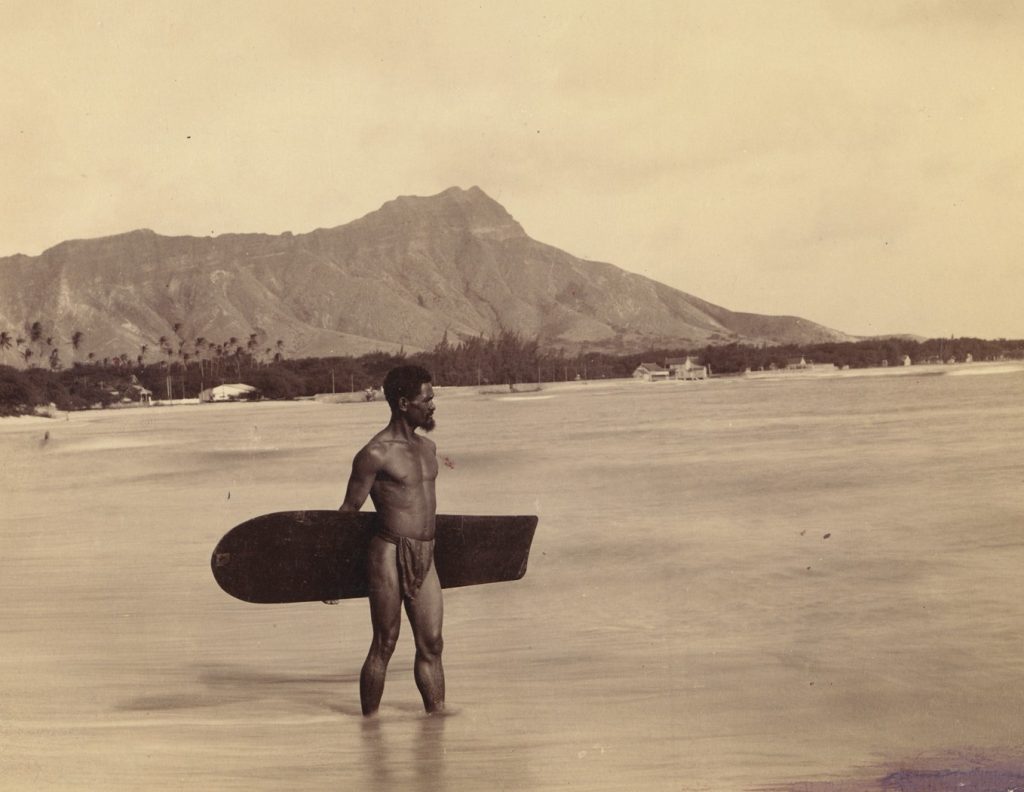
Boards were crafted with care from koa and wiliwili trees. Shapers used stone adzes and smoothed the surface with sharkskin, finishing the wood with plant-based oils that gave boards their dark, lustrous appearance. The process was not purely practical. Prayers and offerings accompanied the work from start to finish, reflecting how seriously Hawaiians took their relationship with the ocean.
Three main board types existed. The paipo was a short, prone board used by beginners and children. The alaia was a thin, finless plank that rewarded skilled surfers with speed and agility. The olo was the prestige board, long and buoyant, sometimes stretching well over 15 feet, and generally reserved for chiefs and members of the ali’i, the Hawaiian nobility.
Surfing at the Heart of Hawaiian Society
Before European ships arrived, surfing was everywhere in Hawaii. Breaks at Waikiki, Makaha, and along the Kona coast of the Big Island were well known and well used. Men and women surfed together, as did children and elders. Skill in the water carried real social weight. A chief who surfed well commanded admiration, and there are historical accounts of Hawaiians betting canoes, fish, and other valuables on the outcomes of wave-riding contests.
Surfing was also entangled with the rhythms of Hawaiian life more broadly. Certain seasons were considered better for surfing, and breaks in fishing or farming would see communities head to the water together. Chants celebrated skilled surfers. Kapu, the system of sacred restrictions that governed many aspects of Hawaiian life, extended to certain surf spots and practices as well.
First European Contact and the Written Record
The first written observations of Hawaiian surfing came from the journals of explorers on Captain James Cook’s voyages in the late 18th century. As early as 1769, naturalists traveling with Cook in Tahiti noted Polynesians riding waves on small boards. A decade later, during Cook’s third and final Pacific expedition in 1779, crew members anchored near the Hawaiian islands observed Native Hawaiians riding standing upright on waves at what is now Kealakekua Bay. Their accounts, written with a mix of astonishment and admiration, mark the first European descriptions of what the world now calls surfing.
The Decline of the 1800s and the Fires That Stayed Lit
When American Protestant missionaries arrived in Hawaii beginning in 1820, they brought with them a set of values that sat uneasily alongside the communal, often joyful beach culture they encountered. Surfing was not banned outright, but missionary influence contributed to a broader suppression of many traditional Hawaiian practices, and surfing suffered accordingly. Foreign diseases devastated the Native Hawaiian population through the 19th century, and the demands of a cash economy left less time for recreational ocean culture. By the 1880s, some observers reported that surfing had all but vanished from certain parts of the islands.
But it never disappeared entirely. In rural communities and among those who held tightly to older ways, surfing continued quietly, waiting.
The Waikiki Renaissance
The revival began at Waikiki in the first years of the 20th century. In 1907, Jack London visited Hawaii and published a now-famous account of surfing there, capturing in vivid prose what it felt like to ride a wave for the first time. His enthusiasm helped romanticize Hawaiian surfing for a mainland American and international audience hungry for stories of the exotic Pacific.
The institutional revival came with two clubs. The Outrigger Canoe Club, founded in 1908 by journalist Alexander Hume Ford and others, aimed explicitly to preserve and promote wave-riding. Three years later, a group of Native Hawaiian watermen formed Hui Nalu, a surf club centered on maintaining Hawaiian traditions in the water. The two clubs coexisted at Waikiki, sometimes in friendly competition, and together they created the social infrastructure that allowed surfing to take root again.
Duke Kahanamoku and the World Tour That Never Had a Name
If any single person is responsible for surfing becoming a global phenomenon, it is Duke Kahanamoku. Born in Honolulu in 1890, Duke was an extraordinary swimmer who won Olympic gold at the 1912 Stockholm Games and again in 1920, with a bronze following in 1924. He was also, by every account, one of the finest surfers of his generation.
Duke carried surfing with him wherever he traveled. During a swim tour of California in 1912 he gave surfing demonstrations that left crowds spellbound. His 1914 and 1915 visits to Australia were even more transformative. His demonstration at Freshwater Beach near Sydney in January 1915, where he shaped a board from local timber and rode the break for astonished onlookers, is widely credited with introducing surfing to Australia, which would later become one of the sport’s most significant countries.
Duke was not just an athlete. He was gracious, charismatic, and deeply proud of Hawaii. He understood that surfing was a gift from Hawaiian culture to the world, and he spent decades serving as its most eloquent ambassador.
Innovation and the Evolving Board
The boards Duke Kahanamoku rode weighed close to 100 pounds and took considerable strength just to carry to the water. Change came in 1929, when a restless innovator named Tom Blake built the first hollow surfboard by drilling channels through the interior of a solid board. The result was dramatically lighter and faster. Blake followed this in 1935 with another breakthrough: attaching a fixed fin to the tail of the board. This single modification transformed surfing’s potential. With a fin, riders could carve turns with control that had previously been impossible, and surfing began its evolution from riding straight toward shore into the dynamic, wave-working discipline it is today.
Through the 1940s and 1950s, the introduction of fiberglass and foam revolutionized board-building further still. Shapers like Bob Simmons in California experimented with new materials and hull shapes, producing boards that were lighter, faster, and more maneuverable than anything that had come before.
Big Waves and the North Shore
By the early 1950s, a small group of surfers in Hawaii were pushing into territory that would have seemed unimaginable to earlier generations. The focus was the North Shore of Oahu, where winter swells from the North Pacific pile up into some of the most powerful and dangerous waves on earth.
Wally Froiseth, George Downing, and Buzzy Trent began riding the giant surf at Makaha on Oahu’s west side in the early 1950s, shaping specially designed guns, long narrow boards built for speed in heavy water. The Makaha International Championships, launched in 1954, became the sport’s first major competitive event.
Then in 1957, a group of surfers rode Waimea Bay on the North Shore for the first time. Waimea had been considered unsurvivable after a near-tragic incident in the 1940s, and its reputation kept surfers away for years. When Buzzy Trent, Greg Noll, Pat Curren and others finally paddled out into its enormous peaks, they crossed a threshold that permanently expanded what surfing was understood to be.
The decade that followed established Pipeline, on the North Shore, as surfing’s most celebrated and most feared wave. Phil Edwards rode it first in 1961, and through the 1970s Gerry Lopez became so closely identified with the break that he earned the nickname “Mr. Pipeline,” threading barrels with a calm that seemed almost supernatural.
The Shortboard Revolution
Late 1966 and the years immediately following brought one of the most disruptive periods in surfing’s history. Influenced by Australian shapers experimenting with shorter, lighter designs and by a general counterculture restlessness in the sport, board lengths dropped dramatically in the space of a few years. Where surfers had ridden 9-foot logs in the early 1960s, by 1969 many were on boards half that length. The shortboard unlocked a new vocabulary of movement, radical turns, vertical attack angles, aggressive maneuvers in the pocket of the wave, and surfing changed faster in those few years than it had in the previous century.
Hawaii, and specifically the North Shore, remained the ultimate arena where all of this was tested. The Pipeline Masters contest, established in 1971, became surfing’s most prestigious event, the contest every serious surfer measured themselves against.
Professional Surfing and Hawaii’s Champions
Fred Hemmings, a North Shore veteran and 1968 World Surfing Champion, and promoter Randy Rarick launched the International Professional Surfers circuit in 1976, creating for the first time a structured world tour with rankings and prize money. The IPS eventually became the Association of Surfing Professionals in 1983, and was later rebranded as the World Surf League in 2015.
Throughout the professional era, Hawaiian surfers have been central to the sport’s story. Rell Sunn, the “Queen of Makaha,” was a force in women’s surfing through the 1970s and 1980s who combined competitive excellence with a generous, community-centered spirit that made her beloved across the surfing world. Margo Oberg became the first official women’s world champion in 1977.
Derek Ho became the first Hawaiian man to win a world title when he claimed the ASP championship in 1993. Sunny Garcia followed in 2000. Andy Irons won three consecutive titles between 2002 and 2004, a remarkable run that placed him alongside the greatest surfers of all time.
The current generation has continued this tradition. John John Florence, born and raised on the North Shore within walking distance of Pipeline, won back-to-back world titles in 2016 and 2017. Carissa Moore, from Honolulu, has won five world titles and in 2021 became the first Olympic surfing gold medalist in history when the sport made its debut at the Tokyo Games.
Tow-In Surfing and the Age of Giants
By the 1990s, a group of surfers at Peahi on Maui’s north shore, a wave known as Jaws, were confronting a problem: the waves were too large and too fast to catch by paddling. Laird Hamilton, Buzzy Kerbox, and Darrick Doerner found a solution in jet skis, using them to tow surfers into waves that would otherwise be uncatchable. Tow-in surfing opened a new frontier, waves in the 50 to 80-foot range that had been purely theoretical suddenly became rideable.
The most famous single wave of this era came in August 2000, when Laird Hamilton was towed into a wave at Teahupoo in Tahiti of such staggering mass and power that the footage, when it circulated, seemed almost unreal. Big-wave venues like Nazare in Portugal and Mavericks in California have since produced some of the largest waves ever ridden, but Hawaii remains the measuring stick, the place where ambition and the ocean have always met.
Why Hawaii Is Still the Center of the Surfing World
There is no shortage of world-class waves outside Hawaii. But surfing keeps coming back to the islands, and not only because of Pipeline or Waimea or the Eddie Aikau Big Wave Invitational, the prestigious contest held at Waimea Bay that only runs when the surf reaches a genuine threshold of size and power.
Hawaii matters because surfing was born here in its fullest, most complete form. The cultural context, the spiritual relationship with the ocean, the tradition of excellence and respect in the water, these things did not disappear when surfing went global. They traveled with it, carried partly by the Hawaiian watermen and women who kept showing the rest of the world what was possible.
From the ali’i riding olo boards on the reefs at Waikiki to a surfer from Honolulu standing on an Olympic podium, surfing’s history is Hawaii’s history. The story is still being written, and Hawaii is still writing it.
Sources and Further Reading
The following sources were consulted in the research and writing of this article, and are recommended for anyone who wants to explore the history of Hawaiian surfing in greater depth.
Academic and Institutional Sources
- University of Hawaii at Manoa: Traditional Ways of Knowing: Surfing in Hawaiʻi. An overview of ancient Hawaiian surfing culture, board types, and the spiritual significance of he’e nalu.
- University of Hawaii at Manoa Library: Surfing: Chronicling America, Historic Newspapers from Hawaiʻi. A research guide covering the documented timeline of surfing in Hawaii from pre-contact through the early 20th century revival, drawing on historical newspaper records.
- Windward Community College Library: Surf History Reading List. A curated bibliography of key books on Hawaiian surfing history, including works by Ben Finney, Nat Young, and John R. K. Clark.
Reference Works
- Encyclopaedia Britannica: Surfing. A comprehensive reference entry covering the origins, cultural history, board evolution, and global spread of surfing, written by Douglas G. Booth, Senior Lecturer at the University of Otago.
- Wikipedia: History of Surfing. A broad overview of surfing’s origins across Polynesia, its development in Hawaii, and its global expansion, with citations to primary historical texts.
Olympic and Competitive Surfing
- Olympics.org: Duke Paoa Kahanamoku. The official Olympic profile of Duke Kahanamoku, covering his 1912, 1920, and 1924 Games performances and his role in spreading surfing internationally.
- Olympics.org: The Legend of Duke Kahanamoku. A detailed account of Duke’s athletic career, his 1915 surfing demonstration at Freshwater Beach in Sydney, and his legacy as the father of modern surfing.
Cultural History
- PBS American Masters: How Native Hawaiian Surfers Used the Ocean as Sanctuary. An essay by Dr. Isaiah Helekunihi Walker, Professor of History at Brigham Young University-Hawaii and author of Waves of Resistance: Surfing and History in 20th Century Hawaiʻi, on the cultural and political dimensions of Hawaiian surfing.
Key Books
- Ben R. Finney and James D. Houston, Surfing: A History of the Ancient Hawaiian Sport (Pomegranate, revised ed.). The foundational academic work on pre-contact Hawaiian surfing, board culture, and the role of the ocean in Hawaiian society.
- Isaiah Helekunihi Walker, Waves of Resistance: Surfing and History in 20th Century Hawaiʻi (University of Hawaii Press, 2011). A scholarly examination of how Native Hawaiians used surfing as a form of cultural resistance and identity during the 20th century.
- Matt Warshaw, The History of Surfing (Chronicle Books, 2010). The most comprehensive single-volume history of surfing ever published, drawing on decades of research and oral history.