History, Shaper Series
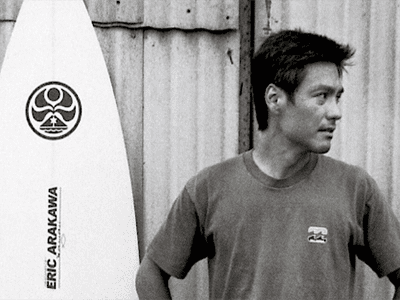
Eric Arakawa: Hawaii’s Master Shaper and the Man Behind Ten World Champions
Feb
Image courtesy of usblanks.com
Eric Arakawa: The Quiet Craftsman Who Shaped Champions
From a teenage hobby in Pearl City to fifty years of boards under the world’s best surfers : this is the story of Hawaii’s most quietly influential shaper
The Boy Who Just Wanted to Surf
Here’s how one of surfing’s greatest careers started: a fourteen-year-old kid in Pearl City, Oahu, didn’t have enough money to buy a new board.
That was it. No grand vision. No master plan to reshape the surfing world. Just a teenager who loved the ocean, an empty garage, a foam blank, and a very practical problem to solve.
Eric Arakawa shaped his first board in 1974 (a 5’8″ round pintail built right there in his family’s home) simply because he wanted to surf and building one was cheaper than buying one. He had no idea that fifty years later, he’d be standing in his Wailua factory on the North Shore of Oahu, still loving Mondays, having shaped boards for more than ten World Champions and quietly changed surfing from within.
That’s the Eric Arakawa story. Not flashy. Not loud. Just relentless dedication to craft, an obsessive eye for detail, and an extraordinary ability to feel what a surfer needs even before they can put it into words.
Pearl City Roots: A Third-Generation Hawaiian Kid
Eric Arakawa was born in 1960 in Honolulu, Hawaii, a third-generation Japanese-American whose roots in the islands run deep. He grew up in Pearl City, not far from the North Shore that would one day become his proving ground.
His introduction to surfing came through his father, who took him down to “Walls” in Waikiki at age ten and put him on a 7’0″ round-tailed Barry Kanaiaupuni mini-gun. That board, modeled after one of Hawaii’s most iconic surfers, probably told young Eric more than anyone realized at the time. The ocean got its hooks in him immediately.
After graduating from Pearl City High School, he spent two years studying business at Leeward Community College. A business education that, looking back, he’d need more than he ever expected. But through school and everything else, those boards kept calling him back to the garage.
By 1977, at seventeen years old, what had started as a cost-saving hobby had turned into something else entirely. Friends asked for boards. Then friends of friends. Eric described the moment he realized things had shifted: “Pretty soon I had friends of friends ordering boards, and one day it dawned on me: maybe I’m in business.”
That year, Hawaiian Island Creations (HIC), one of Hawaii’s most prominent surf companies, came calling. Eric had started shaping professionally.
The Education of a Craftsman: Learning from Michael Ho
If there’s one relationship that defined Eric Arakawa’s development as a shaper above all others, it’s his work with Michael Ho.
Michael Ho is one of Hawaiian surfing’s all-time legends: a powerful, technical surfer with an almost supernatural feel for Pipeline and an equally supernatural ability to identify exactly what was wrong with a surfboard. He was, by Eric’s own admission, the most difficult surfer he ever shaped for.
“He was really picky and demanding,” Eric has said of Ho. “There were a lot of times where I built boards for him and he said the board was good, but he couldn’t win on it. He was always looking for that magic board.”
For another shaper, that might have been demoralizing. For Eric, it was a master class.
The relationship paid its most memorable dividend in 1982, a story Eric counts among the proudest moments of his entire career. Eric had built Michael Ho a quiver for the Pipeline Masters, his first boards of the winter. Then Ho called with alarming news: a broken hand, sustained before the event even started. A fiberglass cast covered it. Duck diving was out. Gripping the board properly was out of the question.
The Broken Hand That Became a Legend
Most people would have called it a season-ending injury. However, Eric and Michael came up with something different. They stuck Astrodeck grip strips on Ho’s hand and on the rail of the board, giving him enough traction to paddle and pop up despite the cast. Ho went out into the most dangerous wave in the world, couldn’t duck dive properly on small waves, and still kept winning heat after heat. He kept getting pitted at Pipe, that impossible barrel swallowing him up and spitting him out on the other side.
Michael Ho won that Pipeline Masters. With a broken hand. On an Arakawa.
“I remember watching him paddle out and he had to bail on small waves,” Eric recalled. “I was thinking, ‘How’s he going to get to his feet?’ But he won the whole event.”
Eric has said it plainly: working with Michael Ho was when he learned the most. It was the foundation for everything that came after.
Island Classics: Building Something from Nothing
In 1982, the same year Michael Ho won Pipe on one of his boards, Eric took the next step and founded Island Classics Surfboards on the North Shore of Oahu.
It was a grassroots operation from the very beginning, with no investors, no corporate backing, and just pure passion for the craft. “It started off as grassroots,” Eric has said. “It was a passion, and we went from there.”
Island Classics quickly became something real. Some of Oahu’s heaviest hitters climbed on board: Michael Ho, his brother Derek Ho, Ronnie Burns, Shawn Briley, Dwayne Maki. These weren’t just team riders. They were the people who surfed Pipeline when it actually mattered, when the best wave in the world was firing and the world was watching. And they were trusting Eric’s boards with their lives.
The brand grew steadily. Consequently, the reputation followed. Before long, Eric Arakawa was becoming a name that meant something on the North Shore.
The Nose Guard: An Invention That Changed Surfing Safety
In 1986, while Island Classics was building momentum, Eric partnered with David Skedeleski to co-found SurfCo Hawaii, and with it co-invented something that’s now in every surf shop in the world: the surfboard Nose Guard.
The idea was simple but important. Surfboard noses are hard fiberglass. They poke holes in surfboards, in wetsuits, and sometimes in people. Eric and David created a rubber protective tip that could be stuck onto the nose of any board, dramatically reducing ding damage and injuries.
SurfCo Hawaii turned the Nose Guard into a global business, eventually distributing surfboards and surf accessories to thousands of accounts around the world. It was Eric’s first experience operating at real scale, and the first indication that his instincts extended beyond shaping foam.
When Eric and his business partner eventually went different directions, he had to start over. The transition was hard. “I went from a good salary to overnight having no salary,” he has said. “I had a wife, two kids, and a mortgage. I was scrambling. But I still had surfboards. It was a tough three years.”
He leaned on what he’d always had: the ability to shape a great board. He got back on his feet.
The HIC Years: Andy Irons and a World Title at Stake
In 1995, Hawaiian Island Creations came back into Eric’s life, this time with an offer that changed everything. HIC wanted Eric’s design skills badly enough to make it a very straightforward deal: they would buy Island Classics and its licensees, and all Eric had to do was shape.
No marketing, no admin, no sales calls. Just design, build, and work with the team.
It was difficult to let go of the brand he’d built. “It was really hard because I worked so hard with Island Classics,” Eric has said. “Building that was my baby, and I had to let it go.” But the trade-off, freedom to focus entirely on boards, proved to be the right call.
The HIC years gave Eric access to a new generation of surfers, and among them was a young Kauai kid named Andy Irons.
The Board Order That Changed the Title Race
The story of Eric and Andy Irons’ most consequential exchange is surfing history. It was 2003. Andy was trailing Kelly Slater by 500 points going into the final two events of the year: Sunset Beach and Pipeline. Back then, 500 points was considered nearly insurmountable. Andy had ordered his winter quiver: boards ranging from 6’0″ to 8’0″. He’d only ordered two 6’6″ boards.
Eric had a feeling. He called Andy and told him he thought the title might come down to 6’6″ conditions, and suggested Andy order a third one.
Andy made the final at Sunset. Kelly lost in the third round. When Andy stepped on the hood of someone’s car outside the contest site and yelled “It’s on!” as he was riding the momentum of that extra board.
At Pipeline, both Andy and Kelly kept winning heats. Andy needed to make the final or Kelly took the title. The rest, as they say, is surfing history. Andy Irons won the 2003 World Title at Pipeline, cementing his legend, with the extra 6’6″ in his quiver.
A decade later, in December 2009, Andy Irons rode an Arakawa at his final Pipeline Masters. Some stories come full circle in beautiful ways.
Shaper of the Year and a Reputation Without Equal
By 2003, the surfing world had caught up to what the North Shore already knew. Surfing Magazine named Eric Arakawa its Shaper of the Year, a recognition that put an official stamp on five decades of work that had quietly been shaping the sport.
By that point, the list of world champions who’d ridden his boards read like a who’s who of professional surfing: Michael Ho, Derek Ho, Megan Abubo, Andy Irons, and many more. His boards had been ridden to victory in countless Triple Crown events, WCT and WQS competitions, and across Longboard and Big Wave World Tours worldwide.
But the accolades tell only part of the story. What made Eric’s work genuinely different was his approach to the shaper-surfer relationship. Where many shapers would hand over a board and move on, Eric treated each build as a collaborative problem-solving session.
“Find a skilled surfboard builder and work with them,” he has advised everyday surfers. When customers visit his factory, he asks them to bring their current board so he can understand it firsthand. His five diagnostic factors (physique, skill level, physical fitness, intended waves, and performance goals) didn’t come from a textbook. Rather, they emerged from thousands of conversations with surfers on the North Shore, ranging from world champions to weekend groms.
A Personal Touch That Set Him Apart
Above all, making it personal is what separated Arakawa from the rest. That personal investment, combined with his deep technical knowledge, is ultimately why it worked so consistently.
Derek Ho, Dane Kealoha, and the North Shore Brotherhood
The Arakawa story is impossible to tell without the Ho brothers, who represent two generations of collaboration and friendship.
Michael Ho, as we’ve already established, was the crucible that forged Eric’s craft. Derek Ho, Michael’s younger brother and the 1993 World Champion, was a long-running chapter of his own. Derek’s contests at Pipeline, riding Island Classics boards and later Arakawa boards, produced some of the most memorable performances of an era when Hawaiian surfing was at its peak dominance.
There’s an image Eric keeps in his storage archive: Derek Ho at Manly, Australia, 1988. He has two bins of material like this: original photographs, magazine spreads, original artwork, positives and slides. Decades of surfing history, preserved in cardboard boxes in a factory on the North Shore.
“I feel like there’s a story to tell,” Eric has said. “And there are some cool stories.”
The Island Classics era, in particular, represents a chapter of Hawaiian surf culture that has never been fully told. The boards, the surfers, the relationships: it’s a history that lives in those two bins, waiting to be shared.
Jack Robinson and the Next Generation
Fifty years in, Eric Arakawa is not coasting. The current chapter of his career involves working with Jack Robinson, the Australian goofy-footer who has emerged as one of the most exciting tube riders on the WSL Championship Tour, a surfer who buries his Arakawas in the deepest parts of Pipeline barrels with the kind of commitment that would make Michael Ho nod in approval.
The relationship with Robinson echoes earlier chapters of Eric’s career, including the methodical development of boards, the trust between shaper and surfer, the pursuit of something perfect for the conditions. It’s the same process Eric has been refining since 1974.
He also works with Kanoa Igarashi, Freddy Patacchia, Reef McIntosh, and others. His international network of licensees means Arakawa boards are being ridden from Indonesia to Japan to Australia to France to South Africa. The North Shore factory remains the heart of the operation, but the reach is genuinely global.
Reclaiming Island Classics: Full Circle
In 2019, Eric Arakawa did something that had been on his mind for years: he reacquired Island Classics from HIC. The brand he’d built in 1982, sold in 1995 as part of a business deal, and watched be sidelined. Now it was his again.
The reacquisition wasn’t driven by a grand business strategy. It was driven by authenticity. Eric had watched the surf industry go increasingly corporate, watched brands that once meant something get hollowed out by offshore production and cost-cutting. He didn’t want that for his name or his legacy.
“The thing with the industry is that a lot of things have gone corporate,” he has said. “There are brands that lack authenticity or have hollow marketing. But with this, it started off as grassroots. It was a passion, and we went from there.”
The revival is personal in every way. His son now manages the business, a direct line of succession from father to next generation. Eric has been recreating boards for legends like Derek Ho and Ronnie Burns from archival designs. There’s talk of screen-printed merchandise, shared stories, photos from those two storage bins.
“I just want to keep it authentic and keep it in the family,” Eric has said. “My son now manages the business, and this is something I can pass on to him.”
It’s less business plan, more love letter to the craft.
The Philosophy: Five Factors and a Monday Morning Mindset
Eric Arakawa has shaped boards for fifty years. He still looks forward to Monday mornings.
That fact alone says more about the man than any list of accolades. Shaping is not glamorous work. It’s physically demanding, dusty, repetitive at times, and deeply technical. Most people eventually burn out. Eric, however, still wakes up excited to go in.
The Five-Factor Framework
His philosophy of surfboard design centers on the same five factors he has used to assess every customer for decades: physique, skill level, physical fitness, intended waves, and performance goals. These aren’t criteria from a surf school handout. They’re the distillation of thousands of conversations and thousands of boards, refined over half a century into a framework that works for everyone from world champions to beginners.
“Custom work is our specialty,” he has said. “We zero in and increase the chance that the customer will be satisfied.”
One Step Back to Go Two Steps Forward
The approach to innovation is similarly grounded. Rather than chasing trends, Eric watches surfers. He identifies what’s missing, what’s limiting, and what would help a rider perform better in specific conditions. Furthermore, when something isn’t working, he’s willing to take a step back to move forward. “I’ve found so often that taking one step backward is necessary to take two steps forward. It’s a risk, but the goal is to get an answer.”
That patient, iterative approach, built from decades of honest feedback from demanding surfers, is precisely what produces boards that world champions trust in the most critical moments of their careers.
The 2025 Boardroom Honor: Fifty Years, Still Going
In October 2025, Eric Arakawa will be honored at the Boardroom International Surfboard Show in Del Mar, California, as the year’s Icons of Foam honoree, the highest recognition in the world of surfboard craftsmanship.
He’ll judge eight shapers in man-on-man round robin heats where they’ll replicate some of his signature designs. Which means that fifty years after shaping his first board in a Pearl City garage, his design work is being treated as the standard that others aspire to reach.
“I am surprised but stoked to be honored,” Arakawa said in a statement. “I love the craft as much or more than when I started 50 years ago.”
That might be the most remarkable thing about Eric Arakawa. Not the world champions. Not the Shaper of the Year award. Not the Nose Guard or Island Classics or fifty years of North Shore presence. It’s that the passion hasn’t dimmed by one degree.
He still loves it, and yes, he still looks forward to Mondays.
The Arakawa Legacy: What Ten World Champions Knew
When you ask Eric what it all comes down to, he keeps returning to relationships.
“The real wealth is in the relationships,” he has said. “The best part about shaping is the relationships you build.”
That’s not a throwaway answer. The Arakawa legacy is built entirely on trust: the trust of Michael Ho putting his career in Eric’s hands at Pipeline, the trust of Andy Irons ordering that third 6’6″ on a gut feeling, the trust of Jack Robinson burying his boards in the deepest tubes on the planet. That trust was earned one board at a time, one conversation at a time, over fifty years of showing up and doing the work.
Over five decades, his boards have been ridden at the highest level in surfing. Today, his designs serve as standards at international competitions. Moreover, his company lives on through his son, and his archive (those two bins of photographs, slides, and original artwork) holds stories of Hawaiian surfing that still haven’t been told.
Eric Arakawa started shaping because he didn’t have enough money for a new board. Then he kept shaping because he fell in love with the craft. Now, after fifty years, he’s still shaping because he genuinely can’t imagine anything he’d rather do.
That’s not a career. That’s a calling.
Experience the Arakawa Legacy in Hawaii
Ride an Arakawa Board
Arakawa Surfboards produces boards based on Eric’s refined designs, available through his factory and international licensees. If you want to understand why ten World Champions trusted these shapes, there’s no better way than paddling one out yourself.
Surf the North Shore
The waves that shaped Eric’s entire career still roll through Oahu’s North Shore every winter season. The proving grounds are real: Pipeline, Sunset Beach, and the contests that made the world pay attention to Hawaiian surfing are all part of the same living tradition Eric has been part of for fifty years.
Visit During Contest Season
The Triple Crown of Surfing brings the world’s best surfers to the North Shore each November and December. It’s the same competitive environment where Eric shaped boards for Derek Ho, Andy Irons, and Jack Robinson, and where his boards are still being ridden in the most important heats of the year.
Support Hawaiian Craftsmanship
Every handcrafted Arakawa board is a direct expression of five decades of North Shore knowledge. When you ride one, you’re connecting to a lineage that runs from Michael Ho’s broken-hand Pipeline victory in 1982 all the way to Jack Robinson burying himself in barrels today.
In His Own Words
Eric Arakawa doesn’t say much publicly. He’s always let the boards do the talking. But the things he has said reveal exactly who he is.
On getting started: “My only motivation at the time was to get a board to ride for myself. I didn’t have enough money to buy a new board, so I thought building a board would get me in the water quicker. I had no idea what I was getting myself into.”
On the craft: “I love the craft as much or more than when I started 50 years ago. I am looking forward to the Boardroom opening day in October.”
On staying authentic: “The thing with the industry is that a lot of things have gone corporate. There are brands that lack authenticity or have hollow marketing. But with this, it started off as grassroots. It was a passion, and we went from there.”
On legacy: “I just want to keep it authentic and keep it in the family. My son now manages the business, and this is something I can pass on to him.”
On still loving it: “I look forward to Mondays.”
Why Eric Arakawa Matters
In a surfing world increasingly dominated by machine-milled pop-outs and corporate design-by-committee, Eric Arakawa represents something that can’t be manufactured: fifty years of honest, obsessive, relationship-driven craftsmanship rooted in the greatest proving grounds in the sport.
He didn’t chase fame. He chased perfection. And somewhere along the way, the world’s best surfers noticed.
The Pearl City kid who just wanted to surf grew into one of the most trusted names in the history of surfboard design. Ten world champions chose his boards when the title was on the line. That’s not a marketing campaign. That’s a legacy.
Sources
- Arakawa Surfboards Official Site
- Eric Arakawa: 50 Years of Shaping: Surfer Magazine, 2024
- Rebuilding a Classic: Island Classics Relaunch: Surfer Magazine, 2025
- Eric Arakawa Interview: Surfer Magazine, 2013
- Shaping Legend Eric Arakawa to Be Honored at 2025 Boardroom Show: Surfer Magazine, 2025
- Eric Arakawa: Encyclopedia of Surfing
- Eric Arakawa: US Blanks Designer Profile
- The Lineup with Dave Prodan: Eric Arakawa: World Surf League, 2025
- Interview with Eric Arakawa: Cleanline Surf
- SurfCo Hawaii: About Us
- Surfboard Factory Hawaii: Eric Arakawa Profile
