Feb
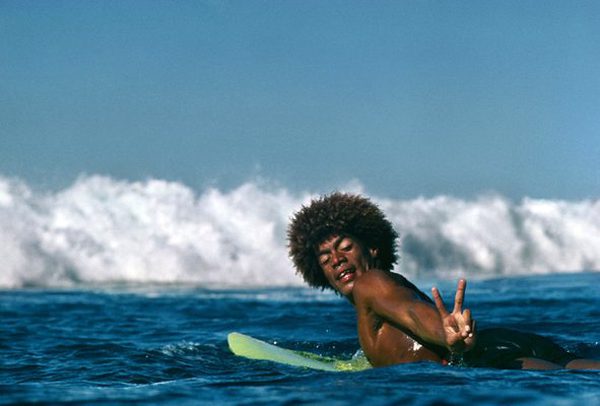
Image courtesy of Jeff Devine
Buttons Kaluhiokalani: The Innovator Who Revolutionized Modern Surfing
Celebrating the life of a half-Black, half-Hawaiian surf legend who transformed the sport and embodied the aloha spirit
Honoring Heritage: Black History Month Meets Mahina ʻŌlelo Hawaiʻi
February holds special significance in Hawaii and across America. As we observe Black History Month alongside Mahina ʻŌlelo Hawaiʻi (Hawaiian Language Month), we celebrate a figure who embodied both traditions: Montgomery “Buttons” Kaluhiokalani, a revolutionary surfer whose African American and Native Hawaiian heritage shaped his unique perspective and groundbreaking impact on surf culture.
Born in 1958 (some sources say 1959), Buttons didn’t just ride waves—he reinvented how they could be ridden. In the 1970s, when he brought skateboard-inspired maneuvers to surfing, he forever changed what was possible on a surfboard. Eddie Rothman called him “the innovator of modern-day surfing,” and his influence echoes through every carving turn and aerial maneuver in contemporary surf culture.
Buttons’ story reminds us that Hawaiian surfing has always been multicultural, and that innovation comes from those who bridge different worlds. His life exemplified resilience—rising to legendary status, falling to addiction’s depths, and climbing back to become a mentor and ambassador of aloha.
During this month of dual cultural celebration, we honor Buttons Kaluhiokalani not just as a surf innovator, but as a bridge between communities, a guardian of Hawaiian traditions, and a testament to the redemptive power of second chances.
Born to Surf: The Early Years
Montgomery Ernest Thomas Kaluhiokalani was born on March 30, 1958 (some sources cite 1959), in Honolulu to a military father and a Hawaiian mother. Named after his mother’s favorite actor, Montgomery Clift, he arrived premature—just 4 pounds—with distinctive curly hair that looked like little buttons. His grandmother gave him the nickname that would define his identity: “Buttons.”
The Name That Stuck
That curly, button-like hair became Buttons’ trademark throughout his life—his signature afro made him instantly recognizable in lineups from Waikiki to Pipeline to Malibu. The nickname fit his personality perfectly, embodying both his distinctive look and his vibrant spirit.
Growing Up Between Two Worlds
Buttons’ mixed heritage—half-Black, half-Hawaiian—gave him a unique perspective during an era when Hawaii was navigating its own racial and cultural identity. As he would later reflect, “I am half-Black and half-Hawaiian. So I guess it was my genetics” when explaining his revolutionary surf style and natural rhythm on waves.
Hawaii in the 1960s and 70s offered more racial fluidity than the mainland, but being of African American and Hawaiian descent still meant navigating complex social dynamics. Buttons learned to honor all aspects of his heritage, understanding that his mixed background was a source of strength, not confusion.
His Hawaiian blood connected him to ancient surf traditions and island culture. His Black heritage contributed to his natural rhythm, athleticism, and innovative approach to riding waves. This intersectional identity would shape both his revolutionary surf style and his later work as a cultural ambassador teaching aloha to others.
Discovering the Ocean
The family originally lived on Oahu’s North Shore, but when jobs became scarce, Buttons’ mother moved him and his brother to Waikiki when he was around five years old. This move would prove fateful, placing young Buttons at the epicenter of Hawaiian surf culture.
At age seven, Buttons discovered his calling. His Uncle Buddy, a Vietnam veteran with long hair who rode a 10-foot longboard, would walk to the beach daily while young Buttons followed behind, mesmerized.
“I would sit on the sand and just watch and be amazed at what he could do on a surfboard,” Buttons recalled. “When I was eight, I used to hang out at Waikiki with my friends and I taught myself how to swim, got my first paipo board and it was on after that, baby!”
By age nine, Buttons and his brother were carrying their uncle’s 10-foot board together, hoisting it over their heads as they made their way to the beach. Those early boards—the 10-foot log and a round-nose single-fin wooden Piper board—became Buttons’ classroom.
Even as a child, Buttons was doing things no one else attempted: “Even when I was a kid, I did these crazy things that pretty much no one was doing at the time on a foam board or paipo board—360’s, spinners, switchfoot.”
The 1970s Revolution: Redefining What Was Possible
Buttons came of age during one of the most exciting periods in surf history. The shortboard revolution was transforming the sport, and a young generation of Hawaiian surfers was pushing boundaries and redefining what could be done on a wave.
Coming of Age with Legends
Buttons grew up surfing alongside Hawaiian greats like Gerry Lopez and Eddie Aikau. He became best friends with Mark Liddell, and together with Larry Bertlemann, this trio of Hawaiian surfers would revolutionize wave riding in the 1970s.
But Buttons stood out even among this elite group. His approach was different—radical, creative, unpredictable. While others refined traditional techniques, Buttons was inventing entirely new ones.
The Skateboard Connection
Buttons’ revolutionary style came from an unexpected source: skateboarding. Thousands of miles away in California, the Dogtown skaters—Tony Alva, Jay Adams, and others—were revolutionizing skateboarding with aggressive, surf-inspired moves in empty swimming pools.
Buttons watched these skaters and had an epiphany: what if those skateboarding moves could be translated back to surfing?
“I was watching [Tony] Alva, watching Jay Adams, watching them skate and I connected the dots,” Buttons explained. “I was doing stuff I couldn’t even dream of doing. I did some crazy things. But you know, brah, I just did stuff that felt good.”
The First Carving 360
Buttons became the first surfer to perform a carving 360-degree turn on film—a maneuver that’s now standard in progressive surfing but was revolutionary in the 1970s. His pocket surfing, switch-foot riding, and skateboard-inspired maneuvers laid the groundwork for modern surfing.
From lineups throughout Honolulu, Buttons’ fit frame topped with his trademark afro could be seen performing a gauntlet of new, skate-inspired maneuvers. He made surfing look like a dance—fluid, creative, and deeply personal.
Uncle Eddie Rothman, a respected figure in Hawaiian surf culture, called Buttons “the Innovator of Modern Day Surfing.” This wasn’t hyperbole. Buttons genuinely transformed what surfers believed was possible, showing that waves could be ridden with the same creative aggression that skaters brought to pools and ramps.
Competition Success
While Buttons’ true legacy lies in innovation rather than contest results, his competitive career demonstrated his elite-level skills:
- 1973 (age 13-14): Second place, Boy’s Division, US Surfing Championships at Malibu
- 1975: Third place, Pro Class Trials
- 1979: Winner, Malibu Sunkist Pro; competed in Pipeline Masters and Sunset World Cup
- 1981: First place, Peru International; Third place, Pro Class Trials; Third place, Pipeline Masters
These results showed Buttons could compete with anyone, but contests were never his primary focus. He was more interested in pushing boundaries and expressing himself through surfing than accumulating trophies.
Hawaiian Culture and Language: Cherishing His Roots
Despite his revolutionary, future-facing approach to surfing, Buttons remained deeply connected to Hawaiian culture and traditions. Understanding where he came from mattered profoundly to him.
Speaking Hawaiian, Living Hawaiian
“The Hawaiian tradition has to live on. We cannot forget where we come from,” Buttons emphasized. “I cherish what I am and who I am and my Hawaiian blood. It’s really important to me that the culture lives on from one generation to the next.”
While Buttons grew up during an era when Hawaiian language was suppressed and declining, he maintained strong connections to Hawaiian culture, values, and spiritual traditions that defined his identity and approach to life.
The Mana of Surfing
For Buttons, surfing wasn’t just a sport—it was a spiritual practice connecting humans to nature and carrying forward ancient Hawaiian traditions. He spoke about “the love and the passion. That love, passion, and mana of surfing. I’m the kind of person that lives and dies for surfing.”
Mana—spiritual power and energy—infused Buttons’ relationship with the ocean. He understood surfing as the Hawaiians did: as a sacred practice, a connection to ancestors, and a way of being in harmony with nature’s power.
Passing the Torch
Buttons recognized his role in the continuum of Hawaiian surf culture: “Surfing is a Hawaiian sport. And it’s a history that has been passed down to every generation that comes after. It all started in Hawaii since the 1700’s.”
He saw himself as a link in this chain, receiving knowledge from previous generations and responsible for passing it forward. He mentored young Hawaiian surfers like Mason Ho and others, ensuring the next generation understood surfing’s cultural roots alongside its modern expressions.
The Dark Years: Addiction and Fall from Grace
As bright as Buttons’ star shined in the 1970s and early 80s, it also dimmed when he fell into the grip of addiction. His struggle with drugs would consume nearly two decades of his life, demonstrating that even legends are vulnerable to life’s hardest challenges.
The Beginning of the Struggle
Buttons’ drug problems began in 1985 with cocaine. The exact circumstances aren’t fully public, but the pressures of fame, the surf industry’s party culture in that era, and personal challenges all likely played roles.
What started as recreational use spiraled into addiction that would nearly destroy him. The free-wheeling, creative approach that made Buttons a surfing revolutionary also left him vulnerable when the surf establishment couldn’t fully embrace his radical style. The disappointment and disconnection may have contributed to his seeking escape through substances.
Lost Years
For years, Buttons battled addiction. He returned to surfing in 1996 but was arrested in 1998 on drug-related charges (though charges were later dropped). His struggles continued into the 2000s.
In 2007, Buttons appeared on the TV show “Dog the Bounty Hunter” after being arrested for drug offenses—a public low point for someone who had once been celebrated as surfing royalty.
The surf community watched one of its greatest innovators struggle, hoping for his recovery but understanding how powerful addiction’s grip could be.
The Turning Point
But Buttons’ story didn’t end in addiction’s darkness. Through friends, family, and his deep-seated faith, Buttons found his way to sobriety in 2007 and remained clean for the rest of his life.
By 2009, Buttons described himself as a “recovering drug addict” who had been sober for three years. His recovery was built on multiple foundations: the support of ohana (family), reconnection to his Hawaiian spiritual roots, faith in God, and the healing power of returning to the ocean.
Redemption: The Buttons Surf School Years
Clean and sober, Buttons dedicated the final years of his life to giving back—teaching surfing, sharing his testimony, and becoming an ambassador of aloha and second chances.
Moving to the North Shore
After achieving sobriety, Buttons moved back to Oahu’s North Shore and founded Buttons Surf School. This wasn’t just a business—it was his mission and redemption, a way to share the love of surfing that had saved him and prevent others from making his mistakes.
Teaching with Aloha
Buttons’ teaching approach combined technical excellence with cultural knowledge and personal testimony. Students didn’t just learn to surf—they learned about Hawaiian culture, the spiritual dimension of connecting with the ocean, and the importance of making good life choices.
He gave lessons to people with disabilities, demonstrating that surfing’s transformative power should be accessible to everyone. He made multiple PSA videos encouraging adults and youth to stay off drugs, using his own story as a cautionary tale and proof that recovery was possible.
“For me it’s just staying healthy, surfing, sending out messages to schools and sharing my testimonial of my life,” Buttons explained. “I am sure I have touched some hearts and have gotten a lot of friends out of it. It is important for me to give and share my strength with others.”
Still Charging at 51
Even in his fifties, Buttons continued pushing boundaries. At age 51, he traveled to Tahiti and was towed into massive waves at Teahupo’o—one of the world’s heaviest, most dangerous breaks.
“For me being 51 years old and being towed into Teahupo’o was the gnarliest thing I have ever done in my life,” Buttons said, demonstrating that age and past struggles couldn’t diminish his love for surfing’s ultimate challenges.
His favorite surf spot remained Backyards on Oahu’s North Shore, where he could often be found sharing waves with the next generation of Hawaiian surfers.
Black Heritage in Hawaiian History
Buttons’ African American heritage connects to a longer, often overlooked history of Black presence in Hawaii. Understanding this history enriches appreciation for Buttons’ unique perspective and contributions.
Early Black Hawaiians
African Americans have been part of Hawaiian history since the earliest Western contact:
Anthony Allen (1810s-1830s): One of the first documented Black residents of Hawaii, Allen became a successful businessman in Honolulu and married a Hawaiian woman, establishing family lines that continue today.
Whaling Era: Black sailors regularly visited and sometimes settled in Hawaii during the 19th century whaling boom, contributing to Hawaii’s emerging multicultural character.
Post-Annexation Migration: After Hawaii became a U.S. territory in 1898, small numbers of African Americans migrated to the islands, seeking economic opportunities and, for some, escaping mainland racism.
Military Presence: World War II and subsequent military bases brought larger African American populations to Hawaii, including servicemen like Buttons’ father who married local women and built families in the islands.
Race in Paradise
Hawaii’s racial dynamics differed significantly from the mainland. While racism certainly existed, the majority-Asian population and significant Hawaiian native presence created a different racial hierarchy than the Black-white binary dominant on the mainland.
For Buttons, being part Hawaiian gave him local identity and cultural belonging. His Black heritage connected him to traditions of rhythm, athleticism, and resilience. Rather than choosing one identity over the other, Buttons embraced both, showing that mixed heritage could be a source of creativity and strength.
He occupied a unique position—local enough to be accepted as kamaʻāina (native-born), diverse enough to understand multiple cultural perspectives, and talented enough to transcend any boundaries others might have tried to impose.
Family and Legacy
Buttons was named after actor Montgomery Clift, and the name suited him—he was movie-star handsome with his fit physique, trademark afro, and charismatic personality. But his real legacy wasn’t fame or looks—it was family and the values he passed forward.
Ohana
Buttons is survived by his wife Hiriata Hart, eight children, and nine grandchildren. Despite his struggles, he maintained strong family connections, and his recovery allowed him to be present for his children and grandchildren in ways addiction had previously prevented.
He raised his children with Hawaiian values, teaching them about their culture, the importance of respecting the ocean, and the power of aloha. His own struggles made him a more compassionate father, understanding human fallibility while teaching the importance of perseverance and faith.
Brother and Extended Family
Buttons’ brother Noble Kaluhiokalani was a constant presence in his life. At Buttons’ memorial paddle-out, Noble spoke movingly about his brother, relating how even as a youth when others would pick on him, “Buttons shrugged it off. Buttons was about love, BIG LOVE.”
Noble shared Buttons’ philosophy: “hate no one, love all”—a principle that guided Buttons throughout his life and recovery.
The Battle with Cancer and Final Days
In 2013, Buttons was diagnosed with stage IV lung cancer. The disease was aggressive, and despite treatment, Buttons knew his time was limited.
Fighting to the End
Buttons was admitted to Saint John’s Hospital in Santa Monica, California, where he fought the disease with a holistic approach, surrounded by family and friends. Even facing death, he maintained the spirit and aloha that had defined his life.
Passing of a Legend
On November 2, 2013—exactly three years after the loss of another Hawaiian legend, Andy Irons—Montgomery “Buttons” Kaluhiokalani passed away due to complications from lung cancer. He was 55 years old.
The surfing world mourned deeply. Tributes poured in from across the globe as surfers, friends, family, and fans shared memories of how Buttons had touched their lives, influenced their riding, or inspired them through his recovery and redemption.
Honoring Buttons: Memorial Paddle-Outs
In the Hawaiian tradition, Buttons’ final resting place was the ocean he loved. Multiple memorial paddle-outs honored his life and legacy.
Waikiki: Where It All Began
On November 29, 2013, a memorial service and paddle-out was held at Kapiolani Park in Waikiki—the beach where seven-year-old Buttons first learned to ride waves. Hundreds of people gathered, some watching from shore, others paddling out to be part of the final farewell.
The family scattered Buttons’ ashes in the waters where his journey began, returning him to the ocean that had given him so much.
Malibu: Where He Made History
On November 9, 2013, a paddle-out was held at Malibu’s Surfrider Beach—the site of Buttons’ second-place finish as a 13-year-old amateur in 1973 and his victory at the Sunkist Pro in 1979. Malibu was where Buttons had been “immortalized” in surf history.
The Willis Brothers (Milton and Michael) were among the first to arrive at sunrise. Someone had written in chalk on the walkway: “We love you Buttons” with a big heart. The ceremony included actual surfboards Buttons had ridden and boards decades old featuring his label.
Alan Sarlo, the King of Malibu with his own strong Hawaiian and California roots, paid deep respect. Buttons’ brother Noble spoke about his brother’s capacity for love. Sumo, a childhood friend who became a pastor, shared stories of growing up with Buttons.
The Malibu paddle-out demonstrated how Buttons had bridged Hawaii and California, connecting island innovation to mainland surf culture in ways that enriched both communities.
Other Memorials
Additional paddle-outs were held at Belmar Beach in New Jersey and other locations, showing how widely Buttons’ influence had spread. Surfers worldwide wanted to honor the man who had shown them new possibilities on waves.
Lasting Impact: The Father of Modern Surfing
Surfer Magazine called Buttons “one of the most influential surfers of all time.” This wasn’t exaggeration—Buttons genuinely transformed surfing in ways that continue reverberating through contemporary surf culture.
Technical Innovation
Every time a modern surfer throws a carving 360, every time they bring skateboard-style maneuvers to waves, every time they ride switch-foot or seek to express personal creativity rather than following rigid technique—they’re riding in Buttons’ wake.
The progression from traditional surfing to modern high-performance wave riding owes an enormous debt to Buttons’ willingness to experiment, to look beyond surfing for inspiration, and to trust that what felt good in the moment was valid even if it wasn’t “proper” by establishment standards.
Cultural Bridge
As someone embodying both Black and Hawaiian heritage, Buttons demonstrated the power of multicultural identity to create bridges between communities. He showed that honoring all aspects of identity enriched rather than diminished cultural authenticity.
His example remains relevant today as Hawaii and America continue grappling with questions of identity, belonging, and cultural preservation in increasingly diverse societies. Buttons proved that you don’t have to choose—you can honor all of who you are.
The Aloha Ambassador
Despite his struggles, Buttons maintained the aloha spirit throughout his life. He treated people with warmth and respect, shared Hawaiian culture generously, and in his recovery years, dedicated himself to helping others avoid his mistakes and find their own paths to healing.
His testimony about recovery inspired countless people struggling with addiction, showing that redemption was possible and that past failures didn’t define future potential.
Inspiration Across Generations
Kelly Slater, arguably the greatest surfer of all time, listed Buttons as #MyFavoriteSurfer—the ultimate tribute from one legend to another, acknowledging the debt modern surfing owes to Buttons’ innovation.
Young surfers who never saw Buttons ride still benefit from the progression he pioneered. Every generation of surfers since the 1970s has built on foundations Buttons helped establish.
Celebrating Black History Month: Buttons’ Significance
Honoring Buttons during Black History Month means recognizing diverse Black experiences beyond typical mainland narratives. His story challenges assumptions about what Black history looks like and where it takes place.
Beyond Mainland Narratives
Black history isn’t limited to the American South, urban centers, or civil rights struggles—though those stories are crucial. It also includes people like Buttons who navigated mixed heritage, built lives in unique cultural contexts, and contributed to fields not typically associated with Black achievement in popular history.
Buttons’ story expands our understanding of where Black people have been, what they’ve accomplished, and how their experiences vary across different geographic and cultural contexts.
Excellence and Innovation
Buttons achieved the highest levels of excellence in his field, revolutionizing his sport in ways that influence it decades later. His technical innovations and creative approach demonstrated Black excellence in action.
His story joins those of other Black innovators across all fields who transformed their disciplines through creativity, skill, and willingness to challenge conventional approaches.
Resilience and Redemption
Buttons’ fall into addiction and subsequent recovery tell a deeply human story of struggle and redemption. His willingness to share his testimony, to be vulnerable about his failures, and to dedicate his final years to helping others avoid his mistakes demonstrate profound courage.
This aspect of his story resonates with broader themes in Black history: resilience in the face of adversity, the power of community support, the importance of faith and spiritual grounding, and the possibility of second chances.
Intersectional Identity
Buttons embodied intersectionality before the term became widely used. His experience as both Black and Hawaiian, his navigation of multiple cultural worlds, and his creation of something unique at that intersection offer wisdom for contemporary discussions about identity, belonging, and authenticity.
Celebrating Mahina ʻŌlelo Hawaiʻi: Language and Culture
Honoring Buttons during Hawaiian Language Month recognizes his commitment to Hawaiian culture and his role in passing it forward to new generations.
Living the Culture
While Buttons came of age during Hawaiian language and culture’s lowest point—when speaking Hawaiian was discouraged and traditional practices were declining—he maintained strong connections to Hawaiian values, spirituality, and identity.
He understood mana (spiritual power), aloha (love and compassion), and ʻohana (family) not as tourist catchphrases but as lived principles guiding his life and surfing.
Cultural Continuity
Buttons saw himself as part of an unbroken chain: “Surfing is a Hawaiian sport. And it’s a history that has been passed down to every generation that comes after. It all started in Hawaii since the 1700’s.”
This understanding of his place in Hawaiian surf lineage—receiving from previous generations, passing to future ones—reflects traditional Hawaiian concepts of generational responsibility and cultural stewardship.
Teaching the Next Generation
Through his surf school and mentoring, Buttons ensured younger Hawaiian surfers understood their cultural heritage. He taught that surfing wasn’t just a sport or business but a sacred practice connecting them to ancestors and requiring respect for tradition alongside innovation.
His emphasis on Hawaiian culture living on “from one generation to the next” reflects the same principle behind Hawaiian language revival: that culture dies when it’s not actively transmitted, and that each generation bears responsibility for preservation.
Visiting Hawaii Today: Walking in Buttons’ Footsteps
Modern visitors to Hawaii can experience the waves Buttons rode and honor his legacy by approaching Hawaiian surf culture with respect and openness to learning.
The Breaks Buttons Mastered
Waikiki: Where seven-year-old Buttons learned to surf, watching Uncle Buddy on a 10-foot log. Queens, Canoes, and other gentle breaks remain perfect for beginners experiencing surfing’s magic for the first time.
North Shore Oahu: Buttons’ adult home, where he ran his surf school and could often be found at his favorite spot, Backyards. Pipeline, Sunset, and other iconic breaks where Buttons competed and innovated continue challenging the world’s best surfers.
Malibu, California: Though not in Hawaii, Malibu holds special significance in Buttons’ story—where he placed second at age 13 and won the Sunkist Pro in 1979, cementing his legacy in California surf culture.
Experiencing Authentic Hawaiian Surf Culture
When choosing surf lessons or beach experiences in Hawaii, look for instructors who:
Share Cultural Knowledge: Teach Hawaiian surf terms, explain cultural significance, and share stories connecting surfing to Hawaiian traditions—as Buttons did.
Demonstrate Aloha: Show genuine warmth, patience, and care for each student regardless of skill level—the standard Buttons set.
Emphasize Ocean Respect: Teach not just technique but reverence for the ocean’s power, understanding of environmental protection, and spiritual dimension of connecting with nature.
Support Hawaiian Community: Seek locally-owned operations that employ Hawaiian staff, support Hawaiian cultural preservation, and give back to the community.
Supporting Recovery and Second Chances
Buttons’ recovery story inspires continued support for addiction treatment and second-chance programs. Organizations like Access Surf Hawaii (which Buttons supported) and the Mauli Ola Foundation continue his work of making surfing accessible and using it as a tool for healing and empowerment.
Buttons’ Message to Future Generations
If we listen to Buttons’ own words, his message to future generations becomes clear:
On Surfing: “The love and the passion. That love, passion, and mana of surfing. I’m the kind of person that lives and dies for surfing.”
On Innovation: “I was doing stuff I couldn’t even dream of doing. I did some crazy things. But you know, brah, I just did stuff that felt good.”
On Culture: “The Hawaiian tradition has to live on. We cannot forget where we come from. I cherish what I am and who I am and my Hawaiian blood.”
On Giving Back: “It is important for me to give and share my strength with others.”
On Aloha: Through his brother Noble: “Hate no one, love all.”
These principles—passion, creativity, cultural pride, generosity, and love—define Buttons’ legacy more than any surf contest or innovative maneuver.
Why Buttons Matters Today
In our current era, Buttons Kaluhiokalani’s story offers crucial lessons about innovation, identity, resilience, and redemption.
Innovation Through Integration
Buttons showed that the greatest innovations often come from those who bridge different worlds. By connecting skateboarding to surfing, California to Hawaii, Black and Hawaiian heritage, he created something neither tradition could have produced alone.
This lesson applies far beyond surfing: breakthrough innovations often emerge at intersections, from people who draw on multiple traditions and aren’t bound by conventional thinking.
Multicultural Identity as Strength
Buttons’ navigation of Black and Hawaiian heritage demonstrates that mixed identity isn’t dilution but enrichment. He didn’t choose one over the other but embraced both, creating unique perspective and capabilities that single-heritage identity might not have provided.
As societies become increasingly diverse and multicultural, Buttons’ example offers wisdom about how to honor all aspects of identity while creating something authentic and whole.
Resilience and Second Chances
Perhaps Buttons’ most powerful lesson comes from his fall and recovery. He reached surfing’s pinnacle, fell to addiction’s depths, and climbed back to become a teacher and inspiration. His story proves that past failures don’t determine future potential, that recovery is possible, and that redemption can transform tragedy into testimony.
In an era when addiction remains epidemic and many people struggle with feeling that past mistakes have permanently defined them, Buttons shows another path: acknowledging failure, seeking help, rebuilding life, and using experience to help others.
Aloha as Practice
Throughout everything—innovation, fame, addiction, recovery—Buttons maintained capacity for aloha. His brother said he was “about love, BIG LOVE,” and those who knew him describe his warmth, generosity, and genuine care for others.
This consistency demonstrates that aloha isn’t situational or transactional but a complete orientation toward life and other people. It’s a principle that transcends specific heritage, becoming universal wisdom about how to be human.
The Legend Lives On
Montgomery “Buttons” Kaluhiokalani passed away on November 2, 2013, but his influence continues rippling through surf culture worldwide. Every time a surfer throws a progressive maneuver, every time someone teaches surfing with cultural knowledge and aloha, every time a person in recovery finds strength to help others—Buttons’ legacy lives on.
His trademark afro, his carving 360s, his switch-foot mastery, his skateboard-inspired innovations—these are now woven into surfing’s fabric, foundational elements of how modern surfing is practiced and understood.
But beyond technical contributions, Buttons showed what it means to:
- Innovate while honoring tradition
- Embrace all aspects of your identity
- Fall down and get back up
- Transform personal struggle into service to others
- Live with aloha even through life’s hardest challenges
A February Celebration
This February, as we observe Black History Month and Mahina ʻŌlelo Hawaiʻi, Montgomery “Buttons” Kaluhiokalani embodies both celebrations. His Black and Hawaiian heritage, his revolutionary impact on surfing, his commitment to cultural preservation, his triumph over addiction, and his dedication to spreading aloha create a legacy that transcends any single category or community.
He was an innovator who transformed his sport. He was a cultural bridge connecting different worlds. He was a man who fell and found redemption. He was a teacher who shared aloha generously. He was, above all, someone who lived fully—embracing both heritage traditions, pushing boundaries, falling hard, climbing back, and never losing the capacity for love.
When you paddle out at Waikiki or the North Shore, when you throw a progressive maneuver, when you teach someone with patience and aloha, when you honor all aspects of your identity, when you get back up after falling—you’re honoring Buttons Kaluhiokalani.
E ola mau ke aloha. E ola mau ka heʻe nalu.
May aloha live on. May surfing live on.
Rest in Peace, Buttons. The ocean remembers. We remember.
Sources and Further Reading
Buttons Kaluhiokalani Biography
- Surfer Magazine – RIP Buttons Kaluhiokalani
- Wikipedia – Montgomery Kaluhiokalani
- Surfer Today – Buttons Kaluhiokalani: The Iconic Progressive Surfer
- Buttons Kaluhiokalani Official Bio
- Hawaii.surf – Buttons Kaluhiokalani Hawaii Surf Legend
Black History in Hawaii
- Bishop Museum – African American Heritage in Hawaii
- University of Hawaii – Black Presence in Hawaiian History
- Hawaii State Archives – Multicultural Heritage Collection
Hawaiian Language and Culture
- ʻAha Pūnana Leo – Hawaiian Language Immersion
- University of Hawaii – Hawaiian Language Programs
- Office of Hawaiian Affairs – Cultural Resources
Surf History and Culture
- Encyclopedia of Surfing – 1970s Hawaiian Surfing
- Bishop Museum – Hawaiian Surfing Collection
- Legendary Surfers – Hawaiian Surf Innovators
This article honors Montgomery “Buttons” Kaluhiokalani during Black History Month and Mahina ʻŌlelo Hawaiʻi (Hawaiian Language Month, February 2026). His legacy reminds us that innovation comes from bridging worlds, that identity is strength, that recovery is possible, and that aloha transcends all boundaries.
