

Informational
Da Hui: History, Culture & Legacy of Hawaii’s Legendary Surf Collective
Dec
Understanding Da Hui Beyond the Myth
Few names in surfing carry as much weight — or as much misunderstanding — as Da Hui. To some, Da Hui represents the hard edge of Hawaiian localism. To others, it stands as one of the most important cultural forces in modern surf history. The truth lies deeper than reputation alone.
Formally known as Hui O Heʻe Nalu, meaning “Club of Wave Riders,” Da Hui emerged on Oʻahu’s North Shore during a period of rapid change in surfing. As professional competition, global media, and surf tourism surged through Hawaii, many Native Hawaiian and local surfers found themselves pushed aside in their own waters. Da Hui was born as a response — not simply to protect waves, but to protect culture, identity, and place.
This is the story of Da Hui: where it came from, why it mattered, and why its legacy still shapes Hawaiian surf culture today.
The North Shore in the 1970s: A Culture Under Pressure
By the early 1970s, the North Shore had become the epicenter of global surfing. Waves like Pipeline, Sunset Beach, and Waimea Bay drew surfers from around the world, along with sponsors, film crews, and professional contests. What had once been seasonal and community-driven was rapidly becoming commercialized.
For local surfers — many of whom grew up surfing these breaks daily — the change was stark. Lineups became crowded with visiting pros. Surf contests began dictating access to waves. Media narratives increasingly centered outsiders while minimizing Hawaiian voices.
Surfing in Hawaii was never just a sport. It was a cultural inheritance tied to genealogy, land, and ocean knowledge. The growing sense that this heritage was being diluted or displaced created deep frustration — and ultimately, organization.
The Formation of Hui O Heʻe Nalu
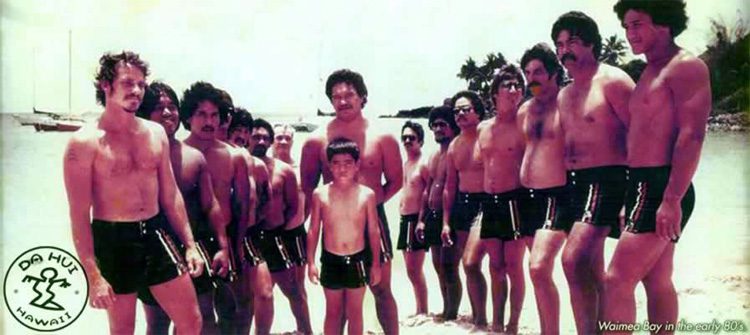
In 1975, a group of North Shore surfers formally organized under the name Hui O Heʻe Nalu. Rather than a loose gang, it was structured as a club, with membership, shared values, and collective responsibility.
Members adopted black surf shorts as a symbol of unity. Over time, outsiders began referring to the group simply as Da Hui — Pidgin shorthand for “the club.” The black shorts became iconic, signaling local identity and mutual support in the lineup.
At its core, Da Hui was built on three principles:
Protection of local access to Hawaiian surf breaks
Preservation of Hawaiian surf culture and respect
Solidarity among North Shore surfers
This unity allowed local surfers to assert themselves during a period when they felt increasingly marginalized in their own home waters.
Localism, Misunderstood
Da Hui is often discussed through the lens of localism, a term that has become shorthand for territorial behavior in surfing. But in Hawaii, localism has deeper historical roots than elsewhere.
Hawaii’s history includes colonization, land loss, cultural suppression, and economic displacement. Surfing — one of the few cultural practices that survived and thrived — became a point of pride and resistance. When waves were commercialized and controlled by external interests, defending access was seen by many locals as an act of cultural preservation rather than exclusion.
Da Hui’s presence in the water sent a clear message: respect the place, the people, and the culture. While confrontations did occur, they were not random acts of aggression, but expressions of a larger struggle over ownership, representation, and respect.
Da Hui and the Professional Surf Era
The rise of professional surfing in the 1970s brought opportunity — but also imbalance. Contest permits, sponsor influence, and visiting surfers often dictated who surfed and when. Hawaiian surfers, despite their deep local knowledge, were frequently sidelined.
Da Hui became known for challenging this system. At times, members paddled into contests or disrupted events they felt disrespected local surfers or excluded Hawaiian participation. These actions drew criticism from surf media but also forced uncomfortable conversations about who surfing in Hawaii was really for.
In many ways, Da Hui exposed the contradictions of professional surfing: a sport born in Hawaii, often profiting outsiders more than the people whose culture created it.
Myth, Media, and Reality
Surf media played a significant role in shaping Da Hui’s image. Stories emphasized intimidation and conflict, often without context. This portrayal cemented Da Hui’s reputation as fearsome enforcers of the North Shore.
Yet within the community, Da Hui was also known for:
Looking out for younger surfers
Enforcing lineup etiquette
Protecting inexperienced visitors from dangerous conditions
Maintaining order in heavy surf
As with many culturally rooted movements, Da Hui became both symbol and scapegoat — representing deeper tensions within surfing that were easier to simplify than fully explain.
Evolution Into a Cultural Institution
Over time, Da Hui evolved. As surfing matured and conversations around respect and inclusivity grew, the organization shifted its emphasis toward community, events, and cultural celebration.
This evolution did not erase the past — it contextualized it.
Da Hui became increasingly involved in:
Community paddles and races
Cultural gatherings
Youth engagement
Preserving Hawaiian surf history
Rather than disappearing, Da Hui adapted — maintaining its identity while embracing a broader role in modern Hawaiian surf culture.
The Da Hui Brand
Out of this evolution came the Da Hui clothing brand, founded by prominent members including Eddie Rothman, Bryan Amona, Kawika Stant Sr., and Clyde Aikau. The brand was never just apparel — it was storytelling.
Da Hui clothing carried messages of:
Hawaiian pride
Unity
Cultural continuity
Respect for the ocean
The brand helped reframe Da Hui’s image globally, allowing people far from Hawaii to engage with its values — not just its reputation.
The Backdoor Shootout: Da Hui’s Signature Event
Perhaps the most enduring public expression of Da Hui’s philosophy is the Da Hui Backdoor Shootout, held annually at Pipeline / Backdoor.
Unlike standard professional contests, the Backdoor Shootout emphasizes:
Team surfing
Multiple surfcraft disciplines
Wave knowledge over point scoring
Local decision-making
Teams are often announced just before competition, reinforcing spontaneity and community. The event celebrates surfing as it exists in Hawaii — fluid, powerful, and deeply connected to place.
The Backdoor Shootout has become one of the most respected events on the North Shore, not because of prize money or rankings, but because it reflects Hawaiian surfing values on Hawaiian terms.
Da Hui’s Influence on Modern Surf Culture
Da Hui’s legacy extends far beyond Hawaii.
1. Redefining Respect
Surf etiquette worldwide increasingly emphasizes understanding local customs — a shift influenced by Hawaiian surf culture and Da Hui’s insistence on respect.
2. Cultural Visibility
Da Hui helped ensure Hawaiian surfers remained visible and influential during a period when global surf narratives risked erasing them.
3. Community-First Surfing
Events like the Backdoor Shootout inspired alternative contest formats focused on community rather than commercialization.
4. Surfing as Identity
Da Hui reinforced the idea that surfing is not just recreation, but a cultural expression tied to lineage, place, and responsibility.
Criticism and Complexity
Da Hui’s history is not without controversy. Some early actions were confrontational, and debates around inclusion versus protection continue today. These complexities are part of the broader conversation about surfing’s past and future in Hawaii.
What cannot be denied is that Da Hui forced the surf world to confront uncomfortable truths — about ownership, respect, and whose voices matter most in places where surfing was born.
Conclusion: Why Da Hui Still Matters
Da Hui is not simply a surf club, a brand, or a historical footnote. It is a reflection of Hawaii’s ongoing relationship with surfing — a relationship shaped by pride, pain, resilience, and adaptation.
From defending access in the 1970s to hosting one of the most culturally significant surf events in the world, Da Hui has left an indelible mark on surfing history. Its legacy lives on every time a surfer paddles out with humility, respect, and awareness of the place beneath their board.
Sources
Da Hui Official Website — Da Hui
Hui O Heʻe Nalu Moʻokūʻauhau (History & Lineage) — Hui O Heʻe Nalu
The Story of the Da Hui Backdoor Shootout — Surfer Today
Da Hui Backdoor Shootout Explained — Jamie O’Brien
The Most Notorious Surf Gangs (Da Hui context) — Jamie O’Brien
A People’s History of Surfing in Hawaii — Jacobin
