

Surf Culture
Da Hui Meaning: History, Culture & Legacy of Hawaii’s Legendary Surf Collective
Dec
Da Hui: The Black Shorts Who Changed Surfing
Most people know Da Hui as a brand. Black shorts, strong logo, ads running across Instagram right now. What they don’t know is why any of it exists — and that story starts in a backyard on the North Shore in the winter of 1975.
I’ve spent years covering Hawaiian surf culture and watching the Backdoor Shootout from the sand at Pipeline. Da Hui is one of those subjects where the surface reputation — intimidating, territorial, feared — completely obscures the actual history. The real story is about Native Hawaiians protecting something that belonged to them long before the cameras arrived. It’s worth telling straight.
Hui O Heʻe Nalu: What the Name Means
Da Hui’s formal name is Hui O Heʻe Nalu — Hawaiian for Club of Wave Riders. “Da Hui” is Pidgin shorthand: da is Pidgin for “the,” hui means club or group. Simple. But the name, the colors, and the iconic black shorts weren’t just picked off a shelf. According to the organization’s own history, they were blessed and created by family members of the founders — a detail almost never mentioned in the mainstream surf media version of this story. From the beginning, this was a sacred undertaking, not just a surf club.
The North Shore in the Early 1970s
To understand why Da Hui formed, you have to understand what the North Shore looked like before them.
By the early 1970s, Pipeline, Sunset Beach, and Waimea Bay had become the most coveted surf real estate on earth. Professional contests were being organized and run largely by outsiders. Sponsorship money flowed in from the mainland and abroad. Film crews arrived every winter. And the surfers who had grown up riding these breaks their entire lives — Native Hawaiians and longtime locals — were increasingly being pushed to the margins of their own ocean.
Surfing in Hawaii was never recreation. It was a cultural inheritance tied to genealogy, land, and generations of ocean knowledge. Watching that get commodified by people with no connection to the place created a frustration that eventually had nowhere left to go but out.
The Backyard Meeting: Winter 1975
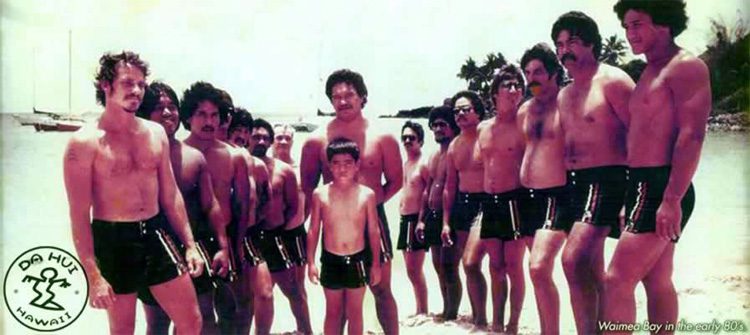
In the winter of 1975, a core group of North Shore watermen gathered — casually, in a backyard — with a single purpose: to protect the rights of Native Hawaiians on land and sea.
What came out of that meeting was the Hui O Heʻe Nalu. Founders included Eddie Rothman, Clyde Aikau, Kawika Stant Sr., and Bryan Amona. The club name, colors, and black shorts were formally blessed by the founders’ family members as a symbol of Native Hawaiian strength and unity. Members would wear black surf shorts as a mark of belonging — visible in any lineup, impossible to ignore.
The Clyde Aikau connection matters here. Clyde’s brother Eddie had become the most iconic waterman in Hawaiian history, a man who represented aloha and courage in equal measure. Da Hui was built in that same tradition — not aggression for its own sake, but protection of something genuinely worth protecting.
What Da Hui Actually Did
The early years were, in the organization’s own words, “challenging and feisty.” Members paddled into contest lineups and refused to leave. They confronted visiting surfers who showed disrespect in the water or on land. They enforced the unwritten rules of Hawaiian lineups in ways the surf media found easy to frame as villainous.
What that framing consistently left out: Da Hui was making a legitimate argument. Professional surfing was being built on Hawaiian waves, using Hawaiian culture as its aesthetic backdrop, while systematically excluding the people whose heritage created the whole thing. Paddling out to stop a contest wasn’t random aggression — it was the most direct statement available.
Surf media needed a villain. Da Hui became one. The actual grievance got buried under the reputation.
Localism in Historical Context
The word “localism” flattens a complicated reality when applied to Hawaii.
Localism elsewhere in the world is usually about territorial behavior in a lineup. In Hawaii it carries a different weight. The islands’ history includes colonization, the overthrow of the Hawaiian monarchy, land loss, and the near-destruction of the Hawaiian language and cultural practices. Surfing — heʻe nalu — survived all of that. It became a point of pride and continuity precisely because so much else was lost.
When Da Hui stood in the lineup and said respect this place and its people, they were saying something that went well beyond wave priority. Understanding that context doesn’t require agreeing with every action taken. It requires being honest about what was actually at stake.
Evolution: From Enforcement to Institution
Da Hui didn’t stay frozen in 1975. Over time, as conversations about respect and representation shifted within surfing, the organization’s emphasis shifted with them — toward community, culture, and events.
Today Hui O Heʻe Nalu runs:
- The Da Hui Backdoor Shootout in memory of Duke Kahanamoku, held annually at Pipeline and Backdoor
- The Hui O Heʻe Nalu Paddle Race, one of the largest paddle races in the world
- North Shore beach cleanups
- Youth engagement and cultural education programs
None of that erases the early history. It contextualizes it — showing an organization that took its founding mission seriously enough to evolve it.
The Backdoor Shootout
The Backdoor Shootout is Da Hui’s signature public expression, and it runs by its own rules.
Teams are often announced close to competition time. The format emphasizes team surfing across multiple craft, wave knowledge over scorecards, and local decision-making throughout. There’s no outside body dictating terms. It’s Hawaiian surfing, run on Hawaiian terms, at the heaviest wave on the island.
Watching it from the beach at Pipeline — which I’ve done — you notice something that doesn’t come through on a broadcast: the energy is completely different from a WSL event. It feels like it belongs there. That’s intentional.
The Da Hui Brand
The clothing brand that carries the Da Hui name grew out of the same impulse as the organization — storytelling and cultural pride made visible. The black shorts, the logo, the aesthetic all carry the weight of what the organization represents.
What’s notable about the brand’s current moment: over 50 years after a backyard meeting in 1975, Da Hui imagery is running in feeds worldwide. The mainstream came to them. That’s a different kind of vindication than winning a contest.
Why It Still Matters
Da Hui forced surfing to have a conversation it didn’t want to have — about whose culture this is, who profits from it, and what respect actually looks like in practice. That conversation is still ongoing. Every localism debate, every discussion about Hawaiian representation in professional surfing, every argument about contest permits on the North Shore traces at least some of its lineage back to that backyard meeting in 1975.
The black shorts didn’t just protect a lineup. They protected an idea: that Hawaiian surf culture belongs to Hawaiians, and that belonging is worth defending.
Mahalo for reading. For more on the culture and history that shaped Da Hui, explore the history of surfing in Hawaii and the unwritten rules of Hawaiian lineups.
FAQ
What does Da Hui mean?
Da Hui is Pidgin shorthand for Hui O Heʻe Nalu, the organization’s formal Hawaiian name meaning Club of Wave Riders. Da is Pidgin for “the” and hui means club or group.
When was Da Hui founded?
Da Hui was founded in the winter of 1975 by a group of North Shore watermen including Eddie Rothman, Clyde Aikau, Kawika Stant Sr., and Bryan Amona.
Why do Da Hui members wear black shorts?
The black shorts were created as a symbol of Native Hawaiian strength and unity. According to the organization’s own history, the club name, colors, and shorts were blessed by family members of the founders — not just a uniform but a cultural statement.
Is Da Hui a gang?
Da Hui is formally organized as Hui O Heʻe Nalu, a non-profit 501(c)(3) organization. Its early years involved confrontational enforcement of lineup access, which generated a gang reputation in surf media. Today the organization focuses on community events, cultural preservation, and youth programs.
What is the Da Hui Backdoor Shootout?
The Backdoor Shootout is Da Hui’s annual surf contest held at Pipeline and Backdoor on the North Shore. Unlike standard professional events, it runs on Hawaiian terms — team format, multiple surf craft, local decision-making — and is held in memory of Duke Kahanamoku.
Does Da Hui still exist?
Yes. Hui O Heʻe Nalu remains active on the North Shore, running the Backdoor Shootout, the Hui Paddle Race, beach cleanups, and youth and cultural programs. The Da Hui clothing brand continues to operate alongside the organization.
What is Da Hui’s relationship to Hawaiian localism?
Da Hui emerged from a specific historical context: Native Hawaiian surfers being pushed aside in their own waters during the commercialization of professional surfing in the 1970s. Their enforcement of local access was an expression of cultural protection rooted in Hawaii’s broader history of colonization and land loss — not simply territorial behavior.
Sources
- Hui O Heʻe Nalu — Our Moʻokūʻauhau (Official History)
- Da Hui Official Website
- Da Hui Backdoor Shootout Explained — Jamie O’Brien
- The Story of the Da Hui Backdoor Shootout — Surfer Today
- A People’s History of Surfing in Hawaii — Jacobin
Related Guides
- Pipeline Surf Break Guide
- The Unwritten Rules of Hawaiian Lineups
- Eddie Aikau: Hawaiian Surf Legend
- History of Surfing in Hawaii
Last Updated: June 2026
The organisation still runs the Da Hui Backdoor Shootout at Pipeline each winter.
