Jul
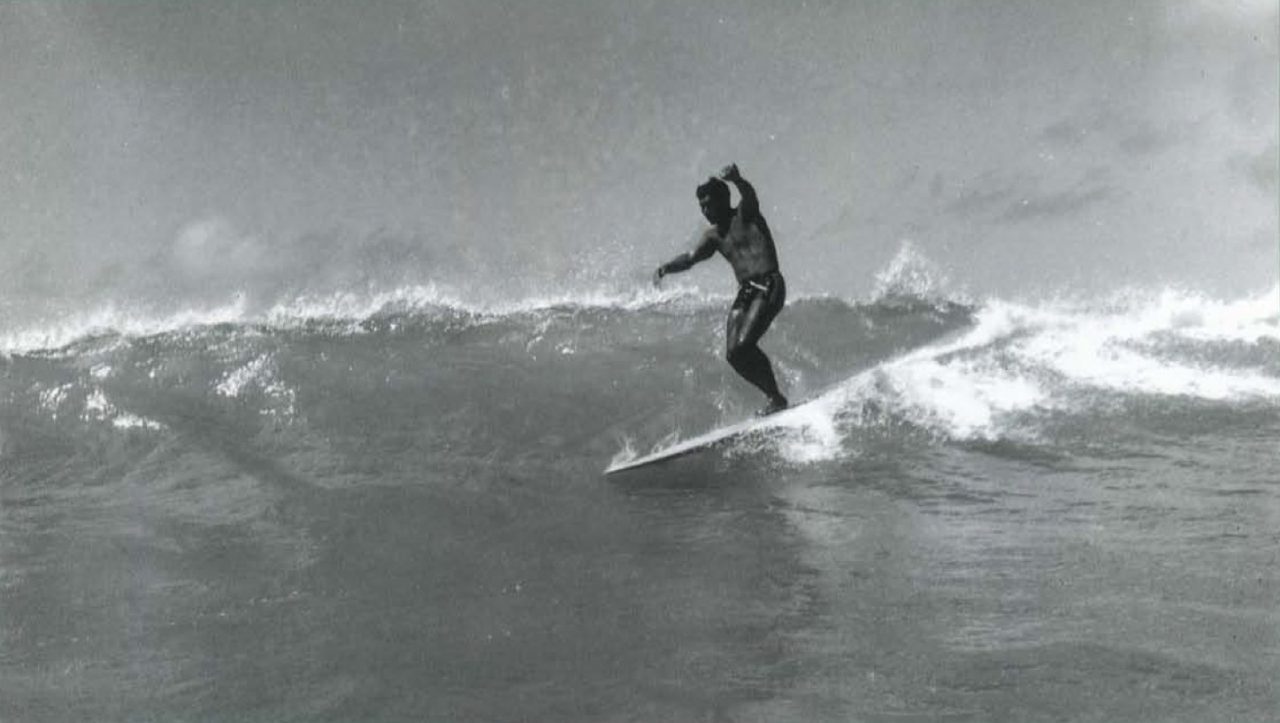
In the summer of 1937, three young surfers stood in a backyard on Black Point, on the eastern edge of Honolulu, and took an axe to a perfectly good surfboard. What they cut that afternoon changed the shape of the surfboard forever — and opened the door to riding waves nobody had thought rideable. They were John Kelly, Wally Froiseth, and Fran Heath, and the board they made is called the hot curl.
The problem with planks
To understand what they did, you have to understand what they were fighting. The boards of the 1930s were solid redwood planks — heavy, wide, flat-tailed, and finless. On the long, gentle rollers of Waikīkī they were fine. But at Brown’s, a steep, glassy break off Diamond Head where the wave stood up fast and hollow, the planks failed in the same maddening way every time. As the wave steepened, the wide tail would lose its grip and slide out sideways — surfers called it “sliding ass.” You could not hold a high line across a steep wall; the board simply let go and spun away beneath you.
Kelly, Froiseth, and Heath were teenagers obsessed with exactly those waves — the steep, fast ones that the older Waikīkī crowd mostly left alone. And they were tired of sliding out.
The cut
After one especially frustrating session at Brown’s, Kelly and Heath hauled a board back to Kelly’s house on Black Point and set it across two sawhorses. The idea was simple and radical: if the wide tail was the thing sliding out, cut the wide tail off. Kelly took an axe to it. “However deep this axe goes,” he later recalled saying, “I’m going to cut that much off.” They hacked the tail down and then refined it with a drawknife and plane, narrowing it to a deep, V-shaped bottom only about five inches across at the very end.
There was no fin — there had never been a fin. The V itself was the answer. When they paddled back out, the narrowed tail knifed into the face of the wave and held. For the first time the steep tubes at Brown’s could be ridden clean and fast instead of sideways and out. A day or two later, watching the boards drive through sections that used to spit them out, Froiseth said they really got you into the “hot curl” — the steep, curling part of the wave — and the name stuck.
What the hot curl changed
The hot curl was not a small refinement. It was, in the judgment of most surf historians, the first surfboard purpose-built for bigger, steeper, faster waves — the direct ancestor of the big-wave gun. It was the moment Hawaiian surfing stopped simply adapting an old object and started engineering a board against a specific wave, a lineage that runs straight through George Downing‘s balsa “Rocket” and Dick Brewer’s pintails to the guns shaped on the North Shore today. You can trace that whole story in our history of Hawaiian surfboard shaping, and its roots in the boards of ancient Hawaiian surfing.
For the next fifteen years the hot curl was the board for anyone in Hawaiʻi who wanted to ride serious surf. It was demanding — the narrow tail asked for constant, precise footwork and gave a beginner nothing to hold onto — but in the right hands it opened water that planks could not touch. Above all, it carried its makers west, to Makaha, where the next chapter of big-wave surfing would be written.
John Kelly: from the hot curl to Save Our Surf
Of the three, John Kelly may have left the largest mark — and most of it came out of the water. After World War II he trained as a musician at Juilliard and worked as a choral director at Honolulu’s Palama Settlement, but he is remembered today as one of the first environmental activists surfing ever produced. In the early 1960s, when the U.S. Army Corps of Engineers planned a jetty at Nānākuli, Kelly and George Downing organized to fight it — and won. That fight grew into Save Our Surf, the grassroots movement that coalesced through the mid-1960s and exploded into a mass campaign by 1971, when a rally at the State Capitol drew thousands of Hawaiʻi schoolkids to defend their reefs.
Save Our Surf is credited with helping protect roughly 140 surf sites around Oʻahu and blocking a string of coastal developments, dredging projects, and reef fills — years before Surfrider existed on the mainland. Kelly ran it with a true radical’s commitment: he installed his own printing press in his Black Point basement to produce the movement’s fliers when commercial shops refused, and he liked to say he got fired from four jobs for telling the truth. His wife and partner in the work, Marion Kelly, was a formidable figure in her own right — a Bishop Museum ethnographer who helped found Ethnic Studies at the University of Hawaiʻi. In 1965 Kelly also published Surf and Sea, a sweeping handbook on wave science, board design, and ocean craft that the historian Matt Warshaw has called “the most intelligent, well-crafted book ever written on surfing.” He kept tinkering with boards too, patenting a split-hull “hydroplane” design in the early 1960s.
Wally Froiseth: Makaha, and a canoe that changed everything
Wally Froiseth learned to build boards as a boy from the Waikīkī beachboy John D. Kaupiko, and he never stopped being a waterman. He was a founding member of the Waikīkī Surf Club in 1948, where he ran the surf and canoe program, and he helped organize the Makaha International Surfing Championships when it launched in 1954 — for years the most important contest in the sport. He won the Makaha International himself in 1959. Through the 1950s he was among the small group, alongside George Downing and Rabbit Kekai, pushing into the big surf at Makaha and Waimea that the hot curl had made possible.
But Froiseth’s most lasting work came later, and on a very different kind of hull. In the 1970s he joined the effort to build Hōkūleʻa, the double-hulled voyaging canoe that would reawaken Polynesian wayfinding — lending his lifetime of canoe-lashing skill to its construction and then spending decades as its builder, caretaker, and crewman, sailing deep-ocean voyages into the 1980s and 1990s and captaining a leg as late as 2003. “There would be no Hōkūleʻa without Wally Froiseth,” the navigator Nainoa Thompson said. “In many ways, he saved the Hōkūleʻa.”
Fran Heath: the quiet one
Fran Heath — the oldest of the group, raised in Kahala just past Diamond Head — was there at the sawhorses in 1937 with the axe and the drawknife, but he never sought the spotlight. By one account he went into his father’s insurance business, and around the war he stepped back from stand-up surfing, becoming a dedicated bodysurfer and, as friends remembered him, something of a loner. Yet the bond held: in the spring of 2001, more than sixty years after the hot curl, Heath teamed up with his old friend Froiseth to complete a replica of Princess Kaʻiulani’s surfboard, joined by his son and granddaughter. No surviving board can be firmly traced to that first 1937 cut, though a redwood hot-curl board of the era is preserved at the Surfing Heritage & Culture Center in California — a reminder of how close the whole idea came to being lost.
Their place in Hawaiian surfing
It is hard to overstate what those three teenagers set in motion. Every big-wave gun that followed — every drawn-out pintail built to hold a high line across a wall of water — descends from the finless V they cut at Brown’s in 1937. Froiseth, Kelly, and Heath belong at the head of the story told in our history of Hawaiian surfboard shaping: the first surfers to stop accepting the board they were handed and reshape it to meet a Hawaiian wave on its own terms.
Frequently asked questions
Who invented the hot curl surfboard?
John Kelly and Fran Heath, in 1937, when they cut down the wide tail of a redwood plank at Kelly’s house on Black Point, Oʻahu, so it would hold in steep waves. Their friend Wally Froiseth gave the design its name.
What is a hot curl surfboard?
A finless redwood board with a narrow, deep-V tail. The V let the board grip the face of a steep, fast wave instead of sliding out sideways, which is why it is regarded as surfing’s first specialized big-wave board.
What was Save Our Surf?
A grassroots environmental movement founded by John Kelly on Oʻahu in the early-to-mid 1960s to protect Hawaiʻi’s surf breaks and reefs from dredging and coastal development. It is credited with helping save roughly 140 surf sites and is considered a forerunner of modern surf-conservation groups.
Is Wally Froiseth still alive?
No. Wally Froiseth died on June 29, 2015, at age 95. Beyond the hot curl, he is remembered for his decades of work building and sailing the Polynesian voyaging canoe Hōkūleʻa.
Does the original hot curl board still exist?
No board can be firmly traced to the first 1937 hot curl. A redwood hot-curl board from the era is preserved at the Surfing Heritage & Culture Center in California, but its exact origins are not documented.
Sources
- Encyclopedia of Surfing (Matt Warshaw) — Hot Curl, John Kelly & Wally Froiseth entries
- The Surfer’s Journal — “The Archivist: Hot Curl”
- Honolulu Star-Advertiser — Wally Froiseth obituary (2015)
- FLUX Hawaii — “Save Our Surf” and John M. Kelly Jr.
- Polynesian Voyaging Society — Wally Froiseth & Hōkūleʻa
- Wikipedia — Save Our Surf
- U.S. Patent 3,111,695 — John Kelly’s “Hydroplane” surfboard
- Surfing Heritage & Culture Center — redwood hot-curl board
- Malcolm Gault-Williams, LEGENDARY SURFERS — Fran Heath
