Legends
Eddie Aikau: “Eddie Would Go” — A Tribute to Hawaii’s Waterman
Nov
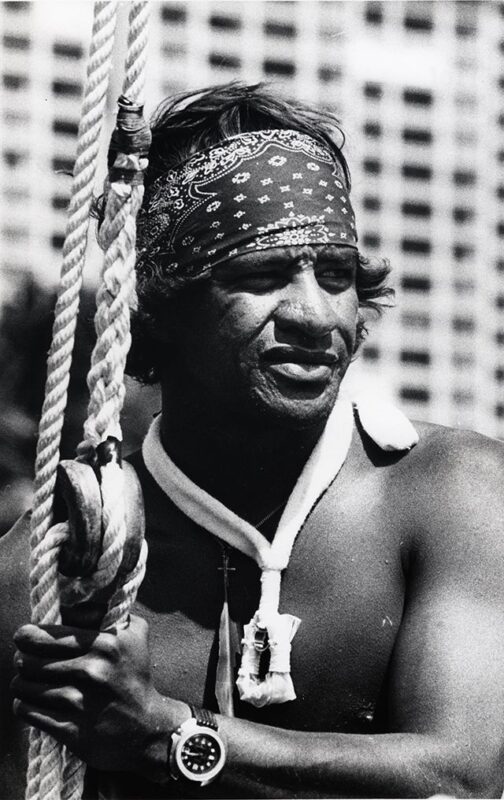
Image courtesy of Surfer
Eddie Aikau: The Waterman Who Went Where Others Wouldn’t
There are surfers, and there are watermen. Eddie Aikau was something rarer still — a man for whom the ocean was not a stage but a calling. He surfed its biggest waves, guarded its most dangerous beaches, and in the end gave his life to it in an act of selflessness that Hawaii has never forgotten.
His name is everywhere on the North Shore. On bumper stickers and t-shirts, in the names of contest heats and the phrases locals drop without explanation. “Eddie Would Go.” Four words that carry the weight of an entire philosophy about courage, responsibility, and what it means to answer when the ocean calls.
Growing Up With the Ocean
Edward Ryon Makuahanai Aikau was born on May 4, 1946, in Kahului, Maui, the fourth of six children in a close Hawaiian family. The middle name Makuahanai — meaning fostering parent — pointed toward something in his nature before he was old enough to understand it. He came up surfing the harbor break at Kahului, bought his first board after working at the Dole pineapple cannery, and when the family relocated to Oahu in 1959, he found the North Shore.
He never really left.
Lifeguard at Waimea Bay
In 1968, Eddie Aikau became the first lifeguard hired by the City and County of Honolulu to patrol Waimea Bay — a break that in those years had no rescue infrastructure, no jet skis, no tow-in equipment. Just a man on a surfboard and the ocean trying to take everything it could.
Waimea Bay in winter is a different place than the flat, glassy swimming hole tourists visit in summer. When the North Pacific sends its biggest swells, the Bay transforms into one of the most powerful and unpredictable waves on earth. Over the course of his tenure Eddie is credited with saving more than 500 lives there, paddling out in conditions that had driven every other person off the beach.
No one drowned on his watch. That is the line people use, and it is not hyperbole.
Waimea is a place that commands real respect even on a moderate day. Standing on the sand watching a solid swell come through — the way the Bay draws water off the beach before each set, the way the lip throws — makes it immediately clear why Eddie’s record there is considered almost supernatural. What he did in conditions far beyond that, with nothing but a surfboard and his own nerve, is difficult to fully comprehend from dry land.
Big-Wave Surfer
Eddie’s lifeguard legacy can sometimes overshadow the fact that he was also one of the finest big-wave surfers of his generation. He rode Waimea, Sunset, and the North Shore’s heaviest breaks through the late 1960s and 1970s with a style rooted in Hawaiian tradition — powerful, deliberate, and utterly without showmanship.
In 1977 he won the Duke Kahanamoku Invitational at Sunset Beach, one of the most prestigious events in Hawaiian surfing, joining a list of champions that includes Jeff Hakman, Jock Sutherland, and Barry Kanaiaupuni. It was the peak of his competitive career, and it came from the same place as everything else he did — a genuine relationship with the ocean, not a performance for anyone watching.
The Hokule’a and the Final Paddle
In 1978, Eddie joined the crew of the Hokule’a — the traditional Hawaiian double-hulled voyaging canoe that had been built as part of the Hawaiian cultural renaissance of the 1970s. The vessel was retracing ancient Polynesian migration routes between Hawaii and Tahiti, a 2,500-mile passage navigated by the stars and ocean swells, without modern instruments. For Eddie, joining the voyage was a natural extension of everything he believed about Hawaiian identity and connection to the sea.
On March 16, 1978, the Hokule’a capsized in heavy swells and strong winds in the Alenuihaha Channel between Molokai and Lanai. The crew clung to the overturned hull, visible to passing planes only if someone could reach shore and raise the alarm. Eddie volunteered to paddle his surfboard through open ocean to find help. He removed his life jacket — believing it would slow him down — and paddled into the dark.
He was never seen again.
The Coast Guard launched the largest air-sea search in Hawaii’s history. The rest of the crew was rescued. Eddie’s body was never recovered.
He was thirty-one years old.
Eddie Would Go
The phrase emerged organically from the people who knew him and the surfers who understood what his life had meant. “Eddie Would Go” was not a marketing tagline — it was a statement of fact about a man who consistently chose the harder, more dangerous, more selfless path when others hesitated.
Today it is the organizing principle of the Eddie Aikau Big Wave Invitational at Waimea Bay, a contest that runs only when conditions reach a minimum threshold of twenty feet Hawaiian scale — one of the rarest and most anticipated events in surfing. Since its founding in 1984 it has run fewer than ten times. When it does run, the whole island stops.
Eddie’s family established the Eddie Aikau Foundation to carry forward his values of aloha, community, and ocean stewardship. His brother Clyde, who was on the Hokule’a that night and watched Eddie paddle away, has spent decades honoring his memory.
What He Left Behind
The thing about Eddie Aikau’s story is that it has no complicated footnotes. There is no controversial chapter, no fall from grace, no asterisk. He lived exactly the way the phrase on every bumper sticker says he did — going when others wouldn’t, serving when others couldn’t, and finally sacrificing everything for the people beside him.
On the North Shore, that kind of life leaves a mark that doesn’t fade. Every winter when Waimea Bay wakes up and the sets roll through, Eddie Aikau is present in the water in a way that requires no explanation to anyone who surfs these islands.
Sources
- Eddie Aikau Foundation: Our History
- Wikipedia: Eddie Aikau
- Surfer: How Eddie Aikau Became a Hawaiian Icon
- SurferToday: The Surfing Life Story of Eddie Aikau
- Polynesian Voyaging Society: Hokule’a
The big-wave invitational that carries his name only runs when Waimea delivers. It was called off for the 2025-26 season. His brother Clyde, who won the event in 1986, is remembered in our tribute to Clyde Aikau.
