May
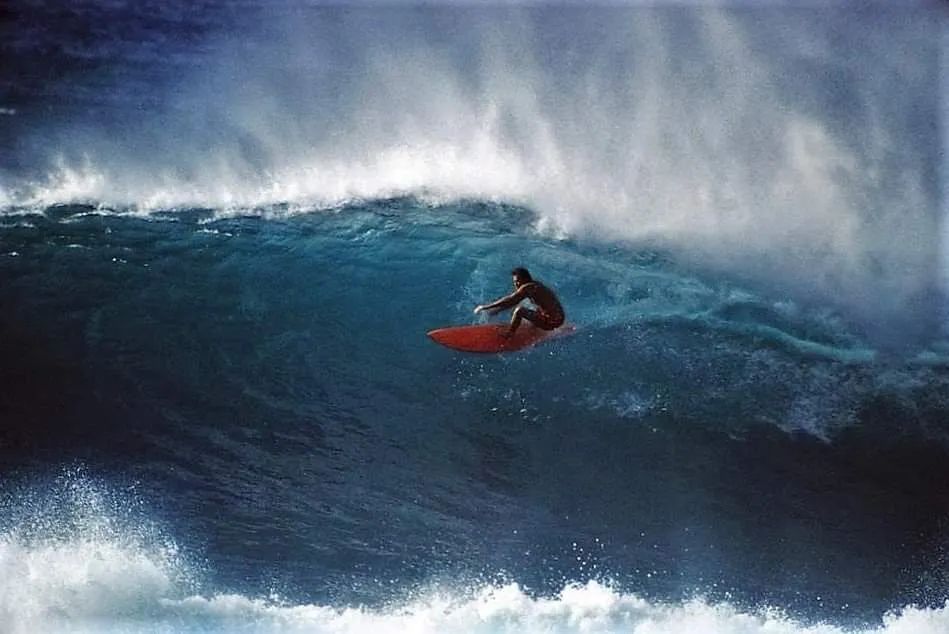
Barry Kanaiaupuni surfed Sunset Beach with more power than anyone of his generation, and in doing so he helped drag surfing out of the longboard era and into the one we still live in. Ask a North Shore local of a certain age who the best power surfer was, and BK’s name comes back without hesitation.
He is also, and this is the part most write-ups leave out, a Hall of Fame surfboard shaper who is still making boards by hand in Haleiwa.
Who Is Barry Kanaiaupuni?
Born in 1945 and raised on Oʻahu, Barry Kanaiaupuni started surfing at eight years old in Waikiki, came up through the 1960s, and made his name in the 1970s at a wave that punished almost everyone who paddled out to it.
Where earlier surfers had drawn long, gliding lines, BK attacked. His surfing was fast, committed, and built on turns that gouged rather than traced. That approach was not just a style preference. It was a different theory of what a surfer could do to a wave, and it landed at exactly the moment when boards were finally short enough to allow it.
From Waikiki to the North Shore
Like most Oʻahu surfers of his generation, Kanaiaupuni learned in town. Waikiki is a forgiving place to start: long, soft, rolling waves that will carry a beginner a very long way and ask almost nothing in return. It is where Duke Kahanamoku taught the world to surf, and it is where thousands of Hawaiian kids, Barry among them, first stood up.
The North Shore is the opposite proposition. It is cold-blooded, fast, and unsentimental, and in the 1960s it was still being worked out. The surfers who went north in that decade were not visiting a proven arena. They were finding out what was survivable.
Kanaiaupuni went north and stayed. The choice defined him, because Sunset Beach is a wave that will not let you fake anything, and the whole of his surfing was an answer to what it demanded.
The BK Turn, and Why Sunset Beach Mattered
Sunset Beach is a big, shifting, deceptively heavy wave. It moves around, it breaks in different places depending on the swell, and it has humbled a great many good surfers. It rewards power and punishes hesitation, which is precisely why it became Kanaiaupuni’s stage.
The signature move was the bottom turn. BK would drop down the face, set a rail hard, and come off the bottom with so much speed and compression that the top turn became inevitable. Surfers still call it the BK turn. On heavy Hawaiian water, on a board with far less forgiveness than a modern one, it was an act of controlled violence.
He was not surviving Sunset. He was dictating terms to it.
The Competitive Record
Kanaiaupuni’s contest results undersell him, which is true of most surfers whose gift was free surfing rather than heat strategy. But the record is there.
He won the Pro Class Trials twice. He drew the most invitee votes for the Duke Kahanamoku Classic, which is its own kind of honour: it means the surfers themselves, asked who most deserved to be in the water, named him first. And in 1976 he finished ranked ninth in the world.
That 1976 ranking deserves a footnote, because 1976 was the first year there was a world ranking to hold. The IPS tour was the sport’s first real attempt to organise professional surfing into a season, and Kanaiaupuni finished its inaugural year inside the top ten — at thirty-one years old, against a field of surfers who had grown up assuming a pro tour would exist.
None of it quite captures what he was. The people who saw him surf Sunset in the mid-1970s do not talk about placings. They talk about what he did on a single wave.
The Shaper: Takayama, Rick, and Lightning Bolt
Kanaiaupuni’s surfing demanded equipment that did not yet exist, so he built it himself.
He learned to shape as a young man under Donald Takayama, one of the finest craftsmen the sport has produced, and he never stopped. Over the following decades he shaped under a run of the era’s most important labels. At Rick Surfboards his own BK model became an icon of the period. He shaped for Gordon & Smith, for Surf Line Hawaii, and for Lightning Bolt, the label that more than any other defined North Shore surfing in the 1970s.
What he made was distinctive: javelin-thin boards, narrow and knifey, built to be driven rather than coaxed. They were pocket rockets, designed by a man who intended to put a board on rail in serious Hawaiian water and hold it there. One assessment of his design work puts it about as strongly as it can be put — that his boards became the prototype for everything North Shore surfing would go on to become.
The design logic follows directly from the surfing. A wide, thick board floats well and paddles easily, but on a steep, fast, bumpy Hawaiian face it wants to skip and slide out; there is simply too much surface for the water to grab. Narrow it, thin it, and pull the rails in, and the board will knife into the face and hold. It becomes harder to catch a wave on and far less forgiving of a mistake, and in exchange it will do exactly what a surfer of Kanaiaupuni’s commitment wants: hold a hard rail at speed, through the bump, without letting go.
That is a board built for one thing, by someone who was doing that one thing better than anybody else. The shaping and the surfing were the same argument, made twice.
This was the shortboard revolution in motion, and Hawaii was its proving ground. Dick Brewer was refining the guns that made big Hawaiian waves rideable, and the feedback loop between what surfers like BK were attempting and what shapers could deliver drove the design forward on both sides. The difference with Kanaiaupuni is that he sat on both sides of that loop at once. The full arc is covered in our history of surfboard shaping.
In 2009 he was inducted into the International Surfboard Builders Hall of Fame.
BK Hawaii, Haleiwa
Around 1980 Kanaiaupuni opened his own shop in Haleiwa, and he has been hand-shaping there ever since.
That is not a ceremonial arrangement. He still shapes something on the order of ten boards a week, working mostly on guns and longboards — which is to say he is still building the boards for the waves that made him, four and a half decades after he opened the doors.
His older boards have become genuinely collectible. Vintage BK Hawaii and Surf Line Hawaii shapes turn up at auction and in collector markets, and they are bought by people who understand what they are holding: a board made by the man who worked out what those waves wanted.
Barry Kanaiaupuni Today
He is alive, he is in Haleiwa, and he is still shaping.
The recognition has kept coming. In 2009 came the International Surfboard Builders Hall of Fame. In 2025 he was inducted into the Surfing Walk of Fame at Huntington Beach, and the tributes that came with it said the same thing over and over, in slightly different words: that we will not see surfing like that again.
It is a strange kind of fame. Outside Hawaii, Kanaiaupuni is not a household name. Inside surfing, among the people who actually know, he is close to untouchable.
Power Surfing and the Hawaiian Line
There is a particular Hawaiian idea of how a wave should be ridden: with commitment, from the pocket, using the power of the wave rather than dancing around it.
Kanaiaupuni is one of the clearest expressions of that idea, and he sits in a lineage that runs through Larry Bertlemann, Dane Kealoha, and later Johnny Boy Gomes. Watch a modern professional lay into a bottom turn at Sunset and you are watching a line that BK drew first.
The Influence of BK
Kanaiaupuni is less widely known outside Hawaii than Duke Kahanamoku or the Aikau family, and that is largely an accident of era and publicity rather than ability. Among surfers who know the history, he is revered. His name still carries weight on the North Shore, and his influence is visible every time someone puts a board on rail and drives.
The rarer thing is the double. Plenty of surfers changed how the sport looked. A much smaller number changed what it rode. Kanaiaupuni did both, and then went on doing the second one, quietly, in a shaping bay in Haleiwa, long after the cameras had moved on.
His surfing was rooted in Hawaiian mana, and he brought it to the heaviest wave he could find. That is the whole story, and it is enough.
Frequently Asked Questions
Who is Barry Kanaiaupuni?
Barry Kanaiaupuni, known as BK, is a Hawaiian surfer and surfboard shaper from Oʻahu, born in 1945. He became famous in the 1960s and 1970s for his powerful surfing at Sunset Beach, and he is a Hall of Fame board builder who still shapes in Haleiwa.
Is Barry Kanaiaupuni still alive?
Yes. He is still living on Oʻahu and still shaping surfboards by hand in Haleiwa. In 2025 he was inducted into the Surfing Walk of Fame at Huntington Beach.
Does Barry Kanaiaupuni still make surfboards?
He does. He has run his own shop in Haleiwa since around 1980 and still hand-shapes roughly ten boards a week, mainly guns and longboards.
Who taught Barry Kanaiaupuni to shape?
He learned as a young man under Donald Takayama. He went on to shape for Rick Surfboards, where his BK model became an icon, as well as Gordon & Smith, Surf Line Hawaii, and Lightning Bolt.
Are Barry Kanaiaupuni surfboards collectible?
Yes. Vintage BK Hawaii and Surf Line Hawaii boards shaped by Kanaiaupuni are actively sought by collectors and appear regularly at vintage surfboard auctions. His guns from the 1970s are the most prized, for the obvious reason: they are the boards that the shortboard era on the North Shore was actually built on. He also still shapes new boards to order from his shop in Haleiwa.
What is the BK turn?
The BK turn is Kanaiaupuni’s signature bottom turn: a deep, hard-driving carve off the bottom of the wave that generates enough speed and compression to set up vertical top-to-bottom surfing. It is named for him and is still referenced by surfers today.
Why is Barry Kanaiaupuni important?
He helped move surfing away from the gliding longboard style of earlier decades toward the high-performance, power-based approach that defines modern surfing — and he shaped the boards that made that style possible.
Where did Barry Kanaiaupuni surf?
Sunset Beach on Oʻahu’s North Shore was his home wave and the break most associated with him, though he surfed across Hawaii and internationally.
Keep Reading
- Sunset Beach Surf Break Guide
- The History of Surfboard Shaping
- Donald Takayama, Surfboard Shaper
- Dick Brewer, the Shaping Guru of the North Shore
- Gerry Lopez and Lightning Bolt
- The History of Surfing in Hawaii
