Apr
How a quiet kid from East Honolulu became the calmest man at the deadliest wave in the world, and made the most dangerous thing in surfing look like meditation.
Before Gerry Lopez, Pipeline was a wave people feared. After him, it was a wave people worshipped. That shift, from terror to artistry, is almost entirely his doing, and it happened through a rare combination of board design, physical genius, and a stillness inside the barrel that no one before or since has fully matched.
The nickname “Mr. Pipeline” is not honorary. He earned it wave by wave at the most dangerous break in Hawaii, and the surfing world has never found anyone to take it from him. The Pipeline Masters itself was informally renamed the Gerry Lopez Pipeline Masters for decades, one of the rarest honors in the sport, where a contest takes the surfer’s name instead of a sponsor’s. That is the measure of what he meant to that wave.
Town Roots
Gerald Ken Lopez was born in Honolulu on November 7, 1948, and grew up on the east side of the city. He attended Punahou School, the same institution that produced a long line of Hawaii’s watermen and thinkers, and came up surfing the semi-secret reefs around Aina Haina and the well-known breaks of metro Honolulu.
His earliest stylistic influence was Paul Strauch, the elegant Hawaiian regularfooter whom Lopez still calls the most stylish surfer ever. Lopez became the Hawaii State Champion at age 14, and alongside his friend Reno Abellira began surfing Ala Moana Bowls relentlessly. It was there, in the long, mechanical walls of Bowls, that he honed the casual, low-slung style and the masterful tube timing that would later define him at Pipeline.
He was a serious competitor as a teenager, winning the 1966 Hawaiian Junior Championships and reaching the finals of state and US titles through the late 1960s. But Lopez was never built for the grind of the world tour. His genius was specialized, and it pointed at one wave.
Learning the Pipeline
By the late 1960s, Lopez and his friends were migrating out to the North Shore to watch the Pipeline pioneers, surfers like Butch Van Artsdalen and Jock Sutherland, ride the hollow, slabbing lefts that most of the surfing world still considered a death sentence. Lopez’s own first attempts at the wave came as early as 1963, and by his own account he didn’t even make the drop on his first day.
He spent years learning Pipeline the only way it can be learned: slowly, patiently, and with total respect for the reef beneath it. Where everyone else used a wave as a stage to perform on, Lopez did the opposite. As surf historian Matt Warshaw put it, his idea was to literally disappear into the wave. He made the hardest thing in the sport look not just easy but meditative. Nobody had better timing.
That stillness was no accident. Lopez was one of the first surfers of his generation to bring yoga into his life and his surfing, and he credited his famously calm demeanor in the barrel to a daily practice of breath control and focus long before any of that was fashionable in the sport.
The Two Masters
Lopez won the Pipeline Masters in 1972 and again in 1973, the back-to-back victories that sealed the nickname forever. The first came during a heavy, contestable day that Surfer Magazine billed as “Huge Monday,” surfed in front of ABC’s Wide World of Sports cameras. The following year he defended the title, surfing to near perfection against rivals like Rory Russell.
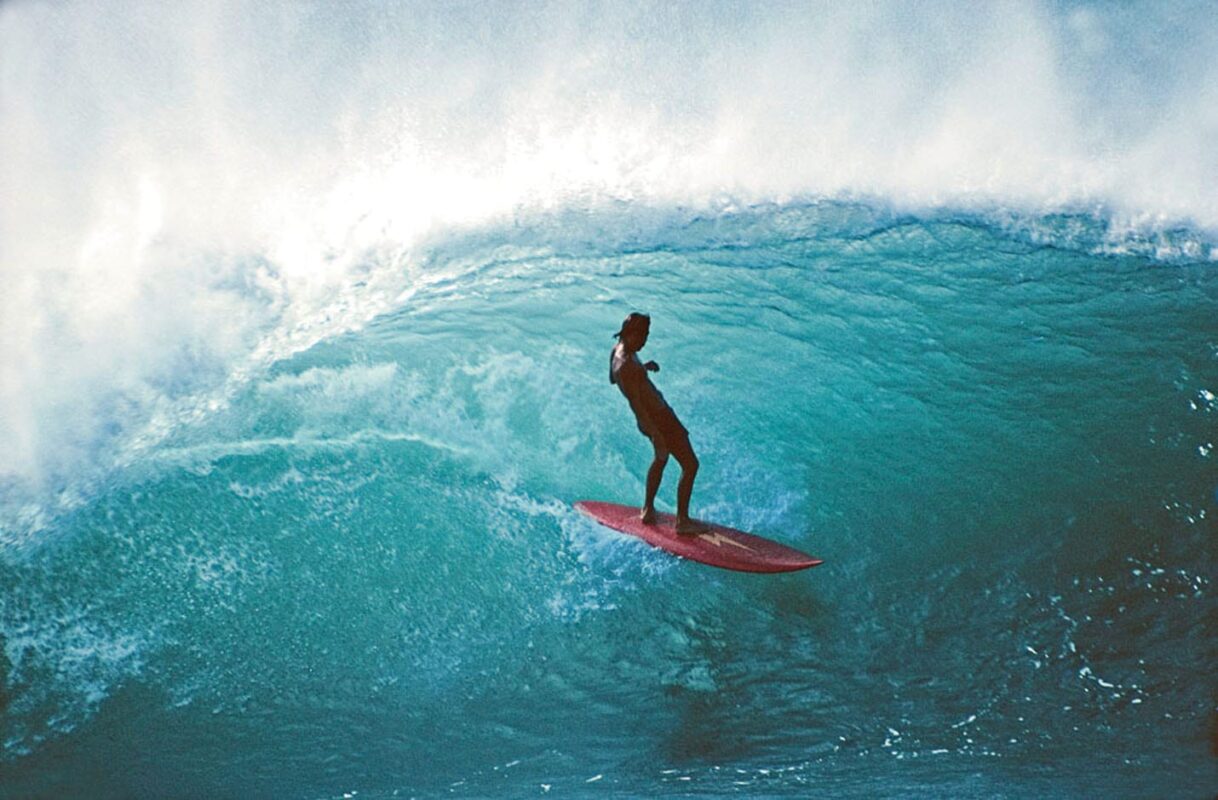
He was, by broad agreement, the best tube rider in the world during that era. His signature look became the template for backside surfing at Pipeline: a vertical takeoff, a quick turn under the lip, then a relaxed, low stance, arms down and knees bent, eyes locked on the exit, riding deep in a barrel that should not have been survivable and stepping out clean.
Lightning Bolt
Lopez’s influence was never limited to his own surfing. He shaped, and around 1970 he and Jack Shipley, with whom he’d worked at the Honolulu shop Surf Line Hawaii, founded Lightning Bolt Surfboards. Lightning Bolt became a landmark in the history of Hawaiian surfboard shaping.
The logo came from Lopez’s own habit of painting a lightning bolt, roughly two feet long, on the stringer of his boards near the nose. It was simple, jagged, and instantly iconic, and he never trademarked it. Every surfer in the 1970s wanted one. Lightning Bolt was the first surfboard brand to sponsor team riders with free boards, a then-radical move that paid off enormously in an era when the surfers carrying the Bolt logo were the most photographed people in the water.
The brand was kept deliberately small and premium, never selling much more than around 2,500 boards a year, because Lopez cared more about the quality and reputation of what they built than about volume. When rival companies started slapping lightning bolts on their own gear, Lopez took out an ad on the back of Surfer Magazine politely asking them to come up with their own symbols. He sold his interest in the company in 1980; the brand expanded into apparel and lost some of its mystique, but boards from the Lopez era remain prized artifacts of 1970s Hawaiian surf culture.
It’s worth noting where Lopez learned the craft. His shaping education ran through Dick Brewer, the North Shore’s “Shaping Guru,” whose mini-gun designs gave Lopez and his peers the very tools that made their Pipeline surfing possible. The line from Brewer’s shaping bay to Lopez’s barrels is direct.
Beyond Pipeline
Lopez was the most-filmed surfer of his generation. A Lopez-at-Pipeline sequence appeared in nearly every major surf film made between 1971 and 1978, including Morning of the Earth, Five Summer Stories, and In Search of Tubular Swells, with the Lightning Bolt logo in every frame.
He also helped push surfing’s map outward. Lopez and fellow North Shore standout Rory Russell were among the first to explore Indonesia as a serious surf destination, opening up G-Land on Java’s Grajagan Bay and helping reveal the potential of Uluwatu in Bali. It was a natural extension of the Lopez mindset: chase the perfect tube wherever it lives, no matter how far from home.
He built a three-story house directly in front of Pipeline, designed so the wave was visible from every room, known variously as Lopez State Park, the Pipeline Hilton, and the Pipe House. He also stepped in front of the camera in another way, appearing in films by his friend and fellow ex-surfer John Milius, including a role in Conan the Barbarian.
Life in Bend
Since the early 1990s, Lopez has lived in Bend, Oregon, with his wife Toni and their son Alex. Snowboarding became a shared passion for father and son, and Lopez applied his craftsman’s eye to building boards for snow as well as water. He still shapes a few surfboards by hand, still practices yoga, and still takes the occasional trip back to the warm-water tubes that made him.
He remains close with his old Pipeline running mate Jock Sutherland; the two appear together in Patagonia’s “Talkin’ Pipe” series, swapping harrowing and funny stories from their early days at the wave. In 2008 Lopez wrote a memoir, “Surf Is Where You Find It,” and in 1999 he was named Waterman of the Year by the Surf Industries Manufacturing Association.
Why Gerry Lopez Still Matters
The Banzai Pipeline is the most photographed wave in the world, and a significant part of the reason is Gerry Lopez. The images of him standing impossibly calm inside barrels that should have swallowed him turned Pipeline into a symbol of something larger than surfing: a picture of what a person is capable of when they stop fighting the ocean and start listening to it.
Every surfer who has ever dropped into a tube and felt that sliver of stillness, even for a second, is chasing something Gerry Lopez first showed the world was possible.
Frequently Asked Questions
Why is Gerry Lopez called Mr. Pipeline?
Lopez earned the nickname through his unmatched mastery of the Banzai Pipeline in the late 1960s and 1970s, transforming a wave most surfers feared into one defined by grace and control. The Pipeline Masters was informally renamed the Gerry Lopez Pipeline Masters for decades in his honor.
What was Lightning Bolt Surfboards?
Lightning Bolt was the high-performance surfboard brand Lopez co-founded with Jack Shipley around 1970. Its simple lightning-bolt logo became one of the most iconic symbols in surfing, and it was the first brand to sponsor team riders with free boards.
Did Gerry Lopez win the Pipeline Masters?
Yes. Lopez won the Pipeline Masters in both 1972 and 1973, the back-to-back victories that cemented his status as the greatest tube rider of his era.
Where did Gerry Lopez learn to shape?
Lopez learned shaping in part through Dick Brewer, the North Shore’s “Shaping Guru,” whose mini-gun designs gave Lopez and his peers the boards that made their Pipeline surfing possible.
Where does Gerry Lopez live now?
Since the early 1990s, Lopez has lived in Bend, Oregon, with his family, where he shapes boards, practices yoga, and snowboards.
What films has Gerry Lopez appeared in?
Beyond countless surf films, Lopez appeared in features by director John Milius, including Conan the Barbarian, and has remained a recognizable figure in surf media for decades.
Sources
- Gerry Lopez — Wikipedia
- SurferToday — Fascinating Facts About Mr. Pipeline
- Jamie O’Brien — Becoming Mr. Pipeline
- Ocean Elders — Gerry Lopez
Related Guides
- Dick Brewer: The Shaping Guru of the North Shore
- Jock Sutherland: The Pipeline Master Who Walked Away
- Pipeline Surf Break Guide
- Ala Moana Bowls Surf Break Guide
- Ben Aipa: Father of Modern Performance Surfing
Mahalo for reading. For more deep dives into the legends and shapers who built Hawaii’s surf culture, the full archive lives at hawaii.surf.
Last Updated: June 2026
