

Legends
Jock Sutherland: North Shore Legend and King of Pipeline
May
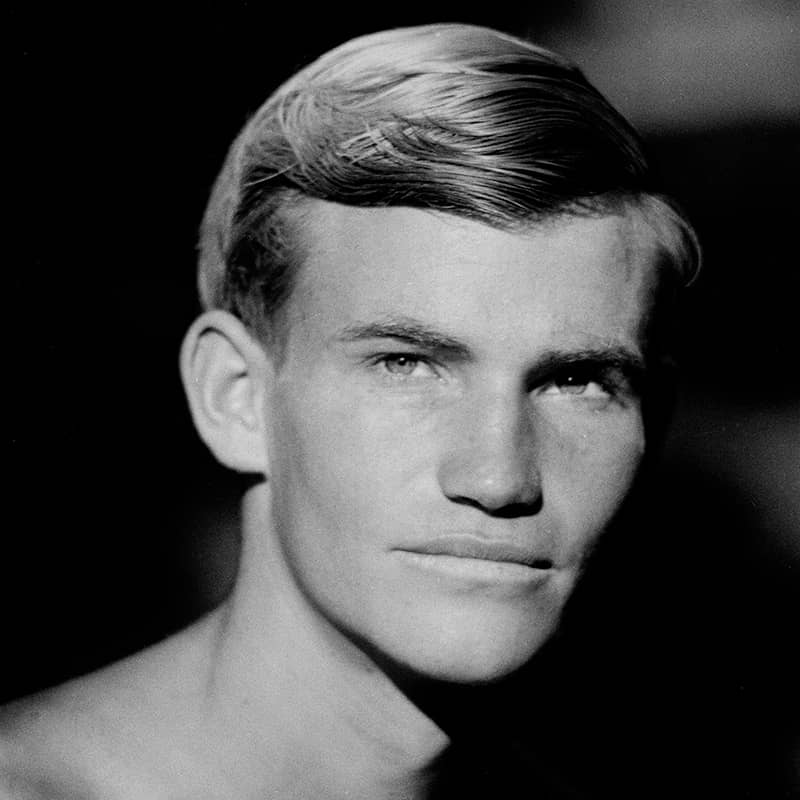
Image courtesy of dukefoundation.org
Jock Sutherland: The North Shore Pioneer Who Stood at the Top of the World and Then Walked Away
He was rated the number one surfer in the world. Surfer magazine had him on the cover. John Severson had built an entire film around him. The North Shore was his proving ground, Pipeline was practically his personal reef, and 1969 was shaping up to be the year that cemented Jock Sutherland as the defining surfer of his generation.
Then he joined the Army.
The story of Jock Sutherland is unlike anything else in Hawaii surf history. It is a story about talent that bordered on supernatural, a relationship with Pipeline that nobody before or since has replicated, and a man who consistently went his own direction no matter what the surf world expected of him.
North Shore Blood, From Day One
Jock Sutherland was born in 1948 in Long Beach, California, but the North Shore shaped him. His family relocated to Haleiwa in the early 1950s, and he learned to surf on one of his father’s old planks before most kids his age had even seen the ocean up close. His father was a World War II Navy officer, a seasoned waterman who fished, kayaked, and surfed. His mother, Audrey Sutherland, became one of the most celebrated sea kayakers in Hawaii, paddling thousands of miles of remote Pacific coastline solo and documenting her journeys in the book Paddling My Own Canoe, published by UH Press.
Water was the family language. Jock just happened to speak it at a frequency most people couldn’t hear.
As a teenager, he shaped his first surfboard in shop class at Washington Intermediate School alongside a classmate named Donald Takayama, who would go on to become one of the most respected shapers in the history of the sport. Sutherland eventually began riding for the Greg Noll team, placing second at the 1965 Makaha International Junior Surfing Championships and again the following year at the Ocean Beach World Contest. At the 1966 World Championships, he stood in the lineup alongside Corky Carroll and a young Nat Young.
Nobody was surprised when he won the Duke Kahanamoku Invitational in 1967. By then, Jock Sutherland was the North Shore.
The King of Pipeline
There is a lineage to Pipeline royalty. Butch Van Artsdalen owned the break first, drawing lines through the barrel that no one else dared to match. After Butch, there was Jock. After Jock, there was Gerry Lopez.
Each of them brought something irreplaceable. What Sutherland brought was controlled aggression at a scale that rewrote what was possible in a tube. He was a switchfoot surfer in an era when that was considered an oddity rather than an asset, and he used it to attack Pipeline from angles nobody had imagined. He stuffed himself deeper into the barrel than his predecessors, holding longer, reading the lip with a precision that felt less like athleticism and more like instinct. Surfing writers struggled to describe what they were watching. Some gave up trying and just pointed a camera at him.
He also incorporated moves that belonged to no established tradition. The sideslip, where the fin breaks free from the wave face and the board slides down before reconnecting, appeared in Sutherland’s repertoire before most surfers understood what they were seeing. He called the tube at Pipeline the Pope’s living room. That quote tells you everything about how he experienced a place that terrified everyone else.
He was not a contest surfer by nature. Competition was a vehicle, not a destination. But even with that attitude he won the Pro Class Trials twice and earned more votes than any other surfer for invitations to the Duke Kahanamoku Classic. His surfing spoke loudly enough on its own terms.
1969: The Year the North Shore Peaked
Ask anyone who was there and they will tell you that 1969 was different. The swells were different, the surfing was different, and the sense that something historic was unfolding was impossible to ignore. Jock Sutherland was at the center of all of it.
John Severson, the founder of Surfer magazine and one of the most influential figures in surf filmmaking, built his landmark film Pacific Vibrations around that winter on the North Shore, with Sutherland as its central figure. Severson’s intention was to time the film’s release to coincide with Surfer magazine naming Sutherland the number one surfer in the world on the Surfer Poll. The plan was deliberate, carefully constructed, and very nearly perfect.
There was one problem. By the time the film came out and the magazine hit newsstands, Jock Sutherland was in basic training.
The Choice Nobody Saw Coming
In 1970, at the absolute peak of his career, Sutherland enlisted in the United States Army. The Vietnam War was at full intensity. The counterculture was in full revolt against the draft. Most of the surf world was moving in the opposite direction. Sutherland went his own.
The story of what happened next has become one of the genuine legends of North Shore surf history. A company commander walked down the street in basic training holding a copy of Surfer magazine with Sutherland on the cover, ranked number one in the world. He walked up to the recruit and asked, “Is this you?” Sutherland confirmed it. From that moment on, he was a marked man in the barracks.
He returned to the North Shore two years later and dove back into the water like he had never left. The Surfer Poll had found him in uniform. The waves didn’t care. Sunset Beach, Pipeline, Waimea — he picked up where he left off, surfing with the same fearlessness that had defined him before he enlisted.
His night session at Waimea Bay became the kind of story that gets told and retold in North Shore lineups for decades. You do not surf Waimea at night. Sutherland surfed Waimea at night.
Jocko’s, the Break That Carries His Name
The break known as Jocko’s sits just off Haleiwa, a freight-train left that peels directly in front of the house where Sutherland grew up. A surf break named after a living legend in his own hometown is a rare kind of honor. In Hawaii, where the culture of surfing runs deeper than any trophy or poll ranking, it is the truest form of recognition.
Sutherland has lived on the North Shore for most of his life. He has worked as a roofer for over four decades. He raised two sons. He has shown up at charity surf events and posed for selfies with anyone who wanted one, always friendly, always willing to talk story. At 74, surfing remains a daily practice. Jocko’s and Pipeline are still his favorite breaks.
In 2022, the Duke Foundation inducted him into the Hawaii Waterman Hall of Fame, a recognition that was long overdue and entirely deserved. His influence on the shortboard revolution, on Pipeline’s history, and on what it meant to approach big Hawaiian surf with genuine creative intent is woven into the DNA of modern surfing even when his name goes unmentioned.
He and longtime friend Gerry Lopez appeared together in Patagonia’s “Talkin’ Pipe” series on YouTube, trading stories about the early days at Pipeline with the ease of two men who survived something most people can only read about.
A Legacy Written in Moving Water
Jock Sutherland did not follow the career arc that surfing laid out for him. He did not chase rankings, build a brand, or leverage his talent into the institutional recognition it deserved while it was most visible. He surfed for himself. He made choices that confused and occasionally frustrated the people around him. And he lived on the North Shore and kept paddling out.
What he left behind is not a trophy case or a competition record. It is something harder to quantify and far more durable. Between Butch Van Artsdalen and Gerry Lopez, there was Jock Sutherland, pushing the boundaries of what Pipeline could be, surfing switchfoot in an era that did not know what to make of him, and carving a line through Hawaiian surf history that no one else could have drawn.
There is a break in Haleiwa with his name on it. That is how Hawaii honors its own.
If you want to go deeper into the North Shore legends who shaped modern surfing, read our profiles on Barry Kanaiaupuni and Buttons Kaluhiokalani. And for the full story of Pipeline itself, explore our Banzai Pipeline surf break guide.
Sources
- Jock Sutherland | Encyclopedia of Surfing
- Jock Sutherland: Soundings | The Surfer’s Journal
- The Legend of Jock-o | The Coast News
- Jock Sutherland | Hawaii Waterman Hall of Fame 2022 | Duke Foundation
- Jock Sutherland Oral History | University of Hawaii at Manoa ScholarSpace
- Sunday Joint: Jock Sutherland | Encyclopedia of Surfing
