History
Olo, Kiko’o, and Alaia: The Boards That Built Hawaiian Surfing
Apr
Long before foam, fiberglass, and fins, Hawaiians were riding waves on boards shaped from solid wood. These were not crude planks. They were carefully designed craft, sized and shaped for different riders, different waves, and different roles in Hawaiian society. The board you rode said something about who you were.
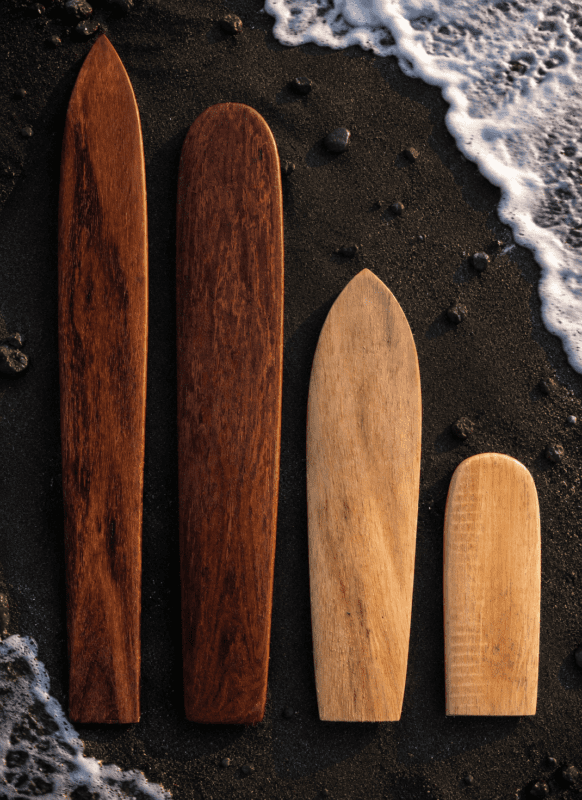
Four main types defined the era: the towering olo, the versatile kiko’o, the everyman alaia, and the little paipo. Here is how each one worked, and why they still matter to the boards we ride today.
The Olo: The Big Board of the Aliʻi
The olo was the giant of the group. These boards ran roughly 16 to 24 feet long and could weigh between 100 and 175 pounds, shaped most often from lightweight wiliwili wood. They were ridden almost exclusively by the aliʻi, the Hawaiian royalty and chiefly class.
A board that size was not built for tight, steep waves. The olo was made for big, rolling, deep-water swells, the kind of wave you catch early and ride on a long, gliding line. Paddling and positioning a board that large took real skill and strength, which was part of the point. Riding an olo well was a display of mastery, and the aliʻi had the time and access to perfect it.
The Kiko’o: The Deep-Water Specialist
The kiko’o sat in the middle, generally 12 to 18 feet long. It is sometimes called the “Duke style” board, and it was built for a specific job: bigger surf breaking in deeper water, further outside.
Less is written about the kiko’o than its siblings, but it filled an important gap. It had enough length and paddle power to chase down larger outside swells, while being more manageable than a full olo. It was a board for confident, capable surfers who wanted to ride beyond the everyday lineup.
The Alaia: The Board of the People
If one board is the ancestor of modern surfing, it is the alaia. Running about 7 to 12 feet long and only around an inch thick, the alaia was carved most often from dense koa, and ridden by commoners and royalty alike. It was the most common and most widely used board in old Hawaii.
What made the alaia special was how it rode. With a rounded nose, a squared tail, and thin, hard rails, the board could bite into the face of a wave and slide sideways at speed, a move Hawaiians called lala. Unlike the big rollers the olo preferred, the alaia came alive on steeper, faster waves. It was quick, responsive, and demanding. Paddling it was hard work, but once you were up and across the face, it rewarded skill in a way the bigger boards could not.
The Paipo: Where Many Surfers Started
The paipo was the smallest of the four, roughly 2 to 5 feet long, ridden prone or on the knees. It was often the board of children, and a natural starting point for learning to read and ride a wave.
Simple as it was, the paipo was a real part of the surfing tradition, and its DNA carries straight through to the bodyboards and paipo revivals you still see in Hawaiian water today.
How the Boards Were Made
These boards were shaped entirely by hand, and building one was a serious undertaking. A shaper selected the right tree, most commonly koa, wiliwili, or ulu (breadfruit), with the lighter wiliwili favored for the royal olo.
The log was split and rough-cut with stone adzes, then shaped down into its rounded nose and squared tail. From there came the long process of smoothing: coral blocks, sand, and finally sharkskin, used like fine sandpaper to bring the surface down clean. The finished board was sealed and treated with kukui nut oil to protect the wood from the sea.
Board making was treated with great care and formality, and a well-made board was a valued possession, looked after and maintained across years of use. Shapers who could produce a fast, reliable board held a respected place in the community.
Why These Boards Still Matter
The line from these wooden boards to the modern surfboard is direct. In the early 20th century, Hawaiian watermen like Duke Kahanamoku carried the surfing tradition to the world, often on large solid-wood boards. Tom Blake later hollowed out the old olo shape to cut weight, and the fin arrived in the 1930s. Fiberglass and foam after World War II finished the transformation into the boards we know now.
But the old shapes never fully went away. Modern shapers like Tom Wegener have revived the alaia using sustainable paulownia wood, chasing that same finless, connected feeling. On the Big Island and beyond, builders continue shaping traditional wooden papa heʻe nalu from Hawaiian wood, keeping the craft alive. The kiko’o lives on in the spirit of today’s versatile mid-lengths, and the olo echoes in the big-wave guns built for spots like Jaws.
Every board in the lineup today traces back to these four. The olo, kiko’o, alaia, and paipo were not just the start of Hawaiian surfing. They were the start of surfing, period.
Want more on the people who carried the craft forward? Read our piece on Dick Brewer, the shaping guru of the North Shore, or explore where these boards were ridden in our Makaha surf break guide.
Sources
- Traditional Ways of Knowing: Surfing in Hawaiʻi (University of Hawaiʻi at Manoa)
- Crafting Papahēʻenalu: From Tree to Sea (Ke Ola Magazine)
- A New Wave for Wooden Surfboards (Maui Magazine)
- The History of Surfboard Design: Alaia (Surf Simply)
- Reflections in Wood: Surfboards and Shapers (SFO Museum)
- Olo board (Wikipedia)
