Apr
Greg Noll paddled out first on the day Waimea Bay stopped being forbidden, built the biggest surfboard factory of the 1960s, rode what a generation called the biggest wave ever attempted — and then walked away from surfing so completely that strangers assumed the story had ended. It hadn’t. When he died in 2021 at 84, every big-wave surfer alive was, in one way or another, working a coastline he had opened.
The Californian Who Kept Coming Back
Noll was born Greg Lawhead in San Diego on February 11, 1937, took his stepfather’s surname, and grew up on the sand in Manhattan Beach — a pier-rat kid who learned to shape under Dale Velzy in the South Bay. At nineteen he was on the US lifeguard team whose Malibu-board demonstrations at Torquay, Australia, are credited with kick-starting modern Australian surfing. By then he had already found his real address: at seventeen he had crossed to Hawaiʻi to finish high school, living in a quonset hut and wintering at Makaha — then the proving ground of big-wave surfing, the break where George Downing‘s generation had worked out the guns and the lines that made riding real size possible. The Hawaiians called visitors like him malihini. Most of them stayed a season. Noll kept coming back for twenty years.
November 1957: Breaking Waimea’s Spell
Waimea Bay carried a kapu no one wanted to test. In December 1943, seventeen-year-old Dickie Cross had paddled out at Sunset with Woody Brown, been caught by a closing swell, swum for Waimea trying to get in, and was never recovered — and for fourteen years afterward, nobody surfed the bay. On a November morning in 1957 — most accounts say the 7th — Noll and Mike Stange paddled out first, with Pat Curren, Mickey Muñoz, and a handful of other Californians close behind, and broke the spell. (History keeps its asterisks: by Matt Warshaw’s account, a Seal Beach lifeguard named Harry Schurch had quietly ridden a few waves alone earlier that same morning.) The session was modest by later standards; the consequence was not. Waimea became big-wave surfing’s arena — the wave that would one day define Eddie Aikau — and Noll had been first off the beach.
Da Bull
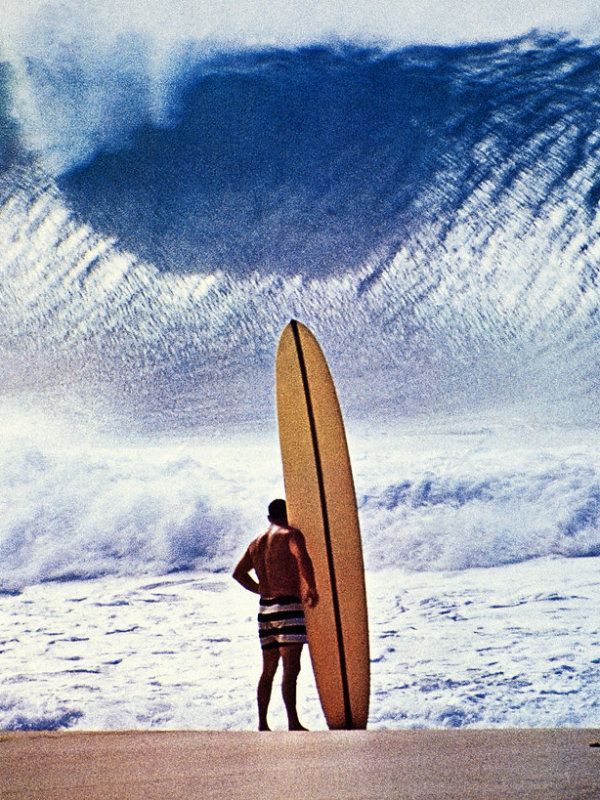
The name came from Phil Edwards, who watched Noll refuse to bail on a doomed wave at Pipeline and told him he was bullheaded enough to be called Da Bull for good. It fit the method: head down, straight lines, no interest in style points, in black-and-white jailhouse-stripe trunks worn deliberately so no photograph could miss him. He kept charging — in November 1964 he and Mike Stange were the first to ride Pipeline’s outside Second Reef. Back in Hermosa Beach he turned Greg Noll Surfboards into an industrial operation — a 20,000-square-foot plant that was the biggest board-building works of its day, turning out some two hundred boards a week, with Miki Dora’s “Da Cat” as its most famous model — and he filled winter auditoriums with five surf films of his own, every one titled Search for Surf. He took his invitations, including a spot among the 24 names at the first Duke Kahanamoku Invitational in 1965, but the contest world Fred Hemmings would soon turn professional was never really his arena. Noll’s competition was the ocean’s ceiling: each winter, the question was whether he would paddle into something bigger than anyone had before.
December 4, 1969
The answer came at Makaha, during the Swell of ’69 — a run of surf so heavy it flooded North Shore living rooms and closed out every break on Oʻahu that mattered. At Makaha’s Point Surf, Noll stroked past the lineup to a place nobody was sitting, waited, and caught a wave witnesses put at thirty to thirty-five feet — for decades simply called the biggest wave anyone had ridden. He made the drop, ran for the flats, and the wave detonated behind him, blowing the board away and handing him a long, ugly swim. The ride was famously never captured — no film, no confirmed photograph, though one filmmaker has long claimed a disputed three-frame sequence — so it lives as the testimony of the people who watched from the beach and the water, including a veteran Makaha lifeguard and old friend who met him on the sand with a cold beer and admitted no rescue would have been coming. Noll said it himself: “That day the monkey was off my back, and my life took a turn.”
Walking Away
The shortboard revolution vaporized the longboard market, and in 1971 Noll closed the factory, left the industry, and moved his family to Crescent City, near the Oregon border, where he fished commercially for salmon for some fifteen years and later ran a sport-fishing boat. No farewell tour, no autograph era — for the better part of two decades the most famous big-wave surfer alive mended nets and worked the water for a living, about as far from the surf business as an American can get without leaving the coast. In a sport that has never been short on self-promotion, the disappearing act became its own kind of legend.
The Long Second Act
The story came back around. His 1989 memoir, Da Bull: Life Over the Edge, written with Andrea Gabbard, put the voice on record — profane, funny, generous. In his workshop he began hand-building museum-grade replicas of old Hawaiian boards, planks and guns finished like furniture, and the collector world beat a path to Crescent City. Stacy Peralta’s 2004 documentary Riding Giants introduced him to a generation that had never seen the trunks, and his son Jed carried the family name back into shaping. Noll died in Crescent City on June 28, 2021, at 84.
Da Bull’s Place in Hawaiian Surf History
Noll was not Hawaiian, and he never pretended otherwise. His place in Hawaiʻi’s surf history is the one he earned in the water: he treated the islands’ biggest waves as the sport’s true measure, apprenticed at Makaha in the tradition of the men who invented big-wave riding, and kicked open the door at Waimea that every charger since — from Eddie Aikau to Mark Foo to the tow crews of today — has walked through. The measure of December 4, 1969 isn’t the exact height of a wave nobody photographed. It’s that for thirty years, when surfers argued about the outer limit of what was possible, the argument started with Greg Noll.
Frequently Asked Questions
Who was Greg Noll?
Greg Noll (1937–2021), nicknamed “Da Bull,” was a pioneering big-wave surfer, surfboard manufacturer, and filmmaker. He was in the first group to surf Waimea Bay in 1957 and rode the famous 1969 Makaha wave long considered the biggest ever ridden.
What happened at Makaha on December 4, 1969?
During the “Swell of ’69,” Noll caught a wave at Makaha’s Point Surf that witnesses estimated at thirty feet or more — widely called the biggest wave ridden to that point. He straightened out ahead of the whitewater and swam in. It was effectively his last big-wave ride.
Is there a photo of the 1969 wave?
No confirmed one. No film exists, and while one filmmaker has long claimed a brief, disputed frame sequence, the ride’s size rests on witness accounts — which is part of why it became legend.
How did Greg Noll die?
Noll died of natural causes on June 28, 2021, in Crescent City, California, at age 84.
Why was Greg Noll called “Da Bull”?
Phil Edwards coined it after watching Noll bullheadedly refuse to bail on a hopeless wave at Pipeline. It stuck because it described everything: the build, the charging style, the refusal to turn around.
Sources
- Encyclopedia of Surfing: Greg Noll
- The Washington Post: Legendary big-wave surfer Greg “Da Bull” Noll dies at 84
- Surfline: R.I.P. Greg Noll, 1937–2021
- Brian Tissot: Unbounded Courage — the First Surfers to Ride Waimea Bay
- Brian Tissot: The Biggest Wave Ever Ridden — Greg Noll at Makaha, 1969
- California Surf Museum: The Legendary Greg Noll
Related Reading
- Waimea Bay Surf Break Guide
- Makaha Surf Break Guide
- George Downing: The Man Who Decided If The Eddie Ran
- Eddie Aikau: The Legendary Waterman
- Mark Foo: The Life and Legacy of a Big-Wave Icon
Last updated: July 18, 2026
Get the next story by email.
