Legends
Mark Foo — The Life, Legacy, and Tragic Death of a Big-Wave Surfing Icon
Sep
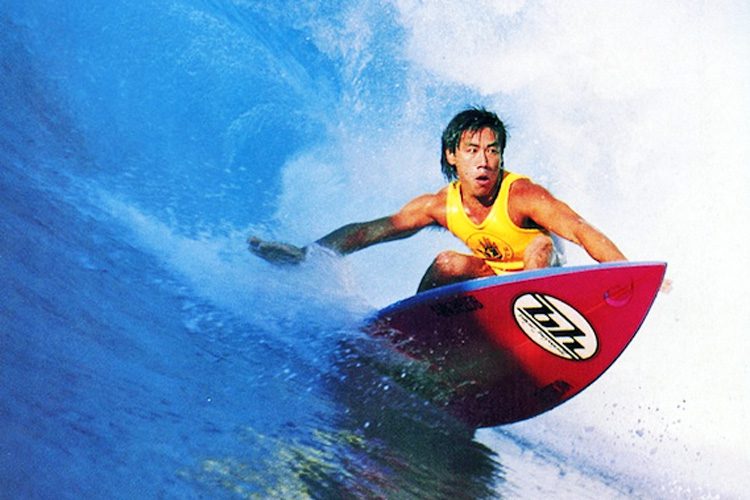
Image courtesy of KHON2
Mark Foo: The Life and Death of a Big-Wave Icon
Mark Foo died on a wave that was not especially big.
That is the detail people forget, and it is the one that matters. On December 23, 1994, at a cold, grey reef break called Mavericks, half a mile out from Half Moon Bay in Northern California, the most famous big-wave surfer of his generation took a routine wipeout on an ordinary set wave and never came up. He was thirty-six. Nobody in the water noticed. His body was found more than two hours later, floating in the lagoon behind the harbour, still tied to the broken tail of his board.
Foo had spent fifteen years arguing, in print and on camera, that the risk was the point. He had built an entire public identity on facing it. And then the ocean took him almost casually, on a day he would not have bothered to mention.
Early Life: Singapore, the Mainland, and Hawaii
Mark Sheldon Foo was born in Singapore on February 5, 1958. His parents, Charlie and Lorna Foo, were Chinese photojournalists who worked for the United States Information Agency, and the job moved the family around.
They came to Hawaii when Mark was ten, and he spent his early childhood surfing the south shore of Oahu. But the family moved several times through his adolescence, including stretches on the mainland, and he did not come back to Hawaii for good until just before he finished high school. He graduated from President Theodore Roosevelt High School in Honolulu in 1975 — the same school that produced Sammy “Steamboat” Mokuahi a generation earlier — and spent two years at the University of Hawaii.
This matters more than it might seem. Foo was Hawaiian by upbringing and by choice, but he was not of the old North Shore families. He arrived as something of an outsider and he had to make his own way in a lineup that did not hand out places. Some of the relentless self-promotion he was later criticised for makes more sense in that light.
The Professional Years
Foo joined the IPS world tour in 1977 and competed for a few seasons without ever threatening the top. In the early 1980s he quit the tour altogether, and it turned out to be the most important decision of his career. Contest surfing was not what he was for.
He first surfed Waimea Bay in 1983 and found the thing he had been looking for. Over the next decade he became one of the defining figures of the big-wave era, a fixture at Waimea and at Sunset Beach, paddling out on mornings when most of the North Shore stayed on the sand.
He also, crucially, knew how to talk about it. Foo was articulate, quotable, and completely unembarrassed about wanting an audience. He worked in surf media, he did television commentary, he gave interviews that other surfers of his era would have mumbled through. He ran a hostel in Pupukea called Backpackers Hawaii. He understood, well before the sport did, that big-wave surfing was a spectacle and that spectacles need narrators.
Not everyone loved him for it. The traditionalists thought he was a self-publicist trading on other men’s ocean. His long, sharp rivalry with Waimea hellman Ken Bradshaw became one of the defining feuds of the era, and it was later chronicled in Andy Martin’s book Stealing the Wave.
January 18, 1986: The Wave That Made Him
On January 18, 1986, Waimea Bay broke on a scale it very rarely reaches, with faces reported in excess of sixty feet. Foo paddled out. He took a wave, was destroyed by it, and had to be plucked out of the impact zone by helicopter. He came up unharmed.
Then he wrote the story up and sent it to the surf magazines.
That, in a sentence, is Mark Foo. The courage was real and so was the appetite for the byline, and he never saw any contradiction between the two. He wanted big-wave surfing to matter to people who had never seen a wave, and he was willing to be the one standing in front of the camera to make that happen.
How Did Mark Foo Die? The Truth About Mavericks
By the early 1990s word had got out about Mavericks, a heavy, cold, shark-haunted slab breaking over a reef off Pillar Point in Northern California. It had been surfed almost entirely alone by a local named Jeff Clark, who rode it by himself for roughly fifteen years before anyone would take him seriously. When the rest of the surf world finally arrived, Foo arrived with it.
On December 22, 1994, a big swell was forecast. Foo took a red-eye from Honolulu, landed in California in the morning, and went more or less straight to the water. He had barely slept.
Conditions on December 23 were solid but unremarkable by his standards: waves in the region of eighteen to twenty feet on the Hawaiian scale. There were photographers on the cliff, a film crew, and a lineup full of good surfers.
Foo took off on a wave, appeared to catch a rail, and fell. It was, by every account of the people who saw it, an entirely ordinary wipeout. Mike Parsons wiped out on the wave behind him and later said he had struck something underwater on the way through.
Nobody counted Foo out of the lineup. On a day like that, a surfer who disappears is assumed to have swum in, and the sets kept coming. It was more than two hours before his body was found, drifting in the lagoon inside the harbour, still leashed to a piece of his snapped board.
The coroner recorded the cause of death as saltwater drowning with blunt head trauma. The leading theory, and it remains a theory rather than an established fact, is that his leash snagged on the rocks of the reef and held him down while the next wave passed over the top, leaving him unable to reach his ankle strap.
What is not in dispute is the awful ordinariness of it. Mark Foo did not die on a monster. He died in a crowd, on a mid-size day, in water he had flown all night to reach, and it took the surf world two hours to notice he was gone.
“It’s Not Tragic to Die Doing Something You Love”
Foo said it years before Mavericks, and it followed him into every obituary that was written about him.
“It’s not tragic to die doing something you love.”
A second line — “if you don’t live for something, you’ll die for nothing” — is also widely attached to his name, though the attribution is contested and it may not be his at all. Either way, the sentiment stuck, because it was so obviously how he had chosen to live.
It is worth saying plainly that a quote is not a justification, and the people who loved him did not find his death any less of a loss for his having predicted it. But he had thought harder about the risk than almost anyone else in the water, and he had made his peace with it out loud, in public, on the record. Very few people get to do that.
The Legacy
His funeral was held on December 30, 1994. More than seven hundred people came, and around a hundred and fifty surfers paddled out at Waimea Bay and formed a circle on the water.
His death changed the sport in three concrete ways.
It made Mavericks famous. The wave went from a rumour to the most talked-about big-wave arena in the world, essentially overnight, for the worst possible reason.
It forced a reckoning with safety. The leash that probably killed him started an argument about big-wave equipment that has never really stopped, and the era that followed brought jet-ski water patrol, inflatable vests, and proper rescue protocol into the lineup as standard. Surfers who ride giant waves today are alive because of arguments that started with Mark Foo.
And it settled the question he had spent his life asking. Foo wanted the world to understand that big-wave surfing was serious, that it was not a stunt, and that the ocean was genuinely capable of killing the best in it. He proved it in the only way that was ever going to be believed, and he did not get to see it land.
He appears in the film Riding Giants, still talking, still explaining, still trying to make you understand what it is like out there.
Questions About Mark Foo
How did Mark Foo die?
He drowned at Mavericks in Northern California on December 23, 1994, after a routine wipeout. The coroner recorded saltwater drowning and blunt head trauma. The leading theory is that his leash snagged on the reef and held him underwater.
How big were the waves the day Mark Foo died?
Around eighteen to twenty feet on the Hawaiian scale. Solid, but nowhere near the biggest surf he had ridden. He had taken far heavier waves at Waimea Bay.
How long before anyone realised he was missing?
More than two hours. He was found in the lagoon behind Pillar Point harbour, still attached to the broken tail of his board.
Was Mark Foo Hawaiian?
He was born in Singapore on February 5, 1958, to Chinese parents, and moved to Hawaii at ten. He was raised and made his name in Hawaii, and graduated from Roosevelt High School in Honolulu.
Who discovered Mavericks?
Jeff Clark, a local from Half Moon Bay, who surfed it almost entirely alone for about fifteen years before the wider surf world arrived. Foo was one of the visitors who came once word spread.
Sources and Further Reading
- Mark Foo — Wikipedia
- Mark Foo — Encyclopedia of Surfing
- Surfer: 30 Years After His Death at Mavericks
- Surfer: Remembering Mark Foo
Related Reading:
- Waimea Bay Surf Break Guide
- Sunset Beach Surf Break Guide
- George Downing: The Man Who Decided If The Eddie Ran
- Greg Noll’s Legendary Makaha Wave
- The History of Surfing in Hawaii
Last Updated: July 2026
