
Feb
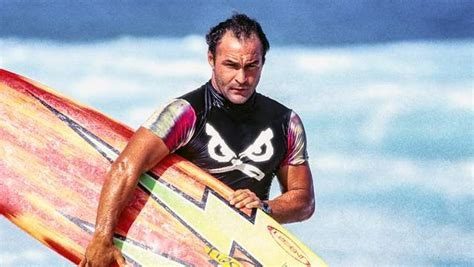
Image courtesy of eos.surf
Johnny Boy Gomes: The Pipeline Master Who Defined Power Surfing
From troubled youth to North Shore legend, the story of Hawaii’s most feared and respected power surfer
The Enforcer of the North Shore
In the late 1980s and throughout the 1990s, no presence commanded more respect and fear on Hawaii’s North Shore than Johnny Boy Gomes. At 5’9″ and 200 pounds of pure muscle, Gomes didn’t just surf Pipeline. He dominated it with a ferocity and power that redefined what was possible on the world’s most dangerous wave.
Born in 1965 in Makaha, on Oahu’s rugged West Side, Johnny Boy Gomes became the epitome of Hawaiian power surfing during an era when local pride and ocean mastery meant everything. His story is one of redemption, raw talent, and an uncompromising approach to both life and waves that made him a legend in Hawaiian surf culture.
While his competitive achievements include the prestigious 1997 Pipeline Masters title and the 1993 World Cup at Sunset Beach, Gomes’s true legacy lies in his fearless approach to big, hollow waves and his status as perhaps the greatest freesurfer Hawaii has ever produced.
What is Power Surfing?
Power surfing represents a distinct approach to riding waves that prioritizes explosive force, aggressive turns, and complete mastery of the wave’s most critical sections. Unlike the smooth, flowing style of soul surfing or the aerial acrobatics of modern progressive surfing, power surfing is about raw strength and precision.
The Power Surfing Style
Power surfers are characterized by:
Low, compressed stance that maximizes leverage and control
Explosive bottom turns that generate massive speed
Vertical attacks on the lip executed with brutal force
Deep barrel riding in the most critical part of the wave
Complete wave domination rather than just riding
Johnny Boy Gomes exemplified this style to perfection. Surf historian Matt Warshaw described his surfing with unforgettable imagery, saying that watching Gomes at Backdoor was like witnessing “Darth Vader eating raw dinosaur leg during a 9.2 magnitude earthquake.” The comparison captured Gomes’s near-superhuman strength and the sheer force he brought to every wave.
The Hawaiian Power Tradition
Power surfing has deep roots in Hawaiian culture. The tradition stretches from legendary watermen through pioneers like Dane Kealoha, who refined the low, compressed style in the late 1970s and early 1980s. Kealoha became Gomes’s mentor, and the younger surfer absorbed and amplified the template, riding “in a tightly clenched weightlifter’s squat, with a ramrod straight back, leveraging his board into one massive turn after the other.”
This approach suited the demanding conditions of Hawaii’s North Shore perfectly, where waves break with tremendous power over shallow reefs and only the strongest, most committed surfers survive.
A Troubled Makaha Childhood
Johnny Boy Gomes’s early life was marked by instability and hardship that would have broken many people. Growing up in Makaha and Waianae, two of Oahu’s roughest communities, Gomes faced challenges from the very beginning.
Running Wild
His parents separated when he was just six years old, and young Johnny was often left to fend for himself. The late Rell Sunn, the legendary “Queen of Makaha,” remembered the young Gomes with a mixture of affection and concern. She called him “the borrow boy” because the kid had to borrow everything: shorts, surfboards, wax, even a safety pin to hold up his pants. He was essentially an orphan, running wild and surviving on junk food.
Despite these circumstances, or perhaps because of them, Gomes found solace in the ocean. He started surfing at age six and quickly developed skills that marked him as special. The waves became both escape and salvation.
Juvenile Detention and Loss
At age 12, Gomes was arrested on theft charges and sent to juvenile detention. Two years later, tragedy struck when his mother died of breast cancer, followed shortly by his father’s death from diabetes. At 14 years old, Johnny Boy Gomes was an orphan with a criminal record and an uncertain future.
His salvation came from an unlikely source. Israel Kamakawiwoʻole, the legendary Hawaiian singer who was only 19 at the time, lived in Makaha and took notice of the troubled but talented young surfer. Known to the world as “Iz,” Kamakawiwoʻole adopted Gomes, hoping to provide the stability the fiery teenager desperately needed.
The Turning Point
Despite Iz’s best efforts, Gomes was arrested again at 16 for theft and served another 14 months in detention. But this second stint proved transformative. Behind bars, Gomes made a decision that would change his life. He committed to dedicating himself completely to surfing, the one thing he was truly good at, the one arena where he felt he belonged.
When he was released on his 18th birthday, Johnny Boy Gomes was ready to prove himself on the North Shore.
Rising Through the North Shore Ranks
Fresh out of detention and burning with determination, Gomes headed straight for Hawaii’s North Shore, the traditional proving ground for serious surfers. What he accomplished in the following years would cement his reputation as one of the most fearless and talented big wave surfers of his generation.
Pipeline Mastery
Throughout the late 1980s, Gomes established himself at Pipeline and Backdoor, the twin barrels that define North Shore surfing. He didn’t just ride these waves. He attacked them with a fury that seemed to channel all the frustration and pain of his difficult childhood into explosive, powerful surfing.
At proper Pipeline, he threaded massive barrels with complete confidence. At Backdoor, the even more challenging right-breaking wave, he demonstrated technical mastery that few could match. He met power with power, leveraging his muscular frame and low center of gravity to control waves that broke with terrifying force over razor-sharp reef.
The Highest Praise
Dane Kealoha, the power surfing pioneer who had mentored Gomes, offered what might be the ultimate compliment a surfer can receive in Hawaii. He declared Johnny Boy “the best freesurfer I’ve ever seen in Hawaii.” Coming from Kealoha, this wasn’t casual praise. It was recognition that Gomes had not only mastered the template but had pushed power surfing to new heights.
Freesurfing, surfing purely for the love and challenge rather than competition, was where Gomes truly shined. He could turn on performances in contests when conditions suited him, but his real genius emerged when he had complete freedom to attack waves on his own terms.
Competitive Career and Breakthrough
While Gomes’s contest results were admittedly hit and miss throughout his career, he achieved several victories that demonstrated his world-class ability when conditions aligned with his strengths.
The 1993 World Cup at Sunset
Gomes’s first major competitive victory came at the 1993 World Cup at Sunset Beach, one of the North Shore’s most powerful and challenging waves. Sunset’s huge, shifty bowls suited his aggressive approach perfectly. The win announced that Johnny Boy wasn’t just a freesurfer. He could deliver when it counted.
The Legendary 1997 Pipeline Masters
The crowning achievement of Gomes’s competitive career came in December 1997 at the Pipeline Masters, surfing’s most prestigious event. At 32 years old, facing debilitating injuries and carrying a reputation as one of Hawaii’s most savage enforcers, Gomes entered the event from the trials, meaning he had to qualify his way into the main draw.
What followed was three days of surfing that bordered on the miraculous. Gomes charged every heaving barrel he could find at both Pipeline and Backdoor, emerging from tubes that left spectators gasping. In the second round, he faced Kelly Slater, who had won four Pipeline Masters in recent years and had just clinched his fifth straight world title.
The heat was decisive. “Johnny Boy just surfed better,” Slater acknowledged afterward, adding prophetically, “This is his year, his time.”
In the final, with darkness approaching and the waves finally showing proper Pipeline form, Gomes delivered a masterclass. He became the first surfer in history to win the Pipeline Masters after coming through the trials, a feat that still stands as one of the event’s most remarkable achievements.
On the beach after his victory, Gomes was transformed. Gone was the menacing enforcer. Instead, he displayed grace and emotion, paying tribute to recently deceased Hawaiian figures in the surfing and music communities. Even Slater recognized the significance, sitting in the channel during Gomes’s victory ride to let the Hawaiian champion soak up every moment of spectator and media attention.
Other Major Results
Gomes continued proving his big wave credentials with additional achievements:
The 1999 Backdoor Shootout championship, which came with the biggest winner’s check in surfing at that time ($50,000)
Third place in the 1999 Quiksilver In Memory of Eddie Aikau, surfing’s most prestigious big wave invitational
Sixth place in the 2002 Eddie Aikau event
Countless magazine spreads documenting his fearless approach to Hawaii’s most dangerous waves
His competitive record, while selective, demonstrated that when waves got serious and conditions suited power surfing, few could match Johnny Boy Gomes.
The Fearsome Reputation
While Gomes’s surfing ability earned respect, his reputation for violence and enforcement created fear throughout the surfing world. During the 1980s and 1990s, he became known as the North Shore’s most terrifying presence, someone who would not hesitate to use physical force to maintain local control of the lineup.
The Enforcer
Australian surf journalist Tim Baker captured the duality of Gomes’s reputation in a 1993 article for Australia’s Surfing Life magazine. Baker acknowledged that the muscular Hawaiian was “outrageously talented” before noting that he had also “soured more surf sessions for more people than any surfer alive.”
Gomes swaggered menacingly up and down North Shore beaches, his presence alone enough to intimidate visiting surfers regardless of their credentials or home breaks. In the lineups at Pipeline, Backdoor, Rocky Point, and other Seven Mile Miracle breaks, he cultivated a hard-earned reputation for unpredictable violence.
Documented Incidents
Several high-profile altercations marked Gomes’s career:
In 1991, the ASP (now World Surf League) fined him $1,000 for slapping fellow competitor Shane Herring during a heat at Sunset Beach
Two years later, he slapped professional surfer Jodie Cooper off her board during an altercation at Ehukai
In 1999, Gomes was arrested for assaulting a man at Chun’s Reef
As recently as 2015, he was arrested again after a fight in the surf at Waikiki, where he allegedly held a man’s head underwater during a dispute
These incidents reinforced his image as someone whose temper could explode without warning, making him a figure of genuine fear in Hawaiian lineups.
The Context of Localism
To understand Gomes’s enforcement role requires understanding the context of North Shore localism in the 1980s and 1990s. Hawaiian surfers watched as their home breaks became increasingly crowded with visitors and professional surfers from around the world, many of whom showed little respect for local culture or wave-riding hierarchy.
For locals like Gomes, enforcement wasn’t just about controlling waves. It represented resistance against the commercialization and colonization of Hawaiian surf culture. The physical confrontations, while controversial, were part of a broader assertion of Hawaiian sovereignty over their own waters.
This doesn’t excuse violence, but it provides important cultural context for why Gomes and other enforcers saw themselves as protectors of Hawaiian surfing traditions against outside exploitation.
Surfing Style and Technical Mastery
Beyond reputation and results, Johnny Boy Gomes will be remembered for a surfing style that redefined what was possible in powerful, hollow waves.
The Physical Approach
At 5’9″ and 200 pounds, Gomes was built like a compact bulldozer. His physique wasn’t just muscular; it represented years of conditioning specifically for riding the most powerful waves on earth. His low center of gravity gave him stability in situations that would throw other surfers, while his strength allowed him to muscle boards through sections that required brute force.
He rode in a tightly compressed stance, back ramrod straight, legs bent deep in a weightlifter’s squat. This position maximized his ability to leverage the board through massive turns, using his entire body weight and core strength to redirect thousands of pounds of moving water.
Tube Riding Mastery
Gomes’s barrel riding at Pipeline and Backdoor became legendary. He positioned himself deeper than almost anyone, tucking into sections where the lip was already throwing over his head. While other surfers might try to outrun closing sections, Gomes would pull in deeper, trusting his speed and positioning to carry him through.
His confidence came from intimate knowledge of these waves. He understood exactly where to be and when, reading subtle changes in the wave face that indicated whether a section would stay open or close out. This knowledge, combined with his fearlessness, allowed him to get barrels that seemed impossible.
Power Turns and Innovation
When not in the tube, Gomes attacked the wave face with devastating turns. His bottom turns generated massive speed, setting up vertical attacks on the lip that would shake the entire wave. He could redirect his board with shocking speed despite his size, executing critical maneuvers in the pocket while maintaining complete control.
While deeply rooted in Hawaiian power tradition, Gomes also pushed the boundaries of what power surfing could be. He added progression and modern techniques to the fundamental template, helping evolve the style for a new generation while maintaining its essential character.
Life Beyond Competition
As Gomes aged out of his competitive prime, his life took various turns, some positive and some challenging.
The Struggles Continue
When his professional career wound down, so did the sponsorship money. Gomes faced financial difficulties and fell into unhealthy habits. He has spoken openly about this period as his worst moment, revealing that at one point he had to sell his Pipeline Masters trophy just to make ends meet.
The pattern of legal troubles also continued periodically, suggesting that while Gomes had channeled his aggression into surfing brilliance, he still struggled with anger management and the trauma of his difficult childhood.
Redemption and Health Transformation
In recent years, Gomes has undergone a remarkable transformation. He reclaimed his Pipeline Masters trophy and committed himself to health and fitness with the same intensity he once brought to surfing.
Rising at 4 AM to work out, adopting a healthy lifestyle, and losing 45 kilograms (nearly 100 pounds), Gomes rebuilt himself physically and mentally. On social media, he shares positive messages about health, discipline, and personal responsibility, repeatedly emphasizing that “there are no excuses, only results” and “your health is your wealth.”
He celebrates being the “CEO of his life” and expresses gratitude for a loving family. Photos show a transformed Gomes, slimmer and fitter than he was during his competitive years, though proudly bald where he once had flowing hair.
Grandfather and Elder Statesman
Now in his late 50s, Gomes has become a grandfather and something of an elder statesman in Hawaiian surfing. While still outspoken on social media about surf politics and industry issues, he has mellowed from the terrifying enforcer of the 1990s into someone who can celebrate his achievements and encourage others.
His transformation demonstrates that redemption is possible, that people can overcome difficult childhoods and self-destructive patterns to build better lives.
Legacy and Influence
Johnny Boy Gomes’s impact on surfing extends far beyond his competitive results or even his legendary status at Pipeline.
Defining Power Surfing
Gomes represents perhaps the ultimate expression of Hawaiian power surfing. While Dane Kealoha established the template and others like Sunny Garcia, Pancho Sullivan, and current chargers like Zeke Lau have carried it forward, Gomes brought a level of pure, explosive force that remains unmatched.
Surf historian Matt Warshaw’s description of Gomes’s power being beyond comparison (stronger than “Darth Vader eating raw dinosaur leg during a 9.2 magnitude earthquake”) isn’t mere hyperbole. It captures how Gomes pushed the physical limits of what was considered possible on a surfboard.
Young power surfers still study footage of Gomes at Backdoor and Pipeline, learning from his positioning, his commitment, and his ability to generate and control massive amounts of force.
Cultural Significance
As a Hawaiian surfer who fiercely defended local waves against outside exploitation, Gomes represents an important chapter in the ongoing story of Hawaiian surf culture. His enforcement role, while controversial, was part of Hawaiian resistance to commercialization and cultural appropriation.
His adoption by Israel Kamakawiwoʻole also links him to broader Hawaiian cultural renaissance. Iz’s music helped revive interest in Hawaiian language and traditions, and his choice to adopt the troubled young surfer demonstrated the Hawaiian value of ohana (family) extending beyond blood relations.
The Complicated Hero
Gomes’s legacy is complicated. He was simultaneously a brilliant athlete and a violent enforcer, a troubled youth who found redemption and someone who continued struggling with anger and legal issues into middle age. He represents triumph over adversity while also showing how trauma can mark people for life.
This complexity makes him more interesting and ultimately more human than one-dimensional heroes. His story reminds us that greatness in one arena doesn’t require perfection in all areas, and that people can be both inspiring and flawed.
The 1997 Pipeline Masters Controversy
In recent years, Gomes has spoken out about what he perceives as disrespect from the World Surf League toward his historic 1997 Pipeline Masters victory.
The Snub
In 2022, when the WSL compiled a list of the greatest Pipeline Masters performances, they excluded Gomes’s 1997 victory. For someone who had become the first and only surfer to win the event after coming through the trials, who had beaten Kelly Slater in his prime on one of surfing’s biggest stages, the omission stung.
“I’ve been keeping this in for a long time because I wanted to be cool and humble for my ohana, but now I’m speaking my mind and the truth,” Gomes wrote on social media. “I can’t believe I’m the first guy in surfing history to make it from the trials to win it and still WSL didn’t even pick it as their top past Pipeline Masters winners list.”
He suggested, half-seriously, that “Kelly and WSL burned the ’97 Pipeline Masters tape,” expressing frustration that his achievement had been seemingly erased from official recognition.
The Call for Recognition
Gomes called for the WSL to offer him a wildcard entry or heritage heat at Pipeline, an opportunity to demonstrate that his skills and knowledge of the wave remain relevant even at nearly 60 years old. The request reflects both pride in his accomplishments and frustration at being overlooked by the modern surf industry.
The controversy highlights broader issues about how surfing history is remembered and celebrated, and who gets to control that narrative.
Lessons from Johnny Boy
Despite his complicated legacy, there are valuable lessons to draw from Gomes’s life and career.
Channeling Adversity
Gomes demonstrated that difficult circumstances don’t have to define you. He took the anger and pain from his childhood and channeled it into becoming one of the greatest big wave surfers ever. While his methods weren’t always positive, his ability to transform trauma into excellence offers inspiration.
Authenticity Over Perfection
Gomes never tried to be anything other than who he was. He didn’t soften his image or apologize for his intensity. This authenticity, while sometimes problematic, also made him real in ways that carefully managed professional athletes often aren’t.
The Power of Commitment
Whether committing to a wave, to fitness, or to rebuilding his life, Gomes has shown what complete dedication can achieve. His recent health transformation at nearly 60 years old demonstrates that commitment can create change at any age.
Cultural Pride
Gomes’s fierce protection of Hawaiian waves and culture, even through controversial means, reflected deep pride in his heritage. That pride and the willingness to stand up for what matters, even at personal cost, remains admirable.
Visiting Hawaii’s Power Surfing Spots
Modern surfers can visit the waves where Johnny Boy Gomes forged his legend, though they should approach with appropriate respect and caution.
Pipeline and Backdoor
The twin barrels of Pipeline (left) and Backdoor (right) remain the ultimate test of big wave tube riding. These waves break over extremely shallow reef with tremendous power, making them suitable only for expert surfers with solid big wave experience.
Visiting surfers should understand that Pipeline maintains strong local culture. Respect, patience, and appropriate skill level are essential. Watch sessions before paddling out, understand the hierarchy, and never drop in or snake waves from locals.
Sunset Beach
Gomes’s 1993 World Cup victory came at Sunset, one of the North Shore’s most challenging and shifty big waves. Sunset rewards power surfing, with massive walls and shifting peaks that demand strength, positioning, and wave knowledge.
The wave is somewhat more approachable than Pipeline for experienced surfers, but still requires significant skill and ocean knowledge.
West Side Heritage
For those interested in Gomes’s roots, visiting Makaha on Oahu’s West Side offers connection to where his story began. Makaha Beach, where the young “borrow boy” learned to surf, still produces quality waves and maintains strong local culture.
Approaching the West Side requires respect and cultural sensitivity. This is not a tourist area but rather a community with deep Hawaiian heritage and legitimate grievances about outside exploitation.
The Power Surfing Legacy Today
Johnny Boy Gomes’s influence continues shaping how surfers approach powerful, hollow waves.
Modern Power Surfers
Current Hawaiian chargers like Zeke Lau, Nathan Florence, and others carry forward the power surfing tradition that Gomes exemplified. They combine the fundamental low, compressed stance and explosive turns with modern progressive elements, evolving the style while maintaining its essence.
The Eternal Appeal
In an era when aerial surfing and progressive maneuvers dominate professional competition, power surfing remains deeply respected, especially in Hawaii. There’s something primal and beautiful about a surfer meeting a powerful wave with equal force, controlling thousands of pounds of moving water through strength and skill.
Gomes demonstrated that power surfing at its highest level is as spectacular and worthy of respect as any other approach to riding waves.
Why Johnny Boy Gomes Matters
Johnny Boy Gomes matters because his story is fundamentally human. It’s about someone dealt a terrible hand in childhood who found salvation in the ocean and became extraordinary at what he loved. It’s about the complications that come with that journey, the ways trauma marks us, and the possibility of transformation even late in life.
His surfing pushed the boundaries of what was possible in the most challenging conditions. His fierce defense of Hawaiian waves, while controversial, represented important cultural resistance. His willingness to acknowledge struggles and share his transformation offers hope to others facing similar battles.
Most importantly, Gomes reminds us that greatness comes in complicated packages, that heroes can be flawed, and that the most interesting stories are rarely simple.
The Enforcer, The Master, The Survivor
William “Johnny Boy” Gomes earned his place in Hawaiian surf history not through popularity or perfect behavior, but through undeniable talent, fearless commitment, and complex humanity. From troubled Makaha youth to Pipeline Master, from feared enforcer to health advocate and grandfather, his journey encompasses triumph, struggle, and ongoing transformation.
The next time you watch footage of Pipeline barrels or witness a power surfer attacking a wave with explosive force, remember Johnny Boy Gomes. Remember the kid who borrowed everything but gave everything to the waves that saved him. Remember the enforcer who protected Hawaiian waters with fierce intensity. Remember the champion who proved that talent and determination can overcome the worst circumstances.
And remember that behind every legendary surfer is a human story of complexity, struggle, and the endless pursuit of that perfect wave.
Experience the power and beauty of Hawaii’s legendary surf breaks. Book a North Shore surf tour and witness where legends like Johnny Boy Gomes forged their reputations in the world’s most challenging waves.
Sources
- SURFER Magazine: From the Archive – The Ballad of Johnny Boy Gomes
- Encyclopedia of Surfing: Johnny Boy Gomes
- SF Gate: Taking Back The Surf – Locals Master The Pipeline
- Stab Magazine: Johnny Boy Gomes Profile
- BeachGrit: Johnny Boy Gomes and Power Surfing
- Duke Surf: The Example of Johnny Boy Gomes
- Honolulu Star-Bulletin: Israel Kamakawiwoʻole Obituary
