
Informational, Surf Break Series
Velzyland Surf Break Guide: V-Land on Oahu’s North Shore | Hawaii Surf
Feb
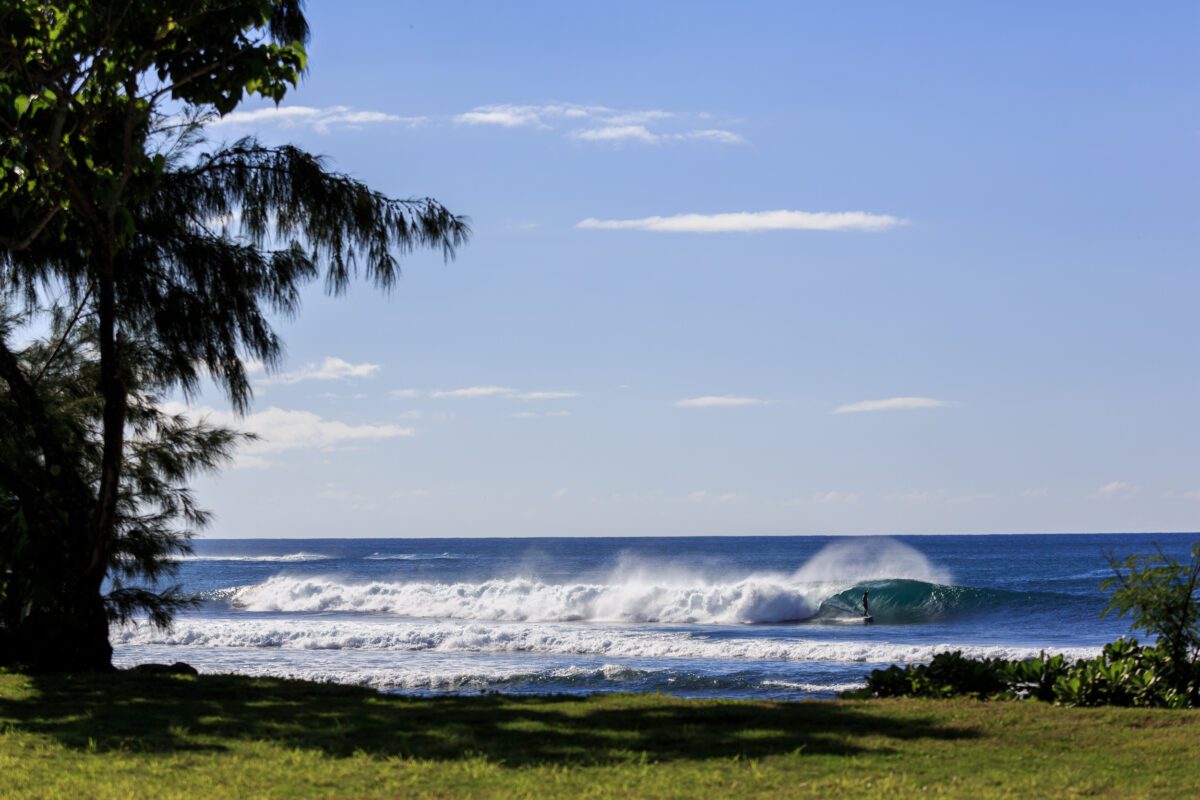
Image courtesy of surfline.com
Velzyland Surf Break Guide: The North Shore’s Best-Kept Secret on Oahu
Picture this: It’s a crisp November morning on Oahu’s North Shore. The air smells like salt and possibility. You hike a scrubby trail through ironwood trees, and suddenly the ocean opens up — a compact, shimmering bay where a perfectly hollow right-hander peels across a shallow lava ledge. A pack of grom kids from the neighborhood scratches for the peak, laughing and hooting. A few older locals sit deep, reading the sets like pages of a familiar book. Welcome to Velzyland — V-Land to those who love it — one of the North Shore’s most treasured and underrated surf breaks.
While Pipeline commands the cameras and Sunset attracts the big-wave warriors, Velzyland holds a different kind of power. It’s a neighborhood wave, a training ground, and a proving ground. On its best days, it serves up some of the most perfectly formed barrels on the island. Bruce Brown named this compact reef break in the late 1950s in honor of California surfboard pioneer Dale Velzy. Since then, it has shaped generations of Hawaii’s finest surfers — from Larry Bertlemann and Buttons Kaluhiokalani to Coco and Mason Ho. This guide covers everything you need to know about V-Land: its history, wave mechanics, ideal conditions, the unspoken rules of the lineup, and how to experience this spot with the respect it deserves.
The History of Velzyland: From a Filmmaker’s Discovery to North Shore Legend
Every great surf break has an origin story, and Velzyland’s is intertwined with one of the most important periods in surfing history — the birth of surf filmmaking and the explosion of surfboard culture in the late 1950s.
Dale Velzy and Bruce Brown: The Men Behind the Name
The wave gets its name from Dale Velzy, one of the most influential figures in surfboard design history. Known as “The Hawk,” Velzy opened what many consider the world’s first professional surf shop in Manhattan Beach, California in 1950. By the end of that decade, he operated five retail locations and multiple shaping facilities across California and Hawaii. Surfers prized his Velzy-Jacobs boards, shaped in partnership with Harold “Hap” Jacobs, up and down the California coast throughout the 1950s. Velzy also mentored future shaping legends including Greg Noll, Bing Copeland, and Donald Takayama.
In 1957, Velzy bankrolled a young, unknown filmmaker named Bruce Brown. He equipped Brown with 16mm camera gear and sponsored his first full-length surf movie, Slippery When Wet. The following year, during filming on Oahu’s North Shore, Brown and a group of California surfers discovered this tucked-away bay and its hollow right-hander. In gratitude to the man who made the adventure possible, Brown named the spot “Velzyland.” The name stuck. Dale Velzy passed away in 2005, but his name lives on every time someone paddles out at V-Land.
Bruce Brown, of course, went on to create The Endless Summer (1966), one of the most celebrated sports documentaries ever made. In a very real sense, Velzyland sits at the intersection of surfing’s golden age — the era that took the sport from a Hawaiian tradition to a global obsession.
The Wave as a Proving Ground
From its earliest days of recognition, Velzyland served a particular function in the North Shore ecosystem: it was the place where young, talented surfers from the area cut their teeth before graduating to the more consequential breaks nearby. While Pipeline and Sunset demanded extreme physical and mental readiness, V-Land offered a slightly more forgiving version of that same North Shore power and hollowness.
Generations of North Shore legends have called V-Land their home break. Dane Kealoha, one of Hawaii’s most celebrated competitive surfers of the late 1970s and 1980s, came up through that lineage. Larry Bertlemann’s revolutionary approach to surfing in the 1970s helped inspire the shortboard revolution’s most progressive maneuvers — and V-Land was his training ground. Buttons Kaluhiokalani, an icon of style and creativity, made V-Land a central part of his surfing life. The Ho family represents perhaps the most visible V-Land dynasty: patriarch Michael Ho, his brother Derek Ho (1993 World Champion), and their children Mason and Coco. As Coco Ho has described it, the wave is her family’s birthright. Deep local knowledge passes from one generation to the next at this break.
That tradition continues today. On any given afternoon when the buoys show a north swell, the water at V-Land fills with groms from nearby neighborhoods, paddling out on battered boards, learning the same lessons that Bertlemann and Buttons learned decades before them.
Understanding Velzyland: Wave Mechanics and Reef Structure
Velzyland is a reef break defined by precision. Unlike the raw, industrial power of Pipeline or the wide-open playing field of Sunset, V-Land is a compact, focused wave that rewards positioning and timing above all else.
The Reef and Bathymetry
The break sits roughly 100 yards offshore over a shallow outcrop of lava reef and coral. The reef has a distinct ledge shape that causes swells to jack up suddenly, pitching forward into hollow, fast-moving barrels. What makes the setup interesting — and unpredictable — is the influence of the outer reefs.
Phantom Reef, a serious big-wave break sitting about a half-mile to a mile straight out to sea, acts as a kind of swell-focusing engine for V-Land. Phantom catches and refracts approaching swells, concentrating energy into the bay before it detonates on V-Land’s shallow ledge. On many days, particularly when Phantoms is too big to paddle, the energy trickling through into V-Land is perfectly groomed and organized. The outer reef essentially pre-processes the swell, stripping out chop and organizing the wave trains before they reach the takeoff zone.
The channel that separates V-Land from the adjacent Backyards break to the north provides a reliable paddle-out route. Once past the channel, you’re in the concentrated, often chaotic energy of the lineup itself, where the takeoff zone is compact and waves peak with little warning. This compressed peak means the takeoff is critical — you either make it or you don’t, and the shallow reef underneath offers little sympathy for poor judgment.
The Right: V-Land’s Main Event
The right-hand wave is what most surfers come to V-Land for. It begins as a rolling swell approaching from the northwest or north, hits the lava ledge, and throws forward into a top-to-bottom barrel section. At its best, the wave offers a roll-in entry from slightly outside the peak, a steeply pitching drop, and a short, intensely hollow barrel before fading into the deeper water of the channel. Surfline has called it one of the best right-handers on the island, and on its day, it’s hard to argue.
The right maxes out when waves reach a bit overhead or slightly above — once the swell gets too large, the wave either closes out or becomes dangerously shallow. Its sweet spot is genuinely in the smaller range: waist to head-high is when V-Land is at its most playful and high-performance, offering both barrel opportunities and rippable open-face sections. This is why it’s often called the best small-wave break on the North Shore — when the rest of the coast is either too small or too big to surf well, V-Land frequently finds the middle ground.
The Left: Fun but Fiercer
An A-frame peak also produces a left at V-Land, though the left runs into considerably shallower reef and closes out more frequently than the right. When it does open up, the left offers fast, hollow walls that reward commitment and speed. It’s more technical than the right and less forgiving — if you fall on the left at V-Land, you’re closer to the most jagged section of the reef.
That said, some surfers specifically seek out the left for its raw energy and the fact that the crowd there tends to be thinner. When the right is stacked three-deep with locals, a visiting surfer patient enough to read the peak and sit on the left side may find more waves coming their way, with more space to ride them.
Freddyland: The Friendlier Neighbor
Just up the beach toward Sunset, a secondary peak known as Freddyland breaks with a more forgiving character. Frequented by groms, less aggressive locals, and anyone who wants a taste of the V-Land experience without the intensity of the main peak, Freddyland is worth knowing about. It won’t give you the same quality of barrel as V-Land proper, but it’s a legitimate wave with its own charm — and far less territorial pressure.
Optimal Conditions for Velzyland
Understanding when and how V-Land works is essential for planning sessions and managing expectations.
Swell Direction and Size
V-Land is unusually versatile for a North Shore break. It picks up northwest through north swells during winter and can even catch wraparound northeast trade wind swells in summer. This gives it more year-round relevance than most of its neighbors. The ideal swell direction is NW to N (315–360 degrees), with northwest swells producing the most organized, hollow conditions.
Keep swell size moderate. First Reef activates from about waist to chest high and performs best in the head-high to slightly overhead range. Once the swell pushes above double overhead, V-Land washes out or turns dangerously shallow — at that point, the North Shore focus shifts to Sunset, Pipe, and Waimea. Swell period matters too. Longer-period groundswells (14+ seconds) organize beautifully through the outer reefs and arrive at V-Land with maximum shape and punch. Shorter-period windswells produce messier, less consistent peaks.
This is why V-Land shines on “in-between” days — big enough to be fun, not so enormous it overwhelms the reef. When Sunset is walled up and Pipeline is maxed out, V-Land often hits its stride.
Wind Conditions
Like all North Shore breaks, V-Land performs best with offshore or glassy conditions. The optimal wind is light and from the south-southeast (SSE), creating clean, groomed wave faces that allow the barrel to stand tall and throw properly. ENE trade winds, Hawaii’s dominant prevailing pattern, are partially cross-offshore for V-Land and workable in lighter strengths (under 10–12 mph), though they add texture to the face.
Morning glass-offs are the most reliable window, typically from dawn until 9 or 10 AM before the trades establish themselves. When a frontal system sweeps through the islands and clocks winds to the south, these can be the best sessions of the season — glassy, powerful, and perfectly shaped.
Onshore NW or N winds are the enemy of V-Land. These tend to coincide with swell arrivals from frontal systems and can make the wave choppy and unpredictable. During these windows, patience pays off — wait for the wind to shift or wait for morning.
Tide Considerations
V-Land performs across a broader tidal range than many North Shore breaks, but mid-tide (roughly +0.5 to +1.5 feet) is considered optimal. At lower tides, the reef becomes dangerously shallow, especially on the left side, and falls carry real consequence. Higher tides (above +2 feet) can cushion the reef slightly but also reduce the wave’s hollowness and snap, making it less exciting.
Incoming tides are particularly favorable — they add a bit of cushion to the reef while still maintaining adequate hollowness. Many experienced V-Land surfers time their sessions around the incoming mid-tide, treating it as the sweet spot where risk and reward are most comfortably balanced.
Crowd Dynamics and Best Times
V-Land is consistently one of the most crowded spots on the North Shore despite its relative obscurity to outside audiences. The reason is simple: it works when other breaks don’t, and the local community knows this. On smaller swell days when Pipeline and Sunset are too small to be worth surfing, V-Land draws virtually everyone — groms, pros on off days, older locals looking for an enjoyable session. The lineup can hold 30–40 surfers on popular afternoons.
For the best experience, aim for early weekday mornings, especially in October, November, or March when the swell season is transitioning. Arrive at or before dawn. The dawn patrol at V-Land is often less chaotic, with a more committed crew, and the morning glass frequently delivers the best barrel conditions of the day. Avoid weekend afternoons in the heart of winter (December–February) unless you’re prepared for heavy crowds and strict lineup hierarchy.
Difficulty Rating and Who Should Surf V-Land
Velzyland occupies an interesting position on the difficulty spectrum. It’s more accessible than Pipeline, Backdoor, or massive Sunset, but it is emphatically not a beginner’s wave. Rate it a solid 7–8 out of 10 for difficulty and consequence, depending on conditions.
The Intermediate-to-Advanced Range
On a genuine small day — waist to chest high with light winds — V-Land can be appropriate for a confident intermediate surfer who has experience at reef breaks, can read lineups, and understands surf etiquette. The wave is not deeply punishing at small size if you fall correctly and aren’t in the wrong position.
However, as soon as the swell climbs to head-high and above, V-Land shifts into advanced territory. The takeoff becomes more critical, the barrel compresses and speeds up, and the consequences of getting it wrong — whether through a reef impact or being in the wrong spot during a set — become more significant. The crowd also intensifies dramatically on any remotely good day, meaning positional awareness and lineup etiquette become as important as pure surfing skill.
Technical Skills Required
To surf V-Land comfortably, you need a solid foundation across several areas.
Reef Break Experience You must understand how reef breaks differ from beach breaks in terms of paddling, positioning, and falling. Reef breaks demand more precise positioning and punish hesitation in ways that sand-bottom waves don’t.
Duck Diving Proficiency Getting through the impact zone during sets requires reliable duck diving technique. A weak duck dive at V-Land means getting worked across sharp reef.
Barrel Experience V-Land’s right-hand barrel is fast and critical. Inexperienced barrel riders tend to pull back on takeoffs that demand full commitment. You’ll spend a lot of your time either threading the tube or wishing you had committed — there’s rarely a middle ground.
Lineup Reading and Wave Priority V-Land’s peak is compact, which compresses the lineup dynamics. You need to know where to sit, when to go, and how to read which waves are yours without interfering. This skill is non-negotiable here.
Safe Falling Technique Covering your head, going limp, and protecting your body over reef is a basic skill every V-Land surfer must have before paddling out.
The Localism Factor
It’s impossible to discuss V-Land’s difficulty without addressing the social dimension. V-Land is one of the most localized breaks on the North Shore, full stop. The local community runs deep here across multiple generations. Locals own the set waves — the best waves — and visiting surfers who ignore this reality will find out quickly. This isn’t hostility for its own sake. It reflects the Hawaiian cultural relationship with the ocean as a community resource, not a public free-for-all.
For visiting surfers, the protocols are clear even if they’re unspoken: sit on the shoulder, be patient, take waves that come to you without jockeying for position, and never drop in on anyone. Show respect through your behavior and body language. The locals notice. Genuine humility and wave knowledge will earn you goodwill. Arriving with a mainland-tourist entitlement mentality will not.
Coco Ho has put it plainly: when the OGs are out and the swell is good, visiting surfers shouldn’t expect the best waves. But windows do exist — early mornings, slower periods between sets, moments when attention drifts — when a patient, respectful visitor can find their way into the lineup and score a few memorable waves.
Essential Gear for Velzyland
Board Selection
V-Land is primarily a performance wave best suited to shortboards in the 5’8″ to 6’2″ range for most surfers. The compact, fast nature of the barrel rewards quick, nimble boards that can accelerate through the drop and fit into the tube without delay. Coco Ho favors a round-tail shortboard at V-Land, noting that the tail shape provides ideal control through the barrel and off-the-lip sections.
On smaller days (waist to chest high), V-Land becomes one of the rare North Shore breaks where a fish, a funshape, or even a longboard can be genuinely enjoyable. The playful, rippable walls lend themselves to creative surfing on alternative equipment, and you’ll often see groms riding everything from fish to mid-lengths when conditions are mellow. However, if you’re paddling out with intentions to score barrels, bring your shortboard and keep it under 6’4″.
For larger conditions or bigger swells connecting from Phantoms, add a bit of volume and length — a 6’4″ to 6’8″ step-up can help with paddle power and control when the wave increases in size and speed.
Safety Equipment
Reef booties are strongly recommended at V-Land. The lava reef is sharp, particularly on the left side. Foot protection during falls and entry/exit is simply sensible. Choose booties in the 2–3mm range — enough protection without losing feel on the board.
A quality leash is mandatory. Check it before every session. A leash failure at V-Land turns your board into a missile in a tightly packed lineup. Match leash length to your board and the conditions.
Impact vests make sense at V-Land, particularly when the wave reaches head-high or above. They protect ribs and vital organs without restricting movement significantly. Their use has grown across the North Shore in recent years for good reason.
Sunscreen is non-negotiable in Hawaii. Use only mineral-based, reef-safe products free of oxybenzone and octinoxate — Hawaiian law restricts both, and for good reason. Apply before you leave the house to minimize water contamination.
The Rest of Your Kit
Pack a dry bag for keys and valuables. Cars parked roadside near V-Land attract break-ins — take nothing you can’t afford to lose, and stow valuables in your trunk or at your accommodation. Keep a first aid kit with reef cut supplies in your vehicle: antiseptic, gauze, and medical-grade tape. Reef cuts infect quickly if you don’t clean them promptly and thoroughly. Bring water and snacks — hydration matters after any North Shore session.
Safety Protocols and Hazards
V-Land is not the most dangerous break on the North Shore, but it carries real risks that demand respect and preparation.
Primary Hazards
The shallow lava reef is the primary physical danger. Experienced locals describe V-Land’s reef as some of the sharpest on the North Shore. Falls carry real potential for lacerations, especially on the left side where the water is shallowest. Even on the right, the ledge at the takeoff zone can injure a surfer who falls incorrectly or lands directly on the drop.
Strong currents run through the bay during larger swells and tidal transitions. They can sweep you along the reef or out toward Backyards fast. Understanding the current for the specific conditions you’re surfing helps you stay in position and recover after wipeouts.
Crowds create real collision risk in V-Land’s compressed lineup. With 20–40 surfers competing for waves that peak at a single concentrated spot, loose boards and intersecting trajectories are constant concerns. Always track the surfers around you and anticipate their trajectories.
Localism itself, while not a physical hazard, can escalate into confrontations that create dangerous situations. The smartest safety protocol for visiting surfers is simply showing respect from the moment you enter the water.
Wipeout Protocol
When you wipe out at V-Land, immediately cover your head with both arms. The reef is the primary threat, and protecting your skull and face takes priority over everything else. Go limp rather than tensing up — a relaxed body flows over reef more safely than a rigid one. Don’t panic during hold-downs; conserve your oxygen and wait for the turbulence to subside before surfacing. When you do surface, look up before raising your head to avoid oncoming boards. Recover quickly and paddle out of the impact zone.
If you’re getting worked on the left side of the break, be especially alert — the reef there is particularly shallow and sharp, and multiple impacts are possible during a single wipeout.
Emergency Information
Unlike Ehukai Beach Park at Pipeline, V-Land has no staffed lifeguards on duty. If something goes wrong in the water, fellow surfers and bystanders on shore must respond. Always surf with someone who knows you’re out there. If you witness an emergency, wave both arms overhead to signal for help. Call 911 immediately for serious injuries. The nearest lifeguarded beach is Sunset Beach, a short drive down Kamehameha Highway.
Spectator Guide: Watching V-Land from Shore
V-Land is a genuine spectator break, particularly on its better days when the barrels are pumping and the locals are charging. The combination of tree-lined beach, clear water, and compressed, dramatic waves makes it a visually compelling spot even from the sand.
How to Get There
V-Land is located between Turtle Bay Resort to the northeast and Sunset Beach to the southwest along Kamehameha Highway (Route 83). There is no dedicated parking lot — access is via roadside parking along Kamehameha Highway, from which a short right-of-way trail through the trees leads to the beach. The trail takes only a few minutes on foot.
From Haleiwa, head northeast on Kamehameha Highway for approximately 6–8 miles, past Sunset Beach and Backyards. From Turtle Bay, head southwest approximately 2–3 miles. Look for vehicles parked roadside near the ironwood trees — this is typically your indicator that you’ve found the right stretch.
Important note: the parking area visible near the beach is gated for emergency vehicles only. Do not park there. Roadside parking along the highway is the standard approach, and car break-ins do occur, so leave nothing valuable visible in your vehicle.
What to Bring
For a comfortable spectating experience, pack binoculars or a camera with a telephoto lens. The lineup sits 100 yards offshore and the best action happens fast. A beach chair or blanket is useful — the beach is relatively narrow with limited natural seating. Shade is minimal at V-Land compared to developed beach parks, so bring a hat, sunscreen, and protective clothing.
Pack water and snacks. There are no food trucks or facilities at V-Land — the nearest services are along the Sunset Beach strip or in Haleiwa. Arrive in the morning for the best light and, almost always, the best surf conditions.
Spectator Etiquette
V-Land’s beach is relatively small and intimate. Respect the space — don’t set up right next to other spectators who have already established their spot, keep noise reasonable, and leave absolutely no trash. The ironwood trees and the beach are part of a neighborhood, not a public venue with staff to clean up after visitors. Pick up what you bring in and whatever you find.
Photography is welcome — V-Land produces beautiful waves and the natural background of trees and blue water makes for striking images. However, be mindful of privacy and avoid photographing local surfers in ways that feel intrusive or that you’d post without their consent.
Getting to Velzyland: Practical Information
From Honolulu and Waikiki
Allow 45–70 minutes depending on traffic. Take H-1 West toward Haleiwa, then H-2 North to Kamehameha Highway (Route 99/83). Continue northeast through Haleiwa past Sunset Beach toward Turtle Bay. V-Land sits roughly two miles southwest of Turtle Bay Resort. North Shore traffic gets heavy on peak winter weekends, so early morning departures are strongly recommended.
From North Shore Accommodations
If you’re staying in the Haleiwa area, V-Land is 20–30 minutes northeast along Kamehameha Highway. If you’re staying near Sunset Beach or Turtle Bay, it’s even closer — 5–15 minutes depending on your exact location.
Public Transportation
TheBus routes 55 and 60 serve the North Shore from Honolulu, though schedules are infrequent and not designed for surf sessions. A rental car or rideshare offers significantly more flexibility. Given the early-morning nature of ideal V-Land sessions, a car is effectively essential.
Best Times to Visit
Prime surf season runs October through March, with November and December often offering the most consistent combination of solid swells and manageable conditions. January can produce the largest, most powerful swells but also the most unpredictable conditions. For smaller-wave, more playful sessions, March is often underrated — the crowds thin slightly after the competition season, and the swell remains active.
Summer (April–September) sees V-Land go flat more frequently than winter, though trade wind swells and occasional north swells still produce rideable sessions. Summer can actually be a good time to visit if you’re focused on spectating and exploring the North Shore without the winter crowds.
V-Land in the Context of the North Shore
Velzyland occupies a specific and important niche within the ecosystem of Oahu’s North Shore breaks. Understanding how it relates to its neighbors helps you plan sessions, calibrate expectations, and appreciate what makes each break unique.
The Seven-Mile Miracle: V-Land’s Place in the Lineup
The stretch of North Shore from Haleiwa to Turtle Bay is frequently called the Seven-Mile Miracle — a concentration of world-class surf breaks unmatched anywhere on earth. V-Land sits near the northern end of this stretch, in the area between Sunset Beach and Turtle Bay where the coastline curves slightly and the outer reef configuration changes.
While Pipeline draws the cameras and Sunset produces the grand, dramatic big-wave theater, V-Land serves the ecosystem in a different way. It’s the workshop. The place where skill is developed, where local surfers maintain their connection to the ocean year-round across a wider range of swell conditions than most breaks can offer, and where the community’s surfing culture perpetuates itself through shared sessions across generations.
Nearby Breaks Worth Knowing
Sunset Beach: The grand dame of the North Shore, Sunset is a massive, shifting break over an enormous playing field. When V-Land is maxing out, Sunset is often just coming into its prime. The two breaks have an almost complementary relationship on the swell chart.
Backyards: Immediately adjacent to V-Land, across the channel, Backyards offers a different wave profile — longer walls, more workable conditions for experienced surfers, and a somewhat less intense crowd than V-Land proper.
Pipeline and Backdoor: Approximately 4 miles to the southwest, Pipeline is the polar opposite of V-Land in terms of consequence, intensity, and media profile. Many surfers who develop their skills at V-Land eventually test themselves at Pipe.
Waimea Bay: The birthplace of big-wave surfing, Waimea sits roughly 6 miles to the southwest and only breaks on the largest swells — typically 15–20+ feet. When Waimea is breaking, V-Land is irrelevant; when Waimea is flat, V-Land is often the best wave on the coast.
Turtle Bay: Just to the northeast, Turtle Bay and its surrounding breaks offer more beginner and intermediate-friendly options in a slightly more protected cove. Surfers not yet ready for V-Land’s intensity often find Turtle Bay more approachable.
Respecting the V-Land Community and Hawaiian Culture
No visit to Velzyland is complete — or responsible — without a genuine reckoning with the community and cultural context surrounding this place.
The Meaning of Local Priority
Visiting surfers often misread local priority at North Shore breaks as simple aggression or territorial posturing. The reality is more nuanced. The families who grew up surfing V-Land — the Ho family, the Bertlemanns, and the generations of neighborhood kids who followed them — share a profound and irreplaceable relationship with this wave. It shapes their identity, their relationships, and their daily lives. When a visiting surfer paddles out and immediately competes for the best waves without acknowledging this context, it’s not just rude — it’s a fundamental misreading of what V-Land means to the people who live there.
The right response, as a visitor, is humility. Sit on the shoulder. Take waves that come to you. Give way. Thank surfers when they share a wave or a tip. If you return repeatedly and demonstrate genuine respect, the welcome you receive will grow over time.
Hawaiian Culture and the North Shore
The North Shore is more than a surf destination. It’s a community with deep roots in Hawaiian culture, history, and land relationships. Your presence as a visitor has real impact — economic, environmental, and social. Support local businesses over chain stores. Minimize your environmental footprint at the beach and in the water. Learn the basic protocols of aloha — not as a tourism slogan, but as a genuine framework for respectful human interaction.
The trees lining V-Land’s beach, the clean water, the relatively uncrowded approach path — none of that happened by accident. It reflects the relative inaccessibility and lower commercial profile of the spot. Help preserve that character: leave no trace, keep noise levels down, and treat the space as borrowed rather than owned.
Frequently Asked Questions About Velzyland
Q: Is Velzyland appropriate for beginner or intermediate surfers?
On very small, gentle days, a confident intermediate with reef break experience may be able to enjoy the peripheral areas of the lineup. However, V-Land is generally an intermediate-to-advanced wave. The reef is sharp, the crowd is intense, and the wave rewards genuine skill. Beginners should look elsewhere on the North Shore — Haleiwa, Turtle Bay, and Laniakea are better starting points.
Q: How does V-Land compare to Pipeline in terms of danger?
V-Land is significantly more accessible and less dangerous than Pipeline, though it carries real risks. Pipeline’s combination of shallow reef, extreme power, and competitive intensity puts it in a category of its own. V-Land’s reef is sharp and the waves are hollow, but the overall consequence of mistakes is lower. Think of V-Land as advanced and Pipeline as expert-only.
Q: What makes V-Land the best small-wave break on the North Shore?
The combination of outer reef focusing (Phantoms channels energy efficiently into the bay), the ledge-shaped reef that creates instant hollowness even on small swells, and the break’s ability to pick up a wide range of swell directions means V-Land consistently finds waves when surrounding breaks are flat or blown out. Its sweet spot at head-high or smaller is when most North Shore breaks are too small to perform well.
Q: Is there a contest held at Velzyland?
V-Land has occasionally hosted or been part of local contests and invitational events over the years, but it is not a regular Championship Tour venue. Its compact size and localized nature make it better suited to smaller, invitation-based events than large professional competitions.
Q: What time of year is best for V-Land?
November through March is the core season, with October being an excellent transitional month when swells begin arriving and crowds haven’t yet reached peak winter density. December and January are peak months for swell quality. March offers an underrated window with solid surf and thinning crowds.
Q: Are there lifeguards at Velzyland?
No. V-Land does not have lifeguard coverage. The nearest lifeguarded beach is Sunset Beach. Surf with a buddy and be aware of your surroundings and limitations.
Q: What’s the best board for V-Land?
For most conditions, a performance shortboard in the 5’8″ to 6’2″ range is ideal. A round-tail is particularly well-suited to the wave. On small days, a fish or mid-length can be a blast. Leave the big guns at home unless the outer reefs are firing and connecting to the inside.
Conclusion: Approaching V-Land with Humility and Stoke
Velzyland is not Pipeline, and that is precisely its charm. It doesn’t demand the same extreme commitment, the same level of consequence management, or the same unrelenting focus that the world’s most famous wave requires. What it does demand is genuine respect — for the wave, for the reef, for the local community that has built its surfing life around this break for nearly seven decades.
When you approach V-Land with the right mindset — patient, humble, aware of what you’re stepping into — it rewards you in ways that more famous breaks sometimes can’t. You get a wave that is technically excellent, visually beautiful, and deeply meaningful to the people who surf it. You get access to a piece of North Shore history that most visitors fly past on their way to Ehukai Beach Park. And on a good morning, when the swell is clean and the barrel is throwing perfectly over that lava ledge, you understand why surfers from Larry Bertlemann to Mason Ho have called this place home.
Mahalo for reading. If you visit V-Land, do it right — and if the waves are pumping, wait your turn. The ocean isn’t going anywhere.
Sources and Further Reading
- Hawaiian South Shore – Waves of the North Shore Series: Velzyland
- Surfline – Velzyland Surf Guide
- Surfline – Spot Check: Velzyland
- T&C Surf – Velzyland Spot Check
- Wikipedia – Dale Velzy
- Surf-Forecast.com – Velzy Land Surf Forecast
- Haleiwa Town – North Shore Surf Spots Guide
- Hawaiian Beach Rentals – Velzyland
- South Bay History – Dale Velzy: The Hawk
- Surfer Magazine – Dale Velzy: A Legend Moves On
Related Guides:
- Pipeline Surf Break Guide
- Sunset Beach Surf Break Guide
- Waimea Bay Surf Break Guide
- Gas Chambers Surf Break Guide
- History of Surfing in Hawaii
Last Updated: February 2026
