

Surf Culture
Who Invented Surfing? The True Origins of Wave Riding
Mar
Who Invented Surfing?
No single person invented surfing. The question itself assumes a cleaner origin story than the evidence supports.
Wave riding appears to have emerged independently in multiple coastal cultures across thousands of years. What we call surfing today — standing on a board, riding a breaking wave — is the product of many peoples, many oceans, and a long history that most accounts only partially tell.
Ancient Peru: The Oldest Known Surf Vessels
The earliest archaeological evidence of wave riding comes not from the Pacific islands, but from the coast of Peru. Pre-Inca civilizations were riding waves in reed craft called caballito de totora as far back as 3,000 to 5,000 years ago. The Moche culture used these vessels — little horses of totora reed — with archaeological evidence placing their use around 200 CE.
These were primarily fishing craft, not surfboards as we know them. But fishermen rode them through the surf zone to reach open water and back again, and the practice became part of daily life. Some historians argue these watercraft more closely resemble stand-up paddleboards than surfboards, which is why most surf historians treat this as a parallel development rather than a direct ancestor of modern surfing. Notably, in the town of Huanchaco, Peru, fishermen still use the caballito de totora today.
West Africa: A Forgotten Chapter
Less well known is the evidence for wave riding along the West African coast. Historian Kevin Dawson, in his book Surfing in Africa and the Diaspora, argues that modern surf cultures developing along Africa’s coastline are not something new — they are a revival of traditions over a thousand years old. The earliest European account from this region dates to 1640, describing children tied to boards in the water on Africa’s Gold Coast.
This history is largely absent from mainstream surf culture, but the evidence is there for those willing to look.
China: Wave Riding on the Qiantang River
Perhaps the most surprising entry in the origin story comes from China. Research by surf historian Nik Zanella points to a wave-riding culture in China dating back at least to the Song Dynasty, between 960 and 1279 CE.
Zanella’s research began when he discovered a clay bas-relief in a Buddhist monastery in Yunnan province — 600 kilometers from the coast, dated to 1880, decades before surfing spread from Polynesia to the West. The figures depicted were standing upright on boards, riding a wave. The monastery abbot gave Zanella a name for them: Nong Chao Er — Children of the Tide.
The birthplace of Chinese wave riding was not a tropical coast, but the Qiantang River in Hangzhou, where tidal bore waves reach up to five meters high. Zanella found references to wave riding in Chinese poetry and imperial records stretching back to the 9th century. This appears to have been an entirely independent development, unconnected to Polynesian surfing.
Polynesia: Where Modern Surfing Began
While wave riding existed in various forms around the world, standing up on what is now called a surfboard is a relatively recent innovation developed by the Polynesians, and the influences for modern surfing can be directly traced to the surfers of pre-contact Hawaii.
Cave paintings from the 12th century show Polynesians gliding on waves. Archaeological evidence supports the notion that surfing as a cultural practice originated in the geographic triangle between Hawaii, Tahiti, and New Zealand. As Polynesian voyagers settled new islands across the Pacific, they brought wave riding with them.
The first written European account comes from 1769, when botanist Joseph Banks, sailing with Captain James Cook, documented Tahitians riding waves in canoes at Matavai Bay. A decade later, Lieutenant James King became the first person to write about surfing in Hawaii, completing Captain Cook’s journals after Cook’s death in 1779.
Hawaii: Where Surfing Became a Culture
Polynesia originated it, but Hawaii took it further than anywhere else on earth.
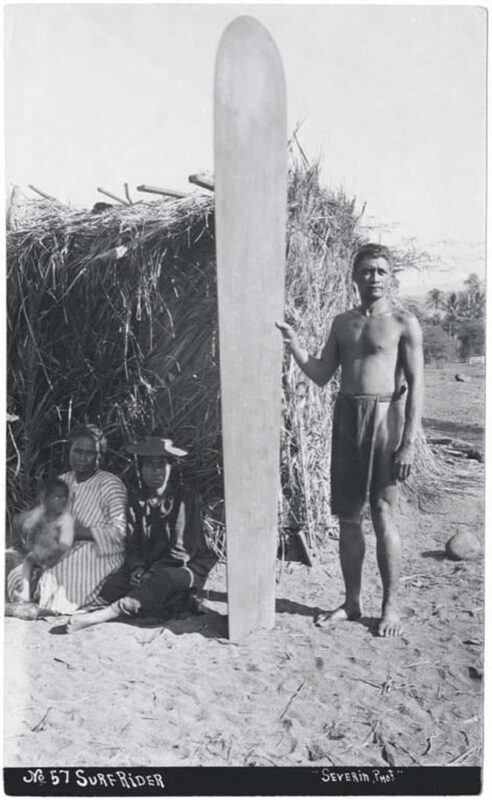
In Hawaii, heʻe nalu — wave sliding — was not recreation. It was woven into the social fabric at every level. Aliʻi claimed the finest surf breaks, and the sport was governed by a strict code of kapu — commoners had their own surf spots, and venturing into royal breaks was strictly forbidden. Boards were shaped from koa and wiliwili wood through a sacred process. Religious rituals were practiced during the shaping of each board. Chants were composed. Wagers were placed. Skill in the water carried real social weight.
No other culture in the world developed surfing to this degree of spiritual and social complexity. Hawaii is not simply where surfing happened — it is where surfing meant something.
The Near Extinction
When Protestant missionaries arrived in Hawaii in the 1820s, that all came close to disappearing. Surfing was discouraged as immoral, and a combination of religious pressure, cultural disruption, and foreign disease reduced the Native Hawaiian population drastically over the following decades. By the late 1800s, the practice had nearly vanished.
Duke Kahanamoku and the Global Revival
The revival began quietly in the early 1900s among a small group of Waikiki watermen. The figure who carried surfing to the world was Duke Kahanamoku — Native Hawaiian, five-time Olympic swimming medalist, and the person most responsible for surfing becoming a global sport. Duke traveled the world demonstrating surfing, introducing it to destinations including Australia and California. George Freeth, another Hawaiian-born surfer, had preceded him to California in 1907. Writer Jack London’s accounts of surfing at Waikiki helped introduce the sport to American readers around the same time.
So Who Invented Surfing?
The honest answer: no one did, and everyone did.
Coastal peoples across Peru, West Africa, China, Polynesia, and Hawaii all found their way to the wave independently, in their own time, for their own reasons. What Hawaii contributed was depth — a culture that elevated wave riding into something sacred, governed, and art. What Duke Kahanamoku contributed was reach — taking that culture and sharing it with the rest of the world.
The story of who invented surfing is really the story of how humans, wherever they met the ocean, found a way to ride it.
Resources
Who Invented the Surfboard?
The surfboard has no single inventor either, but unlike surfing itself, its history does contain a handful of people whose specific contributions changed the object permanently. If you want names, these are the ones that matter.
The Ancient Hawaiian Boards
Long before anyone thought to patent anything, Hawaiians were riding three distinct types of board, each carved from a solid piece of wood and each suited to a different rider and wave.
- Olo — the long board, sometimes reaching sixteen to eighteen feet, ridden by aliʻi (chiefs) and shaped from lightweight wiliwili wood.
- Alaia — thinner, finless, roughly seven to twelve feet, usually koa. Fast, difficult, and the closest ancestor of the performance board.
- Paipo — a short bellyboard, ridden prone, often by children.
These boards were shaped with stone adzes and finished with a ritual care that made the craft itself sacred. We cover that process in the sacred art of surfboard crafting, and the boards themselves in more detail in Olo, Kikoʻo, and Alaia.
One detail is worth pausing on: for most of surfing’s history, boards had no fins at all. Hawaiians held their line by dragging a foot and by the shape of the hull. That single missing component is the key to everything that follows.
Tom Blake and the Two Inventions That Changed Everything
If any one person has a claim to inventing the modern surfboard, it is Tom Blake. In 1926, after studying and restoring ancient Hawaiian boards at the Bishop Museum in Honolulu, Blake built a hollow board. It was drilled full of holes and sealed, and it weighed a fraction of the solid planks everyone else was riding.
Then, in 1935, Blake did something no one had done in a thousand years of wave riding: he fixed a fin to the bottom of his board, borrowing the idea from a boat keel. Before the fin, a surfer slid. After it, a surfer could hold a rail and turn on purpose. Nearly every manoeuvre in modern surfing depends on it. If you want the longer story of that component, see the evolution of the surfboard fin.
Foam, Fiberglass, and the Modern Board
After the Second World War, materials did the rest. Bob Simmons applied hydrodynamic theory to board design in the late 1940s and is often called the father of the modern surfboard. Through the 1950s, balsa and fiberglass gave way to polyurethane foam blanks, which made boards light, cheap, and repeatable for the first time.
The shortboard revolution of the late 1960s then compressed board length dramatically, and Hawaii sat at the centre of it. Dick Brewer shaped the guns that made the North Shore rideable, and shapers like Donald Takayama carried the Hawaiian lineage into the modern era. The full arc is laid out in our history of surfboard shaping.
When Was Surfing Invented? A Timeline
| When | What happened |
|---|---|
| c. 3000–5000 years ago | Reed craft (caballito de totora) ridden through surf in coastal Peru |
| 960–1279 CE | Wave riding recorded on China’s Qiantang River during the Song Dynasty |
| c. 400–1200 CE | Polynesians settle Hawaii, bringing wave riding with them |
| 1640 | Earliest European account of board riding on West Africa’s Gold Coast |
| 1778 | Cook’s expedition records Hawaiian surfing in writing for the first time |
| 1800s | Surfing declines sharply under missionary influence and population collapse |
| 1912 onward | Duke Kahanamoku carries surfing to California, Australia, and the world |
| 1926 | Tom Blake builds the first hollow board |
| 1935 | Tom Blake attaches the first fin |
| 1950s | Polyurethane foam and fiberglass replace solid wood |
| Late 1960s | The shortboard revolution |
Frequently Asked Questions
Who invented surfing?
Nobody, in the sense the question implies. Wave riding developed independently in Peru, West Africa, China, and Polynesia. Surfing as we practise it today (standing upright on a board and riding a breaking wave for its own sake) was developed in Polynesia and refined into a full culture in Hawaii, where it was called heʻe nalu.
Who invented the surfboard?
The surfboard evolved rather than being invented. Ancient Hawaiians shaped the olo, alaia, and paipo from solid wood. The single most consequential modern figure is Tom Blake, who built the first hollow board in 1926 and attached the first fin in 1935. Bob Simmons then shaped the modern board’s hydrodynamics in the late 1940s.
Did Hawaiians invent surfing?
Hawaiians did not invent wave riding, but they are the people who turned it into surfing. Standing upright on a board, the boards themselves, the etiquette, the rituals, and the culture around it all come from Hawaii. Every surfer in the world is riding a Hawaiian inheritance.
When was surfing invented?
Wave riding is at least 3,000 years old. Surfing in the recognisably modern sense (standing on a purpose-built board) was well established in Hawaii by the time Europeans first wrote about it in 1778, and had been practised for centuries before that.
Who invented the surfboard fin?
Tom Blake, in 1935. He adapted the idea from a boat keel. Boards had been finless for the whole of surfing’s prior history, and the fin is what made modern turning possible.
What is the oldest surfboard?
The oldest surviving Hawaiian boards are held in museum collections, including the Bishop Museum in Honolulu, and date to the eighteenth and nineteenth centuries. Wooden boards rarely survive the tropics, so the archaeological record is thin compared with the written and oral one.
Why did surfing almost disappear?
Two reasons, both consequences of Western contact. Introduced disease devastated the Hawaiian population, and missionary influence suppressed surfing as an idle and immodest practice. By the late nineteenth century it survived in only a few places. Figures like Princess Kaʻiulani and Charles Kauha kept it alive through that period, and Duke Kahanamoku carried it back out to the world.
Keep Reading
The full story of how heʻe nalu became a global sport is in our history of surfing in Hawaii, and the rules that once governed who could ride which wave are covered in surfing under the kapu system.
