

Nov
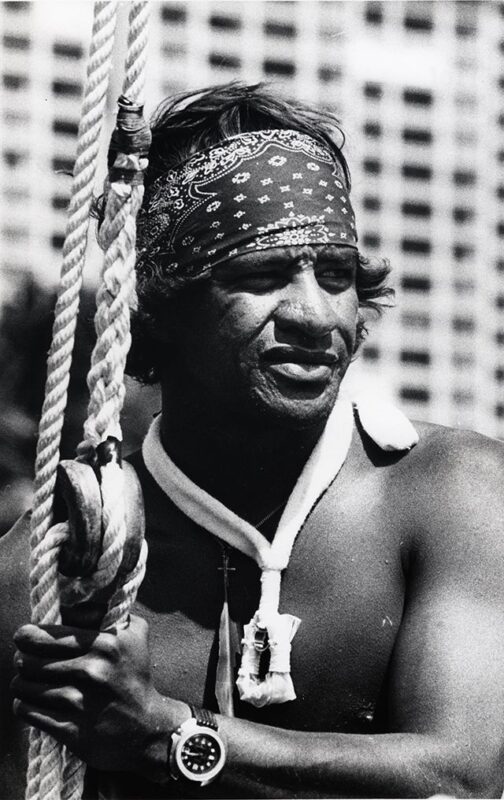
Image courtesy of Surfer
Eddie Aikau: “Eddie Would Go” — A Tribute to Hawaii’s Waterman
Eddie Aikau: The Waterman Who Went Where Others Wouldn’t
In the swell‑cracked waters of the North Shore of Oʻahu, there is one name that still stirs the sea breeze and echoes through the lineups: Eddie Aikau. Known simply as “Eddie,” he was far more than a champion surfer—he was a lifeguard, waterman, cultural ambassador, and embodiment of the Hawaiian value of kuleana (responsibility). His life, though tragically cut short, carries a story of courage, humility, and aloha that remains deeply rooted in surf culture and Hawaiian heritage.
Early Life and Hawaiʻi Roots
Born on May 4, 1946, in Kahului, Maui, Eddie Aikau moved with his family to Oʻahu in 1959. (Wikipedia) From his early days, he displayed a natural relationship with the ocean—learning to surf in the harbor break of Kahului and eventually buying his first surfboard after working at the Dole pineapple cannery.
He came from a large ʻohana (family) and carried the Hawaiian name Makua Hanai (“fostering parent”) in his full name, Edward Ryon Makuahanai Aikau. His cultural lineage connects him to the legacy of Hawaiian navigation and watermanship, a heritage that would guide much of his life.
Lifeguard of Waimea Bay — “No one drowned on his watch”
In 1967 (or 1968), Eddie became the first official lifeguard hired by the City & County of Honolulu to patrol the beaches of the North Shore, including the legendary Waimea Bay. (SurferToday)
During his tenure, he responded to waves routinely exceeding 20–30 ft, rescuing hundreds of people in treacherous conditions. He is reported to have saved over 500 lives while serving at Waimea. His reputation as a calm, fearless protector of others—not just a wave‑rider—earned him deep respect.
“He was a protector… The rescuing of people in conditions others wouldn’t go into.” (Angelus News)
His role as lifeguard laid the spiritual groundwork for his surfing legacy: he never sought just to conquer the waves—he sought to serve the ocean, the people, and his culture.
Big‑Wave Surfing Pioneer
While his lifeguard role is legendary, Eddie was also a world‑class big‑wave surfer. He challenged the heaviest seas on the North Shore during the late 1960s and early 1970s—well before modern jet‑skis and tow‑ins.
In 1977, he won the Duke Kahanamoku Invitational Surfing Championship at Sunset Beach, marking the apex of his contest surfing. (Wikipedia)
His surfing was not flamboyant—it was in harmony with the wave and ocean. His mantra, though not self‑promoted, came from others witnessing his courage: “Eddie Would Go.” Not because he sought fame—but because the call arose and he answered. (Hawaii Aloha)
The Final Voyage — Hokuleʻa and Tragedy
In 1978, Eddie joined the crew of the traditional Polynesian voyaging canoe Hōkūleʻa on a 2,500‑mile journey retracing the ancient route between Hawaiʻi and Tahiti. (Surfer)
On March 16, 1978, the canoe capsized near Molokaʻi. Eddie volunteered to paddle his surfboard toward Lānaʻi in search of help for his stranded crewmates—without a life jacket, believing it hindered his pursuit. He was never seen again.
His disappearance triggered the largest air‑sea search in Hawaiʻi’s history. Though the rest of the crew was rescued, Eddie’s body was never recovered.
His final act embodies the utmost expression of aloha and self‑sacrifice: the one who goes when others cannot.
Legacy and “Eddie Would Go”
From bumper stickers to T‑shirts, the phrase “Eddie Would Go” became a mantra of surfers and Hawaiians alike—symbolizing bravery, selfless action, and respect for the ocean.
The Eddie Aikau Big Wave Invitational was founded in 1984 at Sunset Beach and later moved to Waimea Bay on Oʻahu’s North Shore. It only runs when swell conditions meet the legendary threshold—typically requiring consistent 30–40 foot waves (open ocean swell equivalent) during the holding window.
The 2025 Event
Event window: December 14, 2025, to March 13, 2026, at Waimea Bay.
Invitees for the 2025–26 edition include (men & women):
Aaron Gold, Annie Reickert, Bianca Valenti, Billy Kemper, Chad Keaulana, Eala Stewart, Eli Olson, Emily Erickson, Ezekiel Lau, Grant “Twiggy” Baker, Haʻa Aikau, Jake Maki, Jamie Mitchell, Jamie O’Brien, Joey Cadiz, John John Florence, Justine Dupont, Kai Lenny, Kelly Slater, Koa Rothman, Lucas “Chumbo” Chianca, Luke Shepardson, Makua Rothman, Mark Healey, Mason Ho, Matahi Drollet, Nathan Florence, Nic von Rupp, Ross Clarke‑Jones, Russell Bierke, Torrey Meister.
Alternates are also listed on the official site.
Official website: theeddieaikau.com (for full invitee list, event updates, and streaming information).
When the swell aligns and the bay calls its day, the world pauses. The Eddie is more than a contest—it is a measurement of courage, heritage, and the ocean’s call. Just like Eddie Aikau himself, when the signal comes, the surfers go.
Why Eddie’s Story Matters for Hawaii.surf
At Hawaii.surf our focus is on surf history, Hawaiian legends, and the evolution of surf culture—and Eddie’s story sits perfectly at that intersection. He exemplifies:
Authentic connection to place: Surfing wasn’t just a sport—it was tied to land, lineage, and ocean.
Service and responsibility: His lifeguarding reminds us of surf’s roots in community and care.
Big‑wave innovation: He rode giant waves of his era when equipment and support were minimal.
Cultural renewal: By joining the Hokuleʻa voyage, he helped usher in the Hawaiian cultural renaissance of the 1970s.
When we tell Eddie’s story, we honour not just a surfing icon—but a Hawaiian cultural hero whose values ripple into the present surf narrative.
Conclusion
Eddie Aikau’s name will forever echo in the roar of a North Shore swell, in the hush of dawn before a contest called “Go,” and in the conscience of every surfer who paddles into something bigger than themselves. He reminds us: when the ocean calls, sometimes you must go. And that is the true spirit of aloha.
Further Resources
“The Surfing Life Story of Eddie Aikau” — SurferToday https://www.surfertoday.com/surfing/the-surfing-life-story-of-eddie-aikau
Eddie Aikau Wikipedia page https://en.wikipedia.org/wiki/Eddie_Aikau
Eddie Aikau Foundation — “Our History” https://www.eddieaikaufoundation.org/our-history
“How Legendary Lifeguard and Surfer Eddie Aikau Became a Hawaiian Icon” — Surfer https://www.surfer.com/culture/how-legendary-lifeguard-and-surfer-eddie-aikau-became-a-hawaiian-icon
“‘Eddie Would Go’ – Why Hawaiʻi Celebrates Eddie Aikau” — Hawaii Aloha Blog https://www.hawaii-aloha.com/blog/eddie-aikau/
