
Surf Breaks
Queens Surf Break Guide: Waikiki’s Most Historic Wave | Hawaii Surf
May
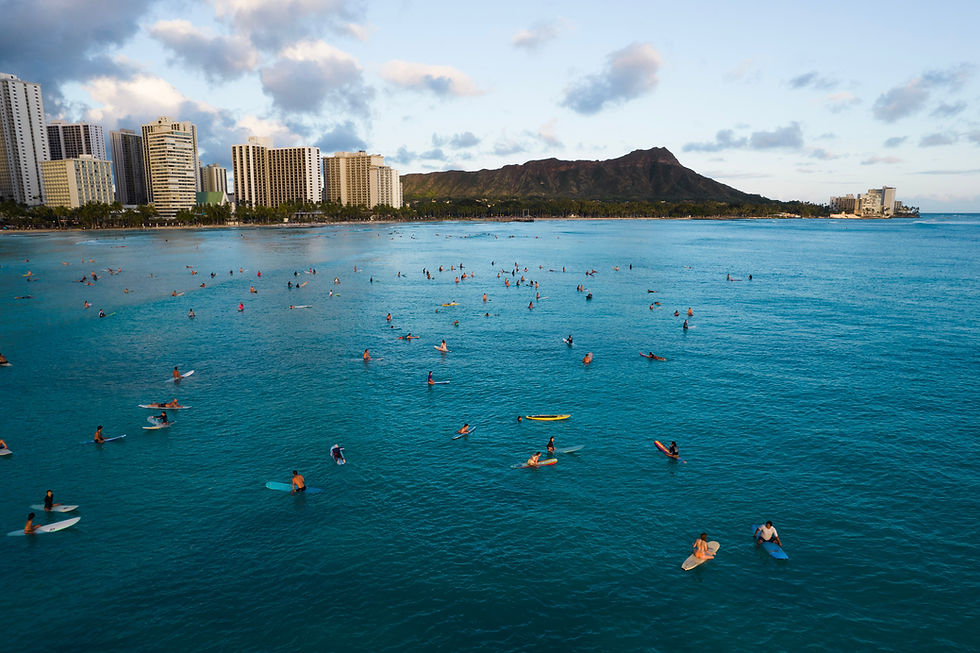
Image courtesy of to-hawaii.com
Queens Surf Break Guide: Waikiki’s Most Historic Wave
There is no surf break in the world with a longer unbroken lineage than Queens. Not Pipeline. Not Jeffreys Bay. Not G-Land. The wave breaking in front of Waikiki has been ridden by Hawaiian ali’i for at least a thousand years, and it was ridden by them well before anyone else on earth thought to stand on a board and let the ocean carry them toward shore.
Most people who paddle out at Queens today are tourists on foamies rented from the beach. That’s fine. That’s part of what the place is. But underneath that layer of sunscreen and GoPros is a surf break with more documented history than almost anywhere else on earth, and knowing that history changes the way you sit in the lineup and wait for a set.
Where Queens Is
Queens sits near the eastern end of Waikiki Beach, roughly in front of Kapiolani Park. It’s a right-hander that breaks over a shallow reef shelf, producing long, rolling waves that section down the line for a considerable distance on the right swell. The named breaks of Waikiki run in a loose chain from Diamond Head west toward the Ala Wai — Cliffs, Rice Bowl, Graveyards, Queens, Canoes, Publics — and Queens is the most historically loaded of all of them.
Getting there requires no hike. Walk into the water from the beach in front of the park, paddle out through a channel, and you’re in the lineup within minutes. There is no secret to it. Queens is deliberately, historically, intentionally open.
The Wave Itself
Queens works on south and southwest swells, which means its primary season runs from May through September. The wave breaks best in the two-to-five-foot Hawaiian scale range, which translates to what most mainland surfers would read as chest to well overhead on the face. Bigger south swells will push the wave larger, and on genuine XXL south events the break can produce serious consequences. But the day-to-day character of Queens is long, peeling, forgiving right-hand walls.
The right-hander is the draw. On a clean south swell with light trades, Queens offers some of the longest natural rides in the Hawaiian islands. It’s not a barrel wave on most days. It’s a trim wave, a hang-five wave, a generate-speed-and-do-something wave. Which is exactly why it built the culture it built.
Current can be deceptive. The channel that makes entry easy also moves water, and less experienced surfers can find themselves well down the beach from where they started without noticing. On bigger south swells the crowd spreads out, but the core of the lineup stays dense. Queens is rarely empty. It was not empty a thousand years ago, and it is not empty now.
What Ali’i Came Here For
Hawaiian surf culture before Western contact was not recreational in the way we use that word today. He’e nalu was woven into religious practice, social hierarchy, courtship, and competition. The chiefs surfed on the longest, heaviest boards — some over fifteen feet, carved from koa — and the quality of a chief’s surfing was understood as a reflection of his mana.
Waikiki was the premier surfing ground of O’ahu’s ali’i precisely because the waves there were long and readable enough to allow genuine skill to reveal itself. Short, punchy shorebreak could be ridden by anyone. The right-hand walls of Queens required timing, balance, and the ability to read the wave well ahead of where it was breaking. These were qualities the ali’i wanted to display publicly.
Kamehameha I reportedly surfed Waikiki. So did Ka’ahumanu, the powerful chiefess who would become regent after his death. The beaches and the waves of this shoreline appear repeatedly in Hawaiian oral tradition and in the accounts of early Western visitors. Captain James Cook’s crew, arriving in 1778, recorded observations of Hawaiian surfing that mark the first documented Western encounter with the practice. They were astonished. Not by the waves, which were modest compared to what Cook had seen in the Pacific. They were astonished by what the Hawaiians were doing on them.
Duke’s Front Yard
No figure connects Queens to the larger arc of surf history more directly than Duke Kahanamoku. He grew up in Waikiki, surfed these waters from childhood, and became the man most responsible for carrying the practice of surfing out of Hawaii and into the consciousness of the wider world.
Duke was not simply a great surfer. He was a member of the Hui Nalu, the Native Hawaiian surf and paddling club founded in 1911 in direct contrast to the whites-only Outrigger Canoe Club that had been established three years earlier on the same beach. The tension between those two organizations, and the way Duke moved between them and eventually transcended both, is one of the more complex stories in early surf history. He competed internationally, demonstrated surfing in California, Australia, and the East Coast of the United States, and won multiple Olympic gold medals in swimming while doing it.
What often gets lost in the legend is how local and specific his surfing roots were. Duke surfed Queens. He surfed Canoes. He surfed the long right-handers of Waikiki on a solid koa board, applying the technique he had learned from older Hawaiian surfers who had learned it from the generations before them. When he shaped a redwood board and introduced surfing to Sydney’s Freshwater Beach in 1915, he was exporting something that had been refined over centuries at this exact break.
You can read more about Duke in the hawaii.surf Legends archive.
The Outrigger, Hui Nalu, and What the Beach Boys Built
The Outrigger Canoe Club, founded by writer and promoter Alexander Hume Ford in 1908, was the first surf club in the world organized along Western lines. Its founding charter was explicitly aimed at preserving surfing and outrigger paddling among the Hawaiian population, though the club itself was oriented toward and largely controlled by white residents and visitors. The social reality of Waikiki beach in the early twentieth century was more layered and contested than the heritage plaques suggest.
Hui Nalu formed in response. Its members were predominantly Native Hawaiian surfers who had been surfing Waikiki their whole lives and did not need a haole-run institution to preserve a practice that was already theirs. Duke was a founding member. The two clubs coexisted on the same stretch of beach, competed against each other in the water, and collectively turned Waikiki into the first internationally recognized surf destination on earth.
Out of that scene came the Waikiki Beach Boys, the loose community of Native Hawaiian watermen who staffed the beach through the middle decades of the twentieth century — giving lessons, operating outrigger canoes for tourists, and maintaining a way of relating to the ocean that was distinctly Hawaiian even as the tourist industry colonized every inch of the shoreline around them. Figures like Rabbit Kekai, who surfed competitively into his eighties and is covered in the hawaii.surf Legends section, came directly from that world.
Paddling Out Today
I have surfed Queens on small summer south swells when the waves were knee-high and forgettable and the lineup was wall-to-wall tourists. I have also surfed it on overhead south swell when the sets were stacking up from well outside and the crowd thinned to the people who knew what they were doing. Both experiences are Queens. The wave doesn’t change its character based on who’s riding it.
What does change is what you pay attention to. On a clean set wave with room to move, you can feel the length of the ride in a way that most North Shore waves don’t allow. The North Shore is about intensity. Waikiki is about distance. The best waves at Queens let you step to the nose, drag a foot, generate trim speed, and still have wave left when you think you’ve used it all up. That is what the ali’i valued here. That is what Duke was doing when he shaped his early boards long and wide. The wave teaches you something about the surfing it produced if you let it.
There are still Beach Boys working out of Queens. There are still outrigger canoes launching through the channel. On a quiet morning before the tourist boats arrive, the place has a continuity to it that is hard to find elsewhere. The condos behind the beach are different. The crowds are different. The wave is the same one.
Wave Conditions at a Glance
Best swell: South and southwest, 2 to 8 feet Hawaiian
Best wind: Early morning before the trades build, or light Kona conditions
Best tide: Mid tide tends to give the cleanest wall
Peak season: May through September
Skill level: All levels, though bigger south swells demand genuine experience
Crowd factor: High year-round, dense in summer and on weekends
Hazards: Reef, current, heavy tourist boat traffic in adjacent channels, high collision risk on smaller days
Getting There
Queens is accessed from the Waikiki Beach stretch fronting Kapiolani Park. Street parking along Kalakaua Avenue is metered and limited. The Honolulu Zoo and Kapiolani Park offer additional parking nearby. The beach is public. No permits required.
If you’re visiting from the North Shore, the drive down Kamehameha Highway through Haleiwa and onto H-2 takes roughly 45 minutes to an hour depending on traffic. Worth the trip in summer when the North Shore goes flat and Queens is firing.
Internal Links
The surf breaks covered in this series connect across the North Shore and beyond. For context on how Queens fits into the broader Hawaiian surf geography, see the guides to Pipeline, Waimea Bay, Sunset Beach, Haleiwa, Laniakea, Velzyland, Rocky Point, Gas Chambers, and Pua’ena Point.
Sources
- Finney, Ben and James D. Houston. Surfing: A History of the Ancient Hawaiian Sport. Pomegranate, 1996
- Westwick, Peter and Peter Neushul. The World in the Curl: An Unconventional History of Surfing. Crown, 2013
- Kruse, Kristin. “The Outrigger Canoe Club: 100 Years.” Honolulu Magazine, 2008
- Hawaiian Mission Houses Digital Archive. Early accounts of Hawaiian surfing, 1820s
- Bishop Museum. Duke Kahanamoku collection and oral history archive
Last updated May 2026
Not sure this is the right wave for you? Compare every Oahu break by skill level and season in our guide to the best surf spots in Hawaii.
