
History
Ancient Hawaiian Surfing: The Story of Heʻe Nalu
Mar
Surfing was not invented in California, and it was not invented for fun. It began here, in the Hawaiian Islands, as heʻe nalu — literally “wave sliding” — and for centuries it was woven so tightly into Hawaiian life that it had its own gods, its own chants, its own sacred law, and its own death penalty. This is the story of ancient Hawaiian surfing: where it came from, who was allowed to ride, what they rode, and how it nearly disappeared.
What Heʻe Nalu Actually Means
Heʻe nalu combines heʻe (to slide, to flow) and nalu (wave). It is not a translation of the English word “surfing” — it is older, and it means something closer to becoming part of the wave. The distinction matters, because in ancient Hawaii riding a wave was never only recreation. It was a demonstration of mana, or spiritual power, and a way of standing in right relationship with the ocean.
That worldview is still audible in the language. Nalu means wave, but it also means to ponder or to reflect — to turn something over the way water turns. Hawaiians did not borrow a sport from the sea. They built a culture inside it.
The Origins: How Surfing Came to Hawaii
Surfing arrived with the Polynesian voyagers who settled these islands — master navigators who crossed thousands of miles of open Pacific by reading stars, swells, and birds. They did not simply bring boats. They brought an intimacy with moving water that most cultures never develop.
Wave riding almost certainly began as a practical skill before it became an art. Fishermen rode broken swell to get their canoes and their catch back to shore, and the fastest way in was to let the ocean carry you. What starts as efficiency becomes technique, and technique, practiced by enough people over enough generations, becomes culture. By the time Europeans arrived, Hawaiians were not simply riding waves — they were riding them standing up, on purpose-built boards, with a vocabulary and an etiquette and a body of chant to go with it.
For the longer argument about origins — including the claim that other Pacific cultures rode waves first — see our piece on who invented surfing.
Where Ancient Hawaiians Surfed
Long before Waikīkī became shorthand for Hawaiian surfing, waves were being ridden all across the archipelago — and the breaks themselves carried rank.
- Waikīkī, Oʻahu. The most famous surf ground in Hawaiian history, and a favorite of the aliʻi. Its long, forgiving rollers were ideal for the enormous olo boards the chiefs rode, and it later became the launching point from which Duke Kahanamoku carried surfing to the world.
- Kahaluʻu Bay, Kona, Hawaiʻi Island. One of the most significant ancient surf sites in the islands, surfed for centuries and overlooked by a heiau — a temple — a reminder of how close the sacred and the surf sat to one another.
- Kealakekua Bay, Hawaiʻi Island. Where Cook’s expedition anchored, and where the first written European description of surfing was recorded.
- Hilo and Lahaina. Both appear in early accounts as places where surfing was common and public, watched from shore by crowds.
The pattern to notice is that the best waves were not simply the best waves. Under the kapu system, a premier break could be reserved for chiefs, and a commoner who paddled out on it was not committing a foul — he was committing a crime.
Who Was Allowed to Surf
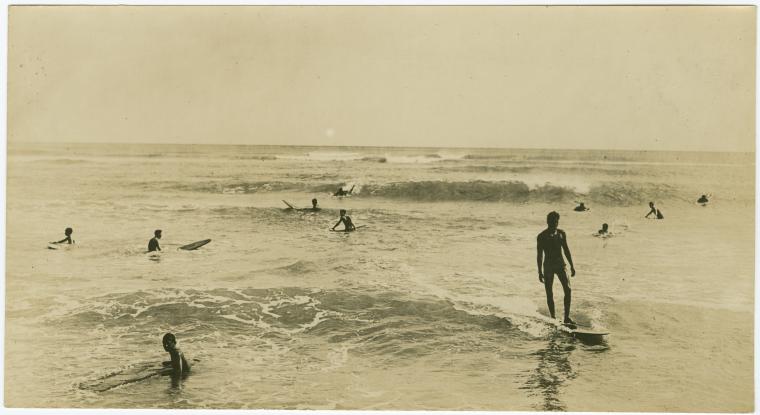
Nearly everyone surfed. Men, women, and children all rode, and Hawaii was one of the few places in the pre-modern world where women surfed openly and expertly alongside men — a fact that startled the first European observers, and one worth sitting with.
But how and where you surfed was governed by rank. The aliʻi — the chiefs and royalty — claimed the finest breaks and the finest boards. The makaʻāinana, the common people, surfed shorter boards on lesser waves. Surfing was simultaneously the most democratic thing in Hawaiian life and one of the most strictly stratified.
Chiefs surfed to prove their mana. A ruler who could ride a heavy wave with control was demonstrating divine favor as clearly as if he had won a battle, and rivals wagered land, property, and pride on the outcome. The ocean was the arena, and the wave was the judge.
The Boards: Olo and Alaia
Ancient Hawaiian boards were solid wood — no fins, no leash, no foam — and riding them demanded strength that modern surfers rarely need.
The olo was the chief’s board: a long, thick plank that could reach roughly 18 feet and weigh well over 100 pounds. It was fast in open, rolling swell and almost impossible to turn, which suited the long Waikīkī walls it was built for. Olo were cut from wiliwili, a light buoyant wood, and reserved for the aliʻi.
The alaia was the people’s board: thinner, shorter — commonly in the range of 7 to 12 feet — and typically shaped from koa. Without a fin, an alaia holds its line through the bite of its rail alone, which makes it genuinely difficult to ride and startlingly fast when ridden well. Modern shapers have revived the design, and surfers who take one out tend to come back humbled.
A third and smaller board, the paipo, was ridden prone and was often the board a child learned on. For the full typology — including the kikoʻo, the mid-length board that sat between olo and alaia — see Olo, Kikoʻo, and Alaia: the boards that built Hawaiian surfing.
Shaping Was a Sacred Act, Not a Craft
A board did not begin at a workbench. It began at a tree.
The shaper — the kahuna kālai, a master craftsman trained in both woodworking and spiritual protocol — selected a living koa or wiliwili and treated its felling as a sacrifice rather than a harvest. A fish was customarily placed at the roots as an offering. Chants accompanied the cutting. The tree was understood to be an entity giving something up so that the board could carry the mana a surfer would need in the water.
The shaping that followed was governed by kapu: not only the techniques, but the conduct of the craftsman himself. Boards were cured, stained with natural dyes, and finished with oils. What came off that process was not equipment. It was an object with a lineage, and it was treated accordingly — stored carefully, sometimes wrapped in tapa, and in some accounts given a name.
Kapu: The Sacred Law That Ruled the Waves
The kapu system was the legal and spiritual architecture of Hawaiian society — a dense web of prohibitions covering food, fishing, rank, gender, and the ocean itself. Tradition holds that it was formalized around 1300, when the priest Pāʻao arrived from Kahiki and restructured Hawaiian religious life.
Applied to surfing, kapu did three things:
- It restricted the boards. The olo belonged to the aliʻi. A commoner caught riding one could face death.
- It restricted the breaks. A chief could place a kapu on a surf spot, closing it entirely — sometimes to honor a deity, sometimes during ritual, and sometimes to let fish stocks recover. That last purpose is worth naming plainly: it was an early and effective form of ecological management.
- It restricted the ritual. Chants and offerings preceded the shaping of a board and, in some accounts, the paddle-out itself. Priests were consulted. The ocean was not simply entered.
Breaking a kapu was not a rules violation. It was an offense against the gods, and the punishment could be execution — by clubbing, by drowning, or by exile. The essential point is this: surfing in ancient Hawaii carried genuine stakes, and the modern etiquette of the lineup — respect the locals, know your place, do not drop in — is a faint descendant of a system where the consequences were absolute.
Kapu also produced its own mythology. Mamala, a kupua — a shape-shifting demigod — was said to surf the waves off what is now Honolulu Harbor, and her legend blurred the boundary between the sacred and the surf in exactly the way the era demanded.
The Golden Age, and What Cook’s Crew Saw
When Captain James Cook’s expedition reached Hawaii in 1778 and 1779, surfing was flourishing. The journals — the surfing passage is generally credited to Lieutenant James King, who completed Cook’s account after his death — describe Hawaiians riding waves standing upright on boards with obvious mastery, and describe the observers as frankly astonished. Crowds gathered. Bets were placed. Races were run. Children played in the shorebreak while chiefs held the outside.
This was surfing’s first golden age, and it was entirely Hawaiian: a mature sport with a governing law, a class structure, a craft tradition, a spiritual framework, and a body of song — arrived at with no reference whatsoever to the world beyond the horizon.
The Collapse
Two events ended it.
The first was disease. Western contact brought epidemics that killed a catastrophic share of the Hawaiian population within a few generations. A practice sustained by community does not survive the loss of the community.
The second was the fall of kapu, followed by the missionaries. In 1819, King Kamehameha II (Liholiho) abolished the kapu system outright — sitting down to eat with women, an act forbidden under the old law, and in doing so dismantling the framework that had ordered Hawaiian life for five centuries. Calvinist missionaries arrived the following year, into a spiritual vacuum. They did not, as the popular story goes, simply “ban” surfing. What they did was steadily discourage it — as idleness, as gambling, as an occasion for mixed bathing and near-nudity — and they replaced the calendar of Hawaiian life with a different one.
By the late 1800s, surfing had contracted to a handful of places. It did not die. It was carried, quietly, by people who refused to put it down — until Waikīkī, the Beach Boys, and above all Duke Kahanamoku pushed it back out into the world, where it belonged.
Why Heʻe Nalu Still Matters
Every person who has ever stood up on a wave is participating in something Hawaiians invented, refined, and nearly lost. That is not a decorative fact. It is the fact.
The inheritance is still visible if you know where to look: in the reverence for certain breaks, in the unwritten hierarchy of a lineup, in the way a Hawaiian shaper still talks about a blank, in the words themselves. Surfing survived colonization, epidemic, and prohibition because it was too deep in the culture to be pulled out.
Heʻe nalu was never just a sport. It was — and remains — a way of being with the ocean.
Frequently Asked Questions
What does heʻe nalu mean?
Heʻe nalu is the Hawaiian term for surfing. Heʻe means to slide or flow; nalu means wave. Together: wave sliding.
Who was allowed to surf in ancient Hawaii?
Nearly everyone — men, women, and children, chiefs and commoners alike. But the kapu system dictated which boards and which breaks each rank could use. The best waves and the long olo boards were reserved for the aliʻi, and a commoner who violated that could be put to death.
What were ancient Hawaiian surfboards made of?
Solid wood, with no fin and no leash. Olo boards — the chiefs’ boards, up to roughly 18 feet — were usually wiliwili. Alaia boards, ridden by commoners and typically 7 to 12 feet, were usually koa. Smaller paipo boards were ridden prone.
Where did ancient Hawaiians surf?
Across the islands, with Waikīkī on Oʻahu and Kahaluʻu Bay on Hawaiʻi Island among the most significant sites. Kealakekua Bay is where Cook’s crew recorded the first written European description of surfing.
Why did surfing almost disappear?
Introduced disease devastated the Hawaiian population, the kapu system collapsed in 1819, and Calvinist missionaries discouraged surfing as idleness. By the late nineteenth century it survived in only a few places — before Duke Kahanamoku carried it back to the world.
Keep reading: the full history of surfing in Hawaii · the evolution of surfboard shaping · Duke Kahanamoku
